
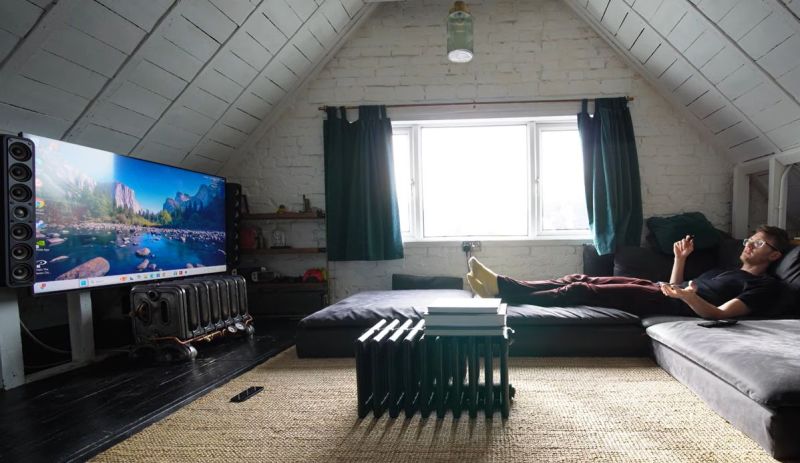
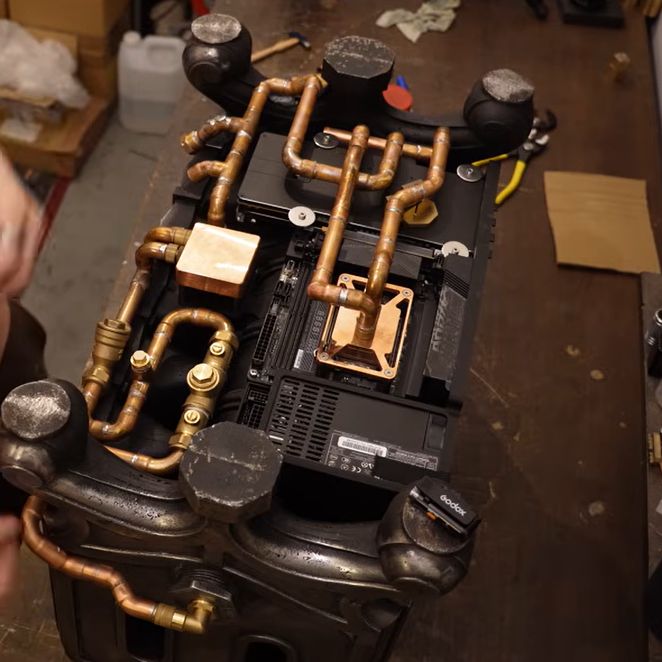
Water-cooled PCs generally have in common that there’s a radiator somewhere in the loop, yet nobody said that you can’t build the PCB into the radiator. Something like a genuine Victorian-era cast-iron radiator, for example. For the folk over at [Billet Labs], this is just your typical project, of course, even if it took a solid three months to make it all work.
Their previous project was also a water-cooled PC, but in the form of a steampunk-esque wall-mounted installation. What differentiates this new build is that it’s trying to be more of a sleeper PC, as long as you ignore some copper tubing and the like running around the outside of this vintage radiator.
Of course, by using a vintage cast-iron radiator like this, you’re also dealing with all the disadvantages of cast-iron, such as the countless impurities in the metal and the immense weight. With water in the loop, the entire build comes in at about 99 kilograms, and cleaning the radiator of particulates released inside it — including rust — was a challenge.
With the amount of water inside the loop, it was little surprise that even a computer stress test only raised the water temperature by two degrees, but the main takeaway from the project was that cast-iron in a water loop is a pain, even with a galvanic corrosion inhibitor. For this reason, the video’s comment section mentioned [gsuberland], for example, mentioning chemical passivation, referencing steel sanitary pipes, and the formation of a nitride layer.
Maybe using a more modern, pure steel radiator would be easier here for that reason, but we can only admire [Billet Labs] for persevering with this project. As a bonus, this is also pretty much a guaranteed theft-proof PC, as even his massive new TV and sound setup weigh less combined, and are probably infinitely more portable. Or, you could choose to go ultra-modern for a futuristic look instead.












Seems like a bad idea because surely those radiators are designed to have a large thermal mass so that they’d retain heat as well as radiate it. Once the cast iron gets warm it’d just keep the working fluid temperature up, rather than helping cool the working fluid.
I find “pathologies of thought” like this fascinating.
fscking comment system. Is this broken at the server or is there something about my browser configuration that it’s choking on?
electronics are ever-shrinking (well, they were until like 2012) so it’s now possible to hide entire computers inside macroscropic every-day items. this is why all electronic front-ends (from phones to watches to TVs to induction stoves) are all black slabs now. hell, a car could maybe be a black slab with wheels. so if you don’t care about display, the object you are putting a device inside of could literally be anything. i kind of miss the days when form was still somewhat dictated by function. that’s what i yell at the kids playing “Jeux Sans Frontières” on my lawn
For those of us in US, 99kg is almost 220 lbs or about 650 banana weight
I appreciate the banana for scale!
Make it a double loop to deal with the impurities
strange question you ask. did you check the url before you read the content?
@LBJsPNS
PR stunt.
Huh? Radiators are designed to warm the room. I’m not sure this matters for this usage. I’ve used oil immersed computers which have similar issues of high thermal mass and limited thermal interface with ambient without issue. And the setup in video seems much more efficient.
But I think it will work fine, the radiator designs is optimized for a large difference between the radiator temperature and the ambient to capitalize on convection.
A smaller difference will not lead to as much convection and the airflow will be poor.
This means in theory the equilibrium point at which the radiator efficiently sheds heat tends towards the high end, compared to an AOI Waterloop where it’ll idle potentially a few degrees above ambient.
However for a typical light computer usage likely 200W heat to disappate it’ll be entirely unnoticed.
As the name implies, the large surface area is able to “radiate” said heat out into the room. This is, after all, it’s main function. Given the relatively low energy input provided by the computer, compared to what normally feeds one of these, I don’t think the cast iron will ever get above ambient.
This was intended to be a reply to “Jon H”.
Sharpest guy in the park!
“Sharpest guy in the park” was for “Mike Smith”
My first thought too. A clean water side and a dirty water side. A suitable stainless heat exchanger of some sort, and probably another circulation pump on the dirty side.
All still able to be hidden within the overall block.
I have a buddy who installed vintage cast iron radiators in his house because he liked the idea…he has had a bit of struggle with them fouling the heat exchanger in his modern ‘boiler’ (actually only 180F, not boiling). In addition, he didn’t really engineer his system and he didn’t come up with estimates for how much heat they release at various water temperatures and times (fwiw, they were made for steam) so he had struggles heating the house sufficiently / evenly, too.
They definitely are neato but i don’t think they’re worth the trouble. I just installed the modern european-style sheet metal radiators in my house and they are great. A variety of sizes, detailed specs, and of course, my water stays clear for years, just a thin coating of black gunk (oil?) on everything, which doesn’t seem to have any impact.
Is it possible to filter the return water? I know of two historic houses that had return pipes installed (both copper and iron) to their original gravity radiators. A workshop was added to the loop and 2 pulse “boilers” have done the job. In one house the replacement “boiler” has gone leaky and got replaced, both have filters for the fill line for city water only.
Is there some chemical scheme worth putting into these setups to preserve them?
Many steam setups were overkill and could roast you when needed. This coincided with the great flu and TB scares, dealt with by fresh air and heat at the same time. My grade school (1900) has holes in the brick wall at the bottom of where radiators stood at each of the outside walls. The holes were plugged when I went there. They went HVAC years ago. The hole-vents are still there.
Yes, and that’s fine.
That’s how passive CPU coolers work.