

Elastocaloric materials are a class of materials that exhibit a big change in temperature when exposed to mechanical stress. This could potentially make them useful as solid-state replacement for both vapor-compression refrigeration systems and Peltier coolers.
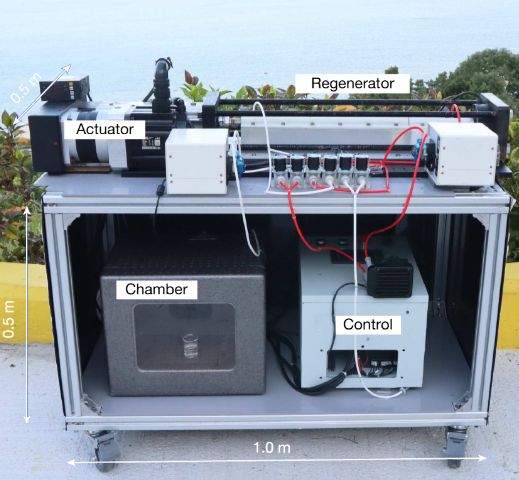
So far one issue has been that reaching freezing temperatures was impossible, but a recently demonstrated solution (online PDF via IEEE Spectrum) using NiTi-based shape-memory alloys addressed that issue with a final temperature of -12°C achieved within 15 minutes from room temperature.
In the paper by [Guoan Zhou] et al. the cascade cooler is described, with eight stages of each three tubular, thin-walled NiTi structures. Each of these stages is mechanically loaded by a ceramic head that provides the 900 MPa mechanical stress required to transfer thermal energy via the stages from one side to the other of the device, alternately absorbing or releasing the energy with CaCl2 as the heat-exchange fluid.
NiTi alloys are known as about the ideal type of SMA for this elastocaloric purpose, so how much further this technology can be pushed remains to be seen. For stationary refrigeration applications it might just be the ticket, but we’ll have to see as the technology is developed further.












Yeah paywall!
PDF is not paywalled.
Try downloading or printing.
We truly do not own our machines, and have truly become serfs when we can’t do something as simple as saving the content displayed to us right on the screen.
At least we can still do a screen capture, or send to a different display device, right? Right?
(the correct answer is “only as much as the web server lets you”)
This is very sad.
I own my TV, I still have to pay for cable TV, streaming services, and the occasional DVD or blue ray disc.
I own a car, I pay for gas, wiper fluid, brake pads, insurance, and the occasional road toll.
Owning a device doesnt mean you never have to pay for related services/content.
The service or consumable you purchase in those cases does not arbitrarily constrain the technical performance of the hardware you own at the whim of the provider.
That’s the key difference.
Here, new OS and browser features, supported by encryption and certificate technologies we are forced to use, are now allowing a remote provider to control our hardware and limit its technical performance.
This did not used to be the case, but now it is, and it’s part of the rapid erosion of our digital autonomy and self-determination.
We are rapidly becoming digital serfs.
https://hackaday.com/2016/08/25/a-refrigerator-cooled-by-rubber-bands/
I remember when i used to repeatedly strech and loosen rubber bands and hold them against my upper lip as a kid. i was fascinated by the cooling effect when releasing the tension
How can it be both solid state and elasto?
compliant mechanisms? At least in the cooling part. So no parts that wear.
The actuator could be non-solid state at the moment.
900 MPa to get a temperature change of a lousy 16.3 C !!!?! Yeesh.
900 MPa is higher than the yield strength of most common steels.
Compressing even just plain air would pump a lot more heat, and get much higher temperature differentials at much lower pressures, and wouldn’t exceed the yield strength of most materials.
A diesel engine compression stroke gets hot enough to instantly ignite fuel at less than 3 MPa.
If you try to put 900 MPa into air it will get hot enough to become plasma. Actually, it will become a supercritical liquid first, but probably rupture your containment vessel even earlier.
900 MPa is insane. That’s starting to approach diamond-making pressures.
(Though, yes, strain is the correct term to use to determine the heat input here, not stress. But stress is what determines when your hardware will turn into a worthless warped lump of waste metal.)
The wires are very thin. So you need very little force to get that type of strain.
Total bs (unless your talking about 1850s tractors with nominal 80 RPM). Modern diesels easily operate at 200 MPa or more, especially when turbo spools up to provide extra air.
How to you get 200 MPa out of 0.1 MPa ambient with a 20:1-ish compression ratio?
It’s plainly obvious you don’t.
200 MPa after ignition, maybe. Highly doubtful, but maybe.
As far as I know, the peak cylinder pressure that a typical modern diesel is designed for is around around 15-20MPa or so. Engine compression itself still only accounts for 3-4MPa of that.
There is one place you can see around 200MPa in a modern diesel engine – that’s about the pressure at which fuel is injected into the cylinder. So the fuel injectors (and the injection pump/rail, if common rail) really do have to handle that pressure. The rest of the engine doesn’t.
But in the history of diesel, this is an extremely new development, only showing up on mainstream car & truck engines in the last 20 years or so. More traditional diesel injection systems work at a fraction of that pressure.
“successfully froze 20 ml of distilled water into ice within 2 h”
So, about one single watt of cooling power. From an actuator that consumes 1500 watts and occupies a volume of 250 liters.
Not performance one can really brag about, is it?