
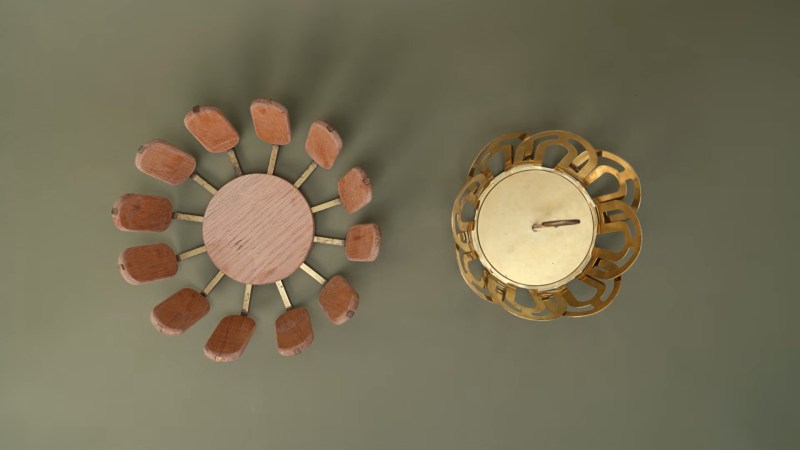
Fruit bowls have an unavoidable annoyance– not flies and rotten fruit, those would be avoidable if your diet was better. No, it’s that the bowl is never the right size. Either your fruit is sad and lonely in a too-large bowl, or it’s falling out. It’s the kind of existential nightmare that can only be properly illustrated by a late-night infomercial. [Simone Giertz] has a solution to the problem: a shape-changing fruit bowl.
See, it was one thing to make a bowl that could change shape. That was easy, [Simone] had multiple working prototypes. There are probably many ways to do it, but we like [Simone]’s use of an iris mechanism in a flat base to allow radial expansion of the walls. The problem was that [Simone] has that whole designer thing going on, and needs the bowl to be not only functional, but aesthetically pleasing. Oh, and it would be nice if expanding the bowl didn’t create escape routes for smaller fruits, but that got solved many prototypes before it got pretty.
It’s neat to see her design process. Using 3D printing and CNC machining for prototyping is very familiar to Hackaday, but lets be honest — for our own projects, it’s pretty common to stop at “functional”. Watching [Simone] struggle to balance aesthetics with design-for-manufacturing makes for an interesting 15 minutes, if nothing else. Plus she gives us our inspirational quote of the day: “As much as I feel like I’m walking in circles, I know that product development is a spiral”. Something to keep in mind next time it seems like you’re going around the drain in your own projects. Just be warned, she does have a bit of a potty mouth.
We’ve featured [Simone]’s design decisions here, if you’re interested in seeing how she goes the rest of the way from project to product. We’re pretty sure her face-slapping-alarm clock never made it into the SkyMall catalog, though.












That’s a neat solution, and it looks like the way the mechanism is designed it won’t just flop open from fruit resting on it.
I’ve appreciated who she became over time. While I don’t know her per se, the early videos felt a little clout seeking, silly as the great ideas were.
I’m really glad she’s gotten confident and carefree, & I have always liked how she approaches design and implementation, albeit in a relaxed way now.
Also, definitely metal over wood for this. Someone suggested a banana hook instead of a ring at the center, which is also a brilliant idea.
Great idea, while the art deco look of the brass version calls to me, I like the look of the wood version as much or maybe a little more. The one thing I don’t understand is that at 2:04 she talks about brass not being food safe. She then rebuilds the whole thing out of brass. Seems a little contradictory in my mind. Maybe I need to do a session of youtube builder therapy hehe.
When prototyping and communicating to others, acknowledging the risk os a material choice is customary, and so is using the easiest material to create the prototype. (Speaking as someone who prototyped scientific test instruments for 30 years) By stating the potential for risk, you allow the person with the usage concern to research materials that meet their safety requirements.
A 30 second Internet search turns up a page on food safety of brass, and says leaching of copper, and of lower concern, zinc, is the primary hazard. Acids and salts are more aggressive. Lacquer is often used in less aggressive environments, such as the fruit bowl. Tinning the contact surfaces is another possibility, for example in cooking pots.
There exist epoxies that are food safe: rated for constant contact with food. Sounds right for a brass fruit bowl.
She’s making prototypes out of brass, but she points out that a commercial product wouldn’t be raw brass.
Other than containing (unsteamed) fruit, how is this not the vegetable steamer basket I’ve been using for a half-century?
https://5.imimg.com/data5/SELLER/Default/2025/4/501856846/DG/XA/YO/238844267/stainless-steel-big-30cm-folding-vegetable-steamer-basket-vegetable-cooking-baby-food-steamer-500×500.jpg
Those baskets don’t hold their shape (when a bit of pressure is applied to the sides).
When open, the sides sit almost flat.
It’s similar, but different.
I have a similar basket and a few pieces of wire could be used at the top to help it hold a basket shape