
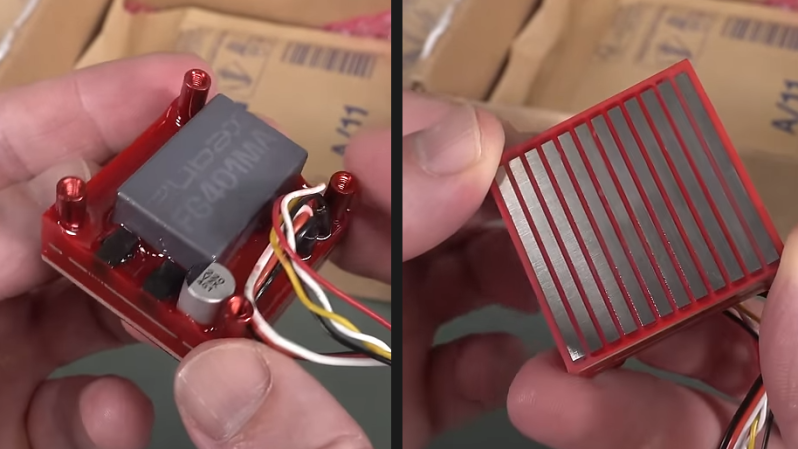
Electro-permanent magnets (EPMs) are pretty nifty concepts, and if you aren’t familiar with them, they are permanent magnets with the ability to be electrically switched on or off. Unlike an electromagnet — which maintains a magnetic field only while power is applied — an EPM can remain “on” even when power is removed. Want to see one work? There’s a video embedded below that shows one off, but if you’d like to know how they work, we have you covered.
Inside are two types of magnet, one of which is permanent and the other being a semi-hard magnet paired with an electromagnetic coil. A semi-hard magnet’s flux can be changed by exposing it to a strong enough magnetic field, and that’s the key to making it work.
When both magnets work together, the EPM is “on” and acts like a permanent magnet. To turn the EPM off, the polarity of the semi-hard magnet is flipped with a short and powerful electromagnetic pulse, after which the two magnets oppose one another and more or less cancel each other out. So rather than generating a magnetic field, an EPM more accurately reconfigures it.
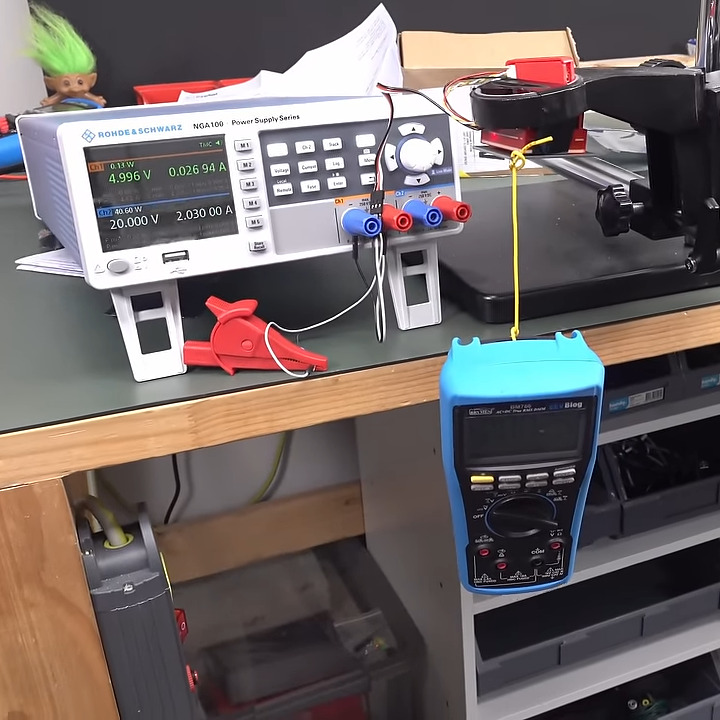
As intriguing as EPMs are, we haven’t really seen one properly in action until it was brought to our attention that [Dave Jones] of EEVblog tried one out last year. He received a Zubax FluxGrip EPM, which is intended for drone and robotic applications and can hold up to 25 kg. Watch [Dave] fire it up in the video (link is cued up to the 7:30 mark), it’s pretty interesting to see one of these actually work.
EPMs are not prohibitively expensive but they are not exactly cheap, either. But if a switchable magnet sounds up your alley and you can’t afford an EPM, consider an alternative “switchable” magnet design that works by momentarily canceling out a permanent magnet with a paired electromagnet. Unlike an EPM, it’s not a permanent switch but it would be enough to drop a payload.












The other way to “turn off” a pernanent magnet is to physically move it away. I have a workshop floor screw and nail finder – you sweep it across the floor and to release any found sharp things you pull a lever. Or a magnetic dial meter that sticks to l lathe bed and to release it you move a little lever.
thats not really turning it off though. thats just moving it out of range. If you have a VERY strong magnet or its attached to an object that is significantly lighter than its attractive force, moving it away isnt always an option.
AFAICT they can be pretty damn strong.
https://duckduckgo.com/?q=switchable+magnetic+mount+lathe&ia=images&iax=images
My first thought on this article was that it must be such a device – just with an electric motor/actuator to turn the magnet inside it (or however they work exactly).
We use these on doors at work. They are indeed super duper strong.
I’ve seen them at business locations and wondered the feasibility of having them in residential buildings or if an EPM could be use instead of mechanical locks/latches for car doors.
The switchable magnet you’ve linked doesn’t work by moving the magnet away though, it works by having two fixed magnets each with a cunning pattern of magnetic domains that cancel out or reinforce each other depending on their rotation.
Alternatively, if you only need to use a magnet once you can heat it beyond it’s Curie point.
My boss hates this one weird trick but, for some reason, the travelling magnet salesman loves it.
I gave a talk on Electropermanent Magnets at this past years’ Supercon! They’re a fascinating subject and a neat technology!
This could be good for door access as well