
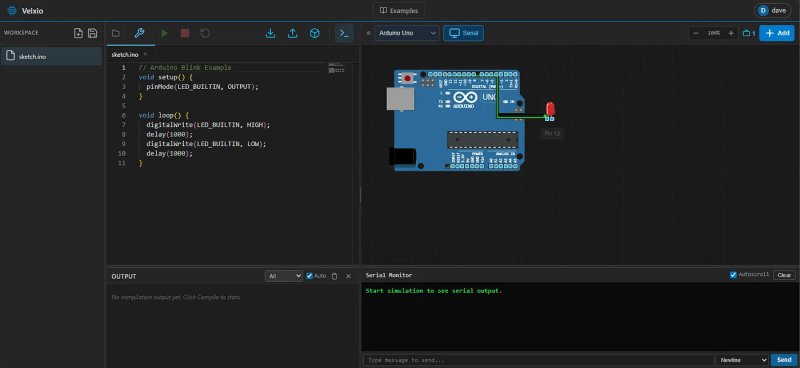
It’s always nice to simulate a project before soldering a board together. Tools like QUCS run locally and work quite well for analog circuits, but can fall short with programmable logic. Tools like Wokwi handle the programmable side quite well but may have license issues or require the cloud. The Velxio project by [David Montero Crespo] is quite an excellent example of an (online) circuit simulator with programmable logic and local execution!
It’s built largely around Wowki’s AVR8JS library for Arduino simulation. All CPU simulation occurs on the local computer, while sketch compilation happens on the backend using official Arduino tools. But this was certainly not the most impressive aspect of the project. Likewise, Velxio features RP2040 execution using the rp2040js library. It also features the execution of some ESP32 derivative boards built around the RISC-V architecture using the RiscVCore.ts library.
For more complex CPU architectures like the vanilla ESP32, Velexio implements a QEMU simulation on the backend. This methodology even enables the execution of Raspberry Pi Python code. Multiple boards can also be used in the same simulation, allowing one to test interactions between Raspberry Pis and other boards! It can also expand to handle multi-file code executions and it keeps everything in a backend database. Of course, everything is wrapped together in a neat modern UI, with a circuit diagram, parts selector, and full-blown IDE. You can try it at velxio.dev. Or, you could execute it on your home lab; it’s just one docker compose away!
If you enjoy embedded simulations, make sure to check out this ember simulation on an RP2040. Not to mention other Arduino/browser simulators we’ve seen in the past.












About 20 years late.
Why do you think it’s 20 years late? I know circuit emulators have existed since the computer was invented, but this one has new features that make it unique
I’d be willing to hear them out if they have LCD emulation. That’s been the hardest thing to find a simulator for.
It literally takes less time to populate a breadboard than draggin crap around and ya dont need network for it… Not sure why this exists for an AVR lol. FPGA sure.
Whatever it is you are building with it is gonna have more issues with deprecated libraries than anything you plug into the pins lol.
I still can see advantages.
I just used those simple ATMEL 8 bits. Ok, compiling is fast, but the time you spend flashing, overtime, still suck. It adds up. Probably not as much as more complex system but I don’t care. Nobody will complain when you can do stuff faster.
Those simulators parse the bytecode if I remember. So no more flash!
So that will help developing time for sure. And for beginners, which is the target, just trying to do something basic will take some time and a looooot of flashing. Not even talking about the electronic side they will learn from…
Plus, those simulators could enhance the user experiences whatever the platform they are using.
They could fake more RAM/FLASH to help with debugging (non optimized code) or to creating a first version that work.
Built-in pin logic history, signal analyzer, …
You aren’t he targeted audience. But that can still become a base for something else if you want to work on that.
Also I found one, recently, that, even if technically online, is more open source. Allowing offline project.
I don’t know if this tool supports it. But I have used tools like this before, even though I’m an “on metal” person myself. The reason is simple: debug capabilities. While you can pause&inspect your MCU with the proper tools, it’s not really possible to pause the rest of the world. While in simulation you can.
This literally came at the perfect time for me (away from desk for a few days with only a laptop, but an itch to try out some ideas). Admintingly I’m only using the serial monitor (and printing a display array there) but it worked great and showed a couple of errors on my part. Thanks for this :)
I’m the creator of Velxio, and I’d like to clarify that this isn’t “20 years late.” To my knowledge, it’s the first system that can emulate multiple types of chips (Arduino/AVR, ESP32, Raspberry Pi, RP2040, and more) within the same circuit at the same time, directly in the browser, and fully open source. The goal isn’t to replace real hardware, but to remove friction: students don’t need to constantly buy and flash chips, you can experiment without risk, test interactions between devices in a single environment, run everything from a phone or any device, and easily share projects with anyone via a link—making embedded development far more accessible from anywhere.