
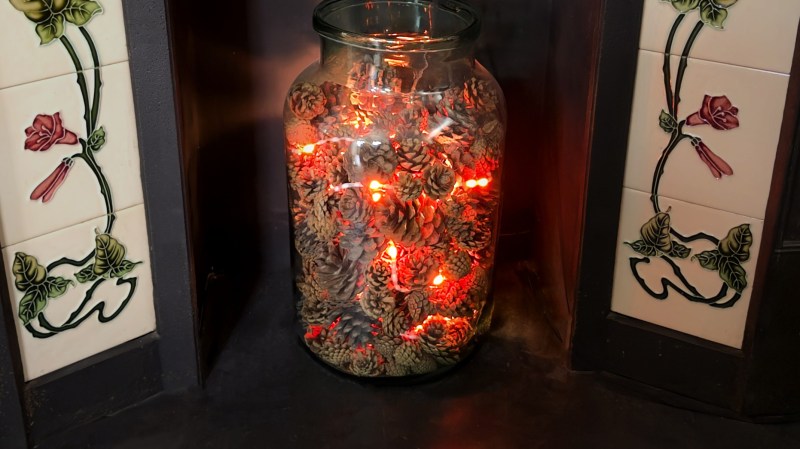
Today, fireplaces, their cozy glow once a household staple, are mostly a thing of the past. In fact, a decent amount of old fireplaces are completely blocked up! [David Capper] brings back the atmosphere without the actual flames, with his RP2040-based fireplace glow simulator.
It’s not just a string of LEDs with some PWM brightness control, either. No, [David] goes into detail about the black body radiation that gives these fires their colors. He then uses the theory of black-body radiation to determine the colors that the LEDs glow to simulate the colors of a real fire.
But the colors alone don’t make for a good simulated fire, so [David] adds the heat equation. It starts with a grid wherein each cell has a temperature. Over time, cells are randomly selected to have heat added to them (increasing the cell’s temperature), then he applies the heat equation to diffuse and decay the heat within the grid for a nice simulated crackling fire. Add in a custom PCB and a nice little 3D-printed case and you’re ready for a cozy hacker time.












I’m glad the author shared what exactly he messed up on the first board revision (putting 3.3V on VREG_VOUT) so I can make sure I’m not making the same mistake in my own WIP schematic
“mostly a thing of the past.” Well, depends on where you live I suspect. There is a lot of households around here that heat with wood…. Or is a secondary source when electricity/gas fails.
Wood is our only heat. We’ve got some portable 1,500 watt space heaters if need be.
Whrre is the video that shows the final result?
There is a video at the end of the linked blog post
I meant a video of the device’s final shape, not just the LED chain. Just to see if it is worth replicating ;)
Hi! An electric Allen Scythe… now you can hear the sound of the grass being obliterated in high definition! These things are legendary for being a bit ‘enthusiastic’ with their reciprocating blades, so I imagine the reduced vibration from the motor actually makes it feel a lot more controllable.
Coincidentally, recently came across a similar build: https://www.youtube.com/watch?v=ICpgNCJmjW0
“I love writing little simulations of physical things.” Okay. then, here’s a challenge for you: create a simulator for an aurora, for either LED or monitor display, or for both (LEDs are going to be rather coarse for this application, if you want a detailed image rather than a vague suggestion of an aurora). I’ve been working on this for quite a while, with some not-very-helpful assistance from AI, and so far haven’t achieved anything that’s even close to realistic. Auroras are not simple.
I would start with studying computer models of laminar fluids. Aurora always remind me of gentle currents in a body of water. Hmmm maybe when I finish my current amateur astronomy projects!
Even with explicit statements of goal, methodology, tools and platform , Claude Code and its ilk have always disappointed
Start with examining computer models of laminar flow in fluids like air and water. Auroras always seemed to me to give the impression of fluid motion. Hmm next project !
I have found the AI coding tools, even when given the most extensive and detailed information on platform, protocol, variables, and desired results produce code that requires more massaging than writing from scratch would, Just me I guess
Add a magnetron to get the warm feeling of the fire when you get close. :)