
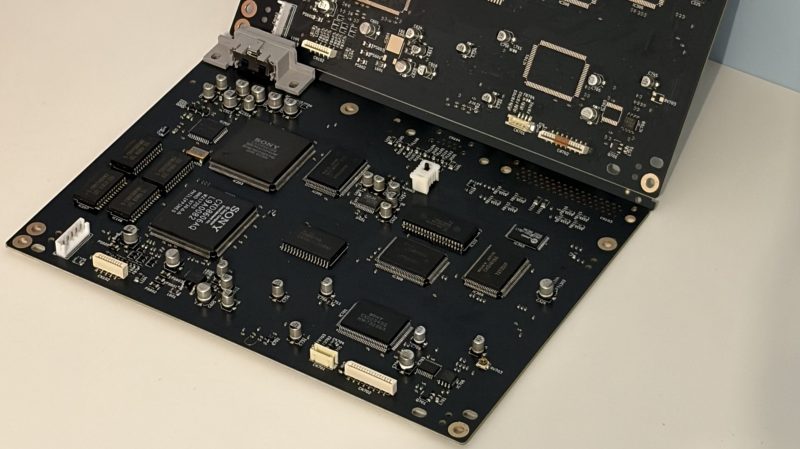
Thanks to things like spilled drinks, leaky batteries, and the general ravages of time, older consoles can be tough to keep going. In particular, excessive damage to a motherboard can make repair difficult or near-impossible to execute even if the rest of the console is in otherwise passable condition. Now, there may be greater hope for those looking to resurrect the worst-treated PlayStations out there, thanks to a new open-source motherboard from [xyzz].
The board is up on GitHub with a CC0-1.0 license. It’s aiming to be a drop-in replacement for the stock motherboard, on to which you would transplant all the necessary proprietary hardware from an existing donor board. The list of transplant parts is quite extensive as you’d expect, including the CPU, GPU, RAM, VRAM, BIOS, sound chips, mechanical control chip, crystals, and all the ports, among others. Some generic parts can still be had off the shelf, but you could also transplant them if so desired. There are some headaches with the current design—namely, it doesn’t fit perfectly with the lid switch connector, and some of the footprints are hard to solder. Still, it’s a great start, and early testing shows that it’s already quite functional.
Fortunately the original PlayStation didn’t have any sort of battery on board to leak all over the place and corrode things, but boards still get damaged in a variety of other un-fun ways. Thus, it’s great to have a potential replacement motherboard on offer to bring badly-damaged machines back to life.
We’ve featured other great restoration projects in this vein before, too, like the efforts to recreate the C64 motherboard from a few years ago. As ever, enthusiasts are doing great work to keep these classic machines alive long into the future.
Thanks to [ToolThatIsTom] for the tip.












Very cool project, very impressive considering its all reverse engineered from the original PCB.
A question, is the experience between an almost cycle perfect FPGA implementation versus the original hardware different? Or is it close enough that most people don’t care? Or are most people okay with emulation? Because I’m almost okay with emulation, 99% of the time.
I just own an “R36S” handheld with a 128GB card with all the games that I can care to play. Its enough, even though I seldom play any games these days.
In the emulation space there are reports of some games being weird or not working at all, usually because they depend on some undocumented feature of the game console. However, that’s valid for every single emulated game console, not only the PlayStation.
And there’s also the people who prefers to use the original hardware as much as possible, this board is useful for replacements when needed. But even among these people there are those who replaces the optical driver with some solid-state drive solution for convenience and future-proofing.
FPGA’s are just more fun IMHO, often software emulation like whats on the R36 and clones can provide more , but also at the same time be not quite there. a example is N64 emulation and mario cart with the “tv screen dual ram” , in software this is really hard to do, uses a lot of cpu power and is often broken, in the FPGA world we create dual ram inside the fpga and it runs per cycle (almost).
It’s also a very good study in how the originals are built for the curious and also esier to build on, a example is I am making a RGB interface for my Tang Primer 25k FPGA as i happen to have a old 25″ crt and the space to set it up.
Also for those that wanted one as a kid and missed out or those that had and want that nostalga back again it’s a great way to get in quick before you spend more on original hardware and for some who have knowledge now they didnt as a kid to build new software and hardware and even find new bugs/features.
So does this new board bring any updates or qol enhancements? Or it’s just to replace failed mobos? I have a stack of like a dozen that all work, 5 bucks here and there at thrift stores and garage sales.
I believe the point of a faithful repro is for matching the original board as a replacement. Not sure if its useful for modding, more for electrical engineers who have donor boards