
Radios were once big complicated appliances, full of warm valves and paper-wrapped capacitors, all humming and glowing to capture signals from the aether and spit them out of a speaker. Every component was chosen to build the radio to suit a particular purpose.
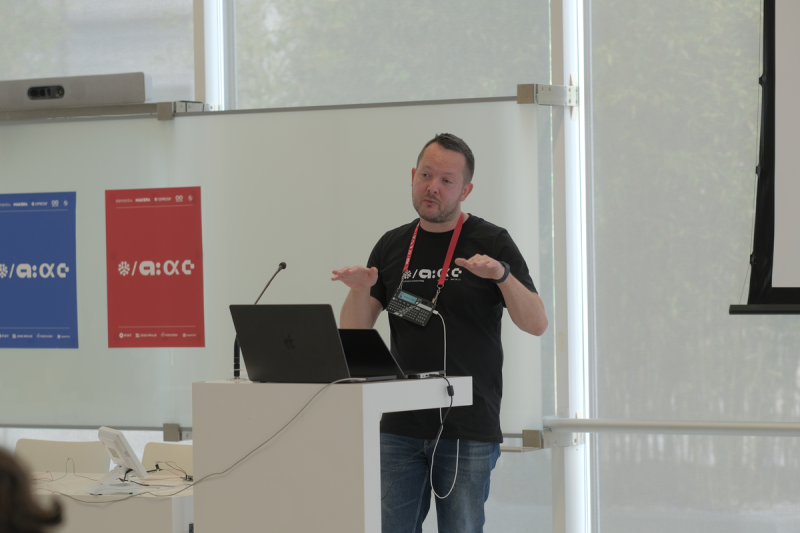
These days, we have altogether fancier technology that lets us build radios that can be reconfigured on the fly; software-defined radios, if you will. [Anders Nielsen] has been exploring how to build a high-performance SDR recently, and came to Hackaday Europe 2026 to tell us all about it.
SDR Killed The Radio Star
[Anders] is a bit of hacker type. He’s a firmware developer for satellites in his day job, and he’s always a fan of tinkering with old integrated circuits and trying to build new and interesting things with them. Recently, though, his personal project has been developing a software-defined radio on a budget of under $50.
Now, [Anders] could have simply bought a cheap SDR off the shelf; he himself calls out the Zync/AD9363 platform as one particular example. However, he notes that many available options hide a lot of the signal chain and come at a certain price. He wanted to build something cheap and transparent for experimentation’s sake.
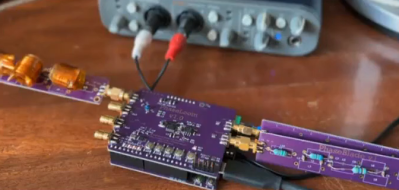
The ultimate goal was to build an affordable SDR with a bandwidth up to 20 MHz. To reach this in his build, [Anders] picked a TLV3253 to serve in the quadrature sampling role, for its quick switching speed and low on resistance. It’s paired with a Silicon Labs 5351 which serves as the local oscillator. It’s possible to phase offset two clocks from the same phased-locked loop, allowing the generation of multiple clocks of the same frequency but offset by 90 degrees. An ADA4891 op-amp is used as a buffer between the capacitors of the quadrature sampling detector and the analog-to-digital converter itself. Testing began with a very simple ADC—a soundcard, capable of up to 44.1 KHz of bandwidth. Later, [Anders] stepped up to using an STM32 with a dual ADC for 200 KHz bandwidth. Eventually, though, the build was upgraded to the HT9201 dual 20 MHz 10-bit ADC. Getting the signal into the computer is handled with an FX2LP clone, which can stream data over USB 2.0 at high speed. With a nominal 480 megabits on offer, the choice is to run with 20 MHz of bandwidth at 8-bit samples, or 10 MHz of bandwidth with 10-bit samples.
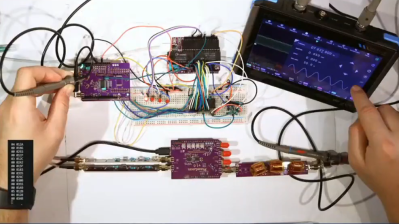
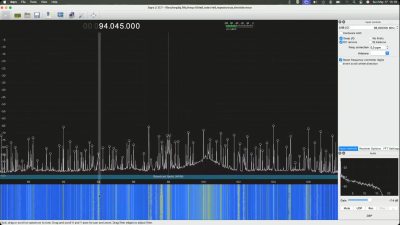
There were some challenges that cropped up along the way. Getting a flat analog frequency response proved difficult, with [Anders] noting this requires good attention to PCB layout, as well as things like amplification and filtering. There were also difficulties with clock jitter and synchronization, and bandwidth limitations in the front end. However, none of this stopped [Anders] from giving a live demo of the SDR in action during the talk. He showed off his rig pulling in the whole FM broadcast band, all at once. The crunchy sound of a commercial station coming in live was an excellent way to show that the SDR indeed was functioning as intended. [Anders] also used this as an opportunity to show some tricks to identifying and dealing with mirror signals when they pop up. There’s plenty that [Anders] wants to do with this project going forward, too. He notes that a wideband front-end mixer is on the cards, as well as a low-noise amplifier and an improved filtering strategy, all of which should improve flexibility and performance.
It’s not the greatest SDR out there, but it is one that taught [Anders] a great deal, and could do the same for others eager to tinker in this field. Sometimes the best way to learn about something is to go and build one for yourself, and this project proves that as so many have done before. It’s exactly what we love to see at a Hackaday conference!












CXADC can sample at 40 MHz if you replace the crystal on an off-the-shelf video capture card.
One way to experiment with SDRs is GNURadio. This open source package is a sort of Lego for radio allowing you to string processing components together to make different types of radios. Its normally paired with an inexpensive USB dongle but if you have an amateur radio license you can get a converter and amplifier module that would allow you to transmit. (SDRs are symmetrical….)
Most amateur radio rigs are SDRs these days. My one has a couple of ESP32s driving it, one for the radio proper and one to operate the interface. The era of the radio containing hundreds of parts has gone the way of the vacuum tube, a historically interesting device that definitely has more ‘soul’. The essential math behind what’s going on in the radio hasn’t changed, its just now implemented in software.
“Most amateur radio rigs are SDRs these days.”
True, but—- most hams still want buttons and knobs.
Even Flex saw that and have that option. I LOVE my
Elad FDM-Duo….the best of both worlds. With the 100w amp
(60dbm.com) I have a Flex grade(almost) radio at less than half the cost!!
There’s sure to be a Winamp for SDR around?
It might be useful to compare and contrast LNAs with “mixer first” architectures.
One starting point is https://research.utwente.nl/files/17136075/Klumperink_CICC_2017.pdf
All of the broadcast fm spectrum at once is pretty neat.
What’s neat is extracting those stations after the fact.
Unfortunately it consumes drive space like crazy.
I’ve done this a couple of times with my bladeRF, it supports USB 3 for the purpose but you can crank the sample rate higher if you drop the sample down to 8bits.
Is there a PCB??? kit????
Gene Stanley
Currently it’s a combination of “Phaseloom” mixer board, “PhaseLatch” ADC board, bridge chip board (fx2lp).
If you want to dig in at the current state they are available on my website – but expect an integrated board “soon”.
-Anders
USB2 is fundamentally NOT high performance…