
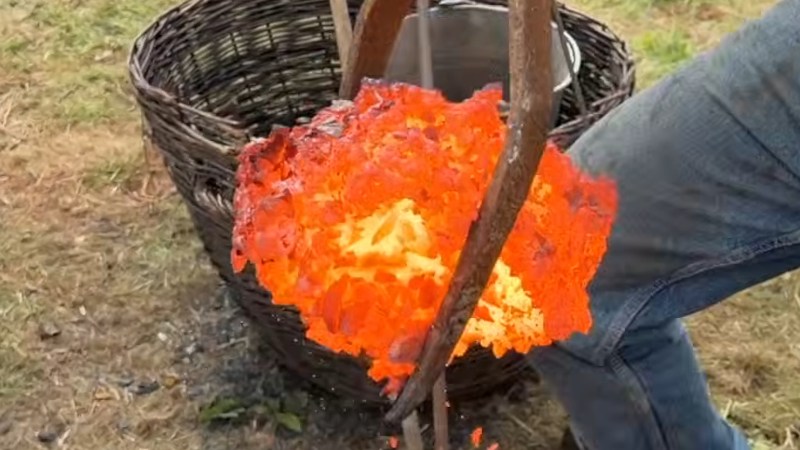
Sometimes along comes a hack with a personal angle, and in a video showing Irish bog ore smelting, we find an appropriate follow up to a Hackaday expedition back in 2019. [Alec Steele] joined Irish Bloomery Iron, for a weekend with a medieval blast furnace.
Our brush with bog ore came in a trip to Hack42 in Arnhem, the Netherlands, where a team of Dutch hackers built a furnace from firebricks in an attempt to do the same thing. The Dutch attempt ended with a lot of mixed slag and very little iron, and looking at how the Irish furnace was constructed we see some clues to their success. Their air injection using a perforated sheet of clay and the air blast injected to form a venturi is particularly interesting,as is the shape of the furnace.
The iron bloom is lifted out through the top of the furnace rather than being tapped as molten iron, and we’re treated to it being worked into a usable bar of iron. Having spent a day with our Dutch friends doing the same work only to have scraps of iron, we’re mightily impressed with the results from the Irish smelters. You can visit their website at www.irishbloomeryiron.com.












This is fundamental to being a pre-modern blacksmith. Knowing how to procure iron locally was critical to the trade. Source varied by locale, but the master smiths used whatever ore was locally available, igneous, sedimentary or biological. Producing wrought or cast iron for most and steel for the wealthy. An under appreciated skill today.
Surely blood was omitted…right?
Some bacteria accumulates iron. If you collect it, dry it out it can be used as a source of raw iron in a reducing furnace.
Yeah I really enjoy Alec’s content, he has an insatiable desire to learn and it really comes through on his channel.
Doesn’t hurt he’s a mild mannered Brit as well.
I can’t wait to see that giant stream hammer he’s restoring in action.
Indeed, I’ve been following the hammer story too. Regular readers may know that my dad was a British blacksmith too, sadly we never had one of those.
If you’ve got nearly two hours, there’s quite a good end-to-end ironmaking demonstration from West Africa here that has everything from charcoal making to a finished product.
https://youtu.be/RuCnZClWwpQ
There is not a single formula for running a successful iron bloom. The particulars on how to build and operate it depend largely on the composition of the ore. Even the same type of ore from different sources will have different levels of silicates or alloying metals that require significant adjustments. A successful bloom calls for celebration no matter the century.
The ‘from dirt to space’ is sadly one of the many projects which had the momentum killed by the Covid period, and Hack42 moving. I was there at one of the melts in 2019, and it was good fun. I expect we would have gotten iron, eventually. Be it that the bricks are not reusable, and at €5 a piece, it gets quite expensive too.
One part I’m missing in the video above is the safety. Not just are hot things hot, the exhaust is very much only carbon monoxide which can very quickly overwhelm you. At some point at Hack42, the person working on the forge was held by the collar just in case.
Yes, we took care to avoid the CO at Hack42.
OK, perhaps it’s time to resurrect From Dirt To Space. Far too much fun to let go.
Where I live in the Scottish Highlands there’s traces of the smelting of bog irons in various places in the mountains. Bearing in mind the difficulty in transporting anything heavy over boggy, steep or rocky ground, it all must have been done with materials close to hand and only the finished product carried away.
bog: No definition found.
A bog is a wetland that contains decaying vegetation, generally peat, and as far as I can recall were a prehistoric forest or woodland. They vary in how wet they are from swampy to quite earthy depending on rain levels, season or if they’ve been drained (naturally or from human intervention). Most in Ireland are protected under conservation acts and some are being restored as they’re host to lots of native flora and native and visiting fauna.
https://en.wikipedia.org/wiki/Bog
The bog in this case refers to where the raw material was extracted from. If you slow burn dried peat (turf) you get this orange brown clumpy ash that looks very much like what’s used in the video.
Was always wondering about the peat composition, as it seem to be mentioned as valuable resource in many historical documents.
I go hiking a lot in New Hampshire.
In the springtime, the snow melt gets into the into the rocks and comes back out further down the mountain as “rills” (tiny streams that only have water in the Spring).
The water has dissolved iron, and the algae that grows is quite noticeably orange in color. You see orange algae in streams everywhere at this time.
The algae gets carried by the water until it hits a section with little or no current – the bog, or swampy area at one end of a lake – where it gets deposited in the lakebed. Over centuries this builds up, and it’s these deposits from algae that is used to make bog iron.
There is a lot of bogs in Scandinavian nature, and some will have iron bacteria. If you see a ‘oily’ sheen on the surface, its probably not from some forest machine leaking, but from the bacteria. The iron can form into lumps, and by wading around in the bog poking down with a long stick, you might find those lumps. As far as I know, bog iron was the primary source of iron during the Viking age, and way later continued to be so in Russia, which was underdeveloped compared to western Europe. Since bog iron will renew itself if the bacteria keep working, some bogs were continually harvested, about 1/30 each year.
The most interesting thing about bog iron, is that it is basically the only source of metal that is actually renewable.
I mean, if you know of anybody who is still uploading their work on blogs and web forums and not on YouTube I’m sure that HaD would love to hear about it. Unfortunately discoverability is very difficult on the internet these days. If you want people to find your stuff you basically only have the big soical media sites.
I once went through a street called Bessemer street. It made me sing to myself ‘bessemer, bessemer mucho’ ㋡ (play on Bésame Mucho of course)
Reference: https://en.wikipedia.org/wiki/Bessemer_process