

Hacking on Raspberry Pi board internals is one of my favourite topics. I know a bunch of obscure things about these cute little boards. Three years ago, I covered a Raspberry Pi 4 RAM upgrade story. Getting a BGA RAM chip and swapping it in seemed like a no-brainer to me – apart from all the numerous uncertain parts about it, you know. It was a joy to see hackers pull it off, and for it to function as well as it did!
Things changed. You can’t really get RAM chips anymore. You also can’t get RAM sticks. You can’t get even SSDs with RAM chips on them. Even getting Raspberry Pi boards can be hard unless you know where to look. This is where a recent three-minute video by [Jeff Geerling] finds us.
Turns out, Raspberry Pi Foundation pushed binary-blob bootloader changes that limit your ability to upgrade RAM. I’ve known about it since last year through the grapevine, and somehow, as I read about it, this didn’t bother me at all. Not enough to write a Hackaday article about it, even, much less talk about it more widely. Why didn’t it bother me? Today, I sat down and pondered this for a bit.
Here’s my conclusion: I don’t think it’s a big deal at all, even if it seems that many people would disagree. Come in, as you are, and I hope you find my thoughts on the situation entertaining.
How It’s Made
First, some ground facts. This change restricts upgrading the RAM chip on your Pi 4 and Pi 5, as well as Compute Modules. By the looks of it, it does not restrict replacing the RAM chip with a chip of a similar size, quote, “locking devices to their original RAM size”. As such, this does not prevent repair of your Raspberry Pi board, but does somewhat limit your repair part choice, at most.
This restriction is easily bypassable. The bootloader is stored in the SPI flash chip, which can be reflashed using the built-in mask ROM over USB and rpiboot, and you are not prevented from flashing older versions of the bootloader, so far. This means even if you manually swap the RAM chip, all you need to do is to also downgrade the bootloader to the last known good release — 2024-09-10 — and then your Pi board or Compute Module will function with upgraded RAM. If you have the skills to upgrade your RAM, you most certainly have the skills to downgrade the Raspberry Pi bootloader.
For most regular use, having a two-year old bootloader version won’t really matter. There have been about 15 releases since the 2024-09-10 one, so I went and read through the patchnotes. Checking quickly, the important features like NVMe boot have been available for a fair bit before this release, maybe you will miss out on a few quality of life fixes or more obscure hardware configuration problems, but that’s it. Hopefully I’m not missing something, please point it out if I am. You know what is an issue, by the way? The patch notes for the 2024-09-23 release don’t mention the RAM size check addition at all, maybe they should fix that.
What’s funny is, I am checking reports and it seems that the board will boot and function well with newer bootloaders (mostly 2025 versions), and in other cases (mostly but not always 2026 bootloader versions) it will outright refuse to boot with a 8 or 9 flash failure code. I haven’t compared details on what exactly might be causing this yet, but it might be that you don’t even need to downgrade bootloader all that badly – though I’d definitely start with the oldest known-good release.
How It Happened
This is the first reason I can’t bring myself to care. If you can upgrade your RAM, you can downgrade the bootloader. However, here’s the point of contention – did this change really need to happen?
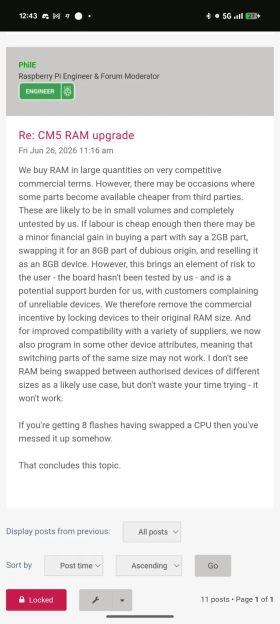 For the reference, this bootloader change happened almost exactly two years ago, at some point between September 10 and September 23, 2024. This was exactly a year and a half after we covered the first Raspberry Pi RAM upgrade. What changed?
The Raspberry Pi Foundation (RPF) justifies this as follows: they saw third-party resellers sourcing low-RAM Compute Modules, upgrading them with RAM from unknown source and unknown stability. My observation is that they’d also be reselling the modules at a markup for purely commercial gain, while undercutting RPF who would otherwise direct that money into RnD, something I much enjoy to see them do. This creates perverse incentives and risk for people buying Raspberry Pi boards online, and RPF decided to limit this primarily for their users’ benefit, plus, if you ask me, some of theirs.
Is this justification true? I can’t know, but I went to check for signs of this happening, and the non-consensual RAM switcheroos seems to be happening all over the place! The related GitHub issues have a fair few pingbacks, and exploring them makes the problem look grim to me.
Off the cuff, I spent 15-20 minutes checking, and I can easily find fifteen different people on GitHub alone complaining about this failure. [(1) (2) (3) (4) (5) (6) (7) (8) (9) (10) (11) (12) (13) (14) (15)] As far as failure modes in popular hardware go, this is a surprisingly large number that suggests at least hundreds of hackers and hobbyists affected, if not more. None of them appear to have performed the upgrade themselves, hot air and flux way, the Hackaday way – all of them seemingly simply bought a “8 GB” version from either Aliexpress or Amazon. In at least one case, the seller immediately lied to the buyer about the issue and did not at all admit that an upgrade took place, even though it clearly did.
How It Makes Sense
This seems to map exactly to what RPF says happened. I can very much see why they would be worried. For instance – at the time they made this change, if my memory isn’t failing me, CM5 or CM4 2 GB boards went for $30-$40, 8 GB boards went for $100ish, and 4 GB boards were somewhere inbetween. As far as the intersection of hacker gadgets and industrial-lite hardware goes, that price is more than fair.
At this point, we’re no longer talking about people upgrading RAM on their boards for fun, and remember, you can still do all of that. Instead, that’s a fair bit of margin for someone to grab for 20 minutes of hot air work, someone who hasn’t done any of the RnD that RPF has put in. I personally much rather would see that margin go to RPF, and I’d like to have them deal with none of the headache, too.
Creating incentives for this kind of switcheroo business, unimpeded, seems deeply corrosive to me. For one, there’s zero repercussions for someone equipping those boards with substandard and harvested chips. RPF, as any experienced hardware company, would know about sourcing harvested or otherwise shady-origin RAM and other chips. A third party on Amazon/Aliexpress passing on those chips undisclosed to unqualified end users, now that goes far beyond the usual harvested chip horror stories. It turns into a game of “will/won’t the user notice the weirdness and ask the seller for a refund on time”, and at $100-$200, together with the ship-item-back requirement these prices bring, the answer will generally be “no”. Now, the buyer finds out about the tampering almost immediately, since Raspberry Pi boards auto-update the firmware.
If you don’t agree that this alone is corrosive – notice how this kind of “upgraded” board clearly requires sellers to misrepresent what they’re selling? You’re not going to find about this “upgrade” in the listing, there won’t be a “8GB reworked” label, clearly that would require lowering the price and/or cutting into the margins. Just like there’s no incentive for using a fresh RAM chip instead of a harvested one, there’s also zero incentive to be open about the mod. That’s no way to sell a pen, much less a full computer.
How RPF Does Things
Here’s the most confusing part to me. I’m seeing [Jeff] and others say that this is out of character for RPF to do. This does not seem true to me, at all? I don’t recall a time when Raspberry Pi has put effort into giving users freedom to hack on the board itself as soon as any sort of legal or competition issue arose.
Raspberry Pi puts cryptographic EEPROMs on Pi Camera boards, v2 and beyond, to thwart clone cameras that became so prolific and cheap with v1, I own at least five of those clones in different form-factors. I don’t like it, but at least the authenticity checks are disabled for Compute Module versions, as far as I remember. They still don’t sell the MLX7704 PMIC that immediately dies if you accidentally short-circuit GPIO header 5 V to 3.3 V, two male pins that are right on the side of the board and exceptionally easy to short-circuit from three sides simultaneously.
Raspberry Pi only ever publishes “reduced” schematics, ever since 2013, and they haven’t even released those for Pi 5. Neither have they published Pi 4 USB-C issue fix schematics despite having promised to do so. Half of the chips on a modern Raspberry Pi board are single-source and board-specific, the aforementioned PMIC being a fun example. Raspberry Pi boards ship closed-source software, from the bootloader to the GPU code whipping the CPU, to all the onboard wireless chips they have used so far, and this brings real issues you’ll stumble upon as you push the limits. The JTAG port has always been locked down, and even the bootloader is cryptographically signed – no patching out the RAM check code, sorry to spoil it.
I’m far from done listing ways in which Raspberry Pi prevents or works against low-level board tinkering, there’s at least five more things I could list from memory if I were bothered to check them thoroughly enough right now. Point is, if anyone came to Raspberry Pi for the low-level hackability of the hardware, there was never a shortage of reasons to look elsewhere. That was never the upside.
I don’t think low-level board hackery is what people genuinely expect from Raspberry Pi at all, even if they might say that they do – because it was never really there. You can’t genuinely expect something that was barely ever present. In contrast, there’s plenty of competition that publishes full board schematics, sometimes even gerbers, uses as much open code as possible, doesn’t sign bootloaders, and so on. Raspberry Pi is not open or hackable hardware by those metrics, and it never was. It’s not hackable hardware anywhere as much as it’s hardware made for hackers to use, and there’s clearly a big difference.
How Did We Get Here?
In practice, people clearly come to Raspberry Pi because of their community in the millions, meticulously explored and documented hardware, unmatched availability of boards and software alike, having solutions for nigh every little niggle and nitpick, RPF’s ability to experiment and release new cool hardware year after year, and even new standards they create along the way. Most of low-level problems get papered over through sheer scale – say, last year [Jonathan Clark] reverse-engineered the Raspberry Pi Zero 2 W, and then [TubeTime] reverse-engineered the Compute Module 5, how cool is that?
I could agree with [Jeff Geerling] that it could instead benefit from a “warranty bit” type of mechanism, but really, the bootloader downgrade isn’t that hard of a penalty, and “board autoupdates firmware, fails on next boot” is a much stronger indicator that you should go get a refund at haste. A refund is also way easier to get if you say “hey, the board stopped working immediately”, and who knows, maybe you’ll get a refund and get to keep the board so that you can downgrade its firmware and still use it! Win-win, seller loses out on selling you a shady board, and you get a shady board that might just work, for free. Chances are, we wouldn’t even be talking about the RAM swap restrictions if it weren’t for the RAM shortage, and that is not RPF’s fault at all whatsoever.
My advice: don’t lament Raspberry Pi RAM upgrades, especially given they’re only slightly harder to perform now. Very few hackers ever performed them, the main audience for them turned out to be dodgy hardware resellers online, and in most cases, repair doesn’t seem to be impeded at all, either.
Think of the users that will no longer be fooled by a shady seller on Amazon, especially now that the perverse incentives for board mods and reusing harvested RAM chips are at their highest. RAM shortages might make any RAM topic hurt deeper than usual, which to me is the most likely reason we’re discussing this in 2026 instead of 2025, but this change is far more likely to help a hacker in practice, than it is to hurt.












>locked down hardware will help hackers
sir this is a wendys
The target audience of Raspberry Pi boards are infinitely more likely to be helped by this restriction than they are to be hurt by it, as I describe in the article. Especially in 2026 – the calculation has changed so much that at this point I’d straight up expect those RAM chips to be harvested from water damaged phones. If I ever feel like upgrading (not even repairing!) RAM myself, I’ll simply downgrade the bootloader and have a functional board. Sounds like a fair tradeoff to me, in exchange for having less people deal with glitchy Raspberry Pi boards, newcomers in particular. I was a newcomer once, and this would’ve sucked to deal with.
Very much agreed.
While the video seems more geared to stir controversy ( and generate views ) .
For those that need to repair, they will use the correct parts.
The normal people that are buying a very cheaper unit from some non-official place ? Well, “caveat emptor” .
The 6 or 7 normal people with the skills to do this chip replacement ? Well, they are skilled also to reflash the bootloader.
Basically, the boards only work with certified parts. So , they work, and that is the important part. If someone wants to use whichever chip-of-the-day on a board, they can design and build their own SBC´s ( document it on a series of blog posts and send a link to HaD ) .
I think the most illuminating part about this change is that it was made exactly 2 years ago, and nobody has been affected badly enough to make a fuss about it, up until RAM became a sore point for everyone – and even then it took almost an extra year for people to notice. I think the video makes some fair points, though I vehemently disagree that Raspberry Pi ever had board hardware modifiability (or any other cool things that open-source hardware brings!) as a selling point.
Tinker toys are fine until you grow out of them. Anything that shoots the advanced user in foot is bad. Advanced users get to be advanced users by shooting themselves in the foot. They need no help to shoot themselves in the foot and preventing them from doing so interferes with learning a lesson. They also come up with things that commercial vendors never will do to limited market or cost. What if I want or need faster RAM?
This is nothing more that Raspberry Pi proteccting their profit margins on boards with more memory. Sellers who sell reworked boards that don’t work don’t last long. RP can open their own official store on Amazon if they want to protect their brand name and reap the profits of trust. Otherwise its caveat emptor
I’m an OG who has written microcode to get DRAM to work. I don’t use Raspberry hardware but you don’t advance if you are locked down and pigeon holed. If we limit people to using python and Arduinos to make lights blink all we will have is blinking lights and limited choices of dev boards.
Literally at least half of this article is written from an advanced user perspective. As much as I get you, in these accursed times, there’s no shortage of boards where you can upgrade the RAM chip if you so desire – if you are an advanced user, you know about those boards and likely own a few. Raspberry Pi was never especially open about hardware, you don’t even need to remember what an Odroid W is (rather, was) to know that. Perhaps it’s best to use different boards according to their strengths and weaknesses.
Yeah use each board for its strengths only, don’t recycle, don’t reuse, don’t repair, don’t adapt. The board doesn’t do what you need? Buy a new one and put the old one on the trash pile. Don’t worry, the planet has infinite resources.
Hackaday Ethos , 2026 edition
What is this article, seriously?
Agree. Personally don’t use such hardware, but it sounds contrary to their experimental cause. And from someone looking from the outside in, it’s tracking pretty similar to Microsoft. Earlier versions of Windows allowed you to do a lot, especially shoot yourself spectacularly in the foot. These days it’s a battle to get anything worthwhile up and running as the OS as it’s so locked down it’s almost pointless.
If this is the way they want to run their hardware, someone will probably have to start over with a new board and a new focus, and build something useful from scratch. In the past, boards had these things called “sockets”, so we could choose what to use and / or upgrade. Still remember when Windows locked that down, making the OS spit its dummy if you changed to many components. That was about the same time I stopped building new computers and instead switched to buying second hand business grade computers and changing pretty much nothing.
Simple overview, when the tech industry starts to tout security above all else, it’s usually the beginning of the end of whatever they’re pushing.
My knee-jerk reaction was to agree with Jeff Geerling. Your thoughtful and well-reasoned argument has brought me around to your way of thinking.
What the Foundation is doing still bothers me, but I guess it’s inevitable when you have unscrupulous opportunists giving your product a bad reputation.
It’s not even bad reputation that bothers me personally, funnily enough, I have my own share of criticism for RPF. It’s that unwitting newcomers are going to end up with glitchy boards that randomly lock up, reboot, corrupt in-memory data as well as storage contents, and in general pretend to be unmodified boards while being sold for the price of a modified one. Such boards are terribly painful to work with, from my experience, I have no doubt they can even put people away from the hobby, and I wouldn’t wish that on anyone.
Not to mention all the newcomers that eventually turn their hobby into a profession and accidentally rely on such a board in a place where uptime is money, or people who try to build useful infrastructure out of these, so many cases where a glitchy board will easily quadruple the already non-trivial suffering we experience when building something reliable. Seeing just how many of these “upgraded” boards got sold is lowkey heartbreaking for me, and as much as I have appreciated the RAM upgrade capability, I’d much rather have newcomers to this hobby be protected.
Ah, the classic “think of the children” argument 😂
“The Raspberry Pi Foundation (RPF) justifies this as follows: they saw third-party resellers sourcing low-RAM Compute Modules, upgrading them with RAM from unknown source and unknown stability.”
Mmmm.. how many unwitting newcomers are using compute module boards? If THAT is what bothers you… I’m inclined to disbelieve your claims.
To me this looks like the RPiF is trying to cut out aftermarket mods. I’m guessing that while you CAN downgrade the bootloader, the older versions of the bootloader are probably also mysteriously harder to find? It’s just a guess, but it sure wouldn’t be the first time such a thing has happened.
Surely 95% of them, according to statistics pulled out of mysterious places.
Also, 89% of people who turn RPi projects into a profession source them from anonymous sellers on ebay.
As to just how many of these “upgraded” boards got sold, it is probably 67% of total sales, extrapolated from 15 complaints, which is why it is so heartbreaking. Also 0% of these people had the firmware misidentify the RAM due to a bug or RAM degradation or whatever, so there is that.
I have all the stats, just ask.
“how many unwitting newcomers are using compute module boards?” a non-zero amount, given that there’s Compute Module projects aimed at newcomers. fwiw, experienced engineers find it unpleasant to receive such modified boards for the same price and without disclosure, either.
There are other options that would get much of the same effect without hurting end users. The downgrade “option” is just cope.
Or – hear me out – you could upgrade/repair the RAM without having to downgrade the bootloader?
I’m sure people who have incorporated Raspberry Pis in commercial equipment are going to love the fact they are a software update away from bricking deployed systems. I hope the remember Raspberry’s attitude when designing new hardware as well.
Ah, the Windows experience!
Saw it happen with Windows 8.1 update, which silently dropped support for AMD K9 and other early X86_64 CPUs
and bricked many Windows installs after re-boot
I wonder if those “ordinary” Raspberry users that can’t be expected to a read/understand warning about modified Pi hardware
will blame Raspbian/Raspberry Pi OS for their bricked Pi or Linux in general.
After all, it’s this very OS that enforces the firmware upgrade.
Their fault for bying shady RPIs for commercial equipment then.
Their ability to justifiably interrogate their supplier and possibly still get their money back, with testimony from Raspberry Pi, even!
My god the cope is strong with this one. They are protecting their users by bricking their hardware. No warnings, no alerts, just an automatic upgrade that bricks devices. And your argument is that it’s good for the users … that’s HILARIOUS…
@Enrico If you paid attention, you’d notice that on the timeline of events, they rolled out the bootloader change way early enough that the wave of shady RAM upgrades happened later, and very few people were actually caught by surprise as a result.
Damage is done to their customers faith in their product. Also these are legitimate RPIs and there is no way to distinguish that they were modified. This is just as bad as when FTDI pushed a windows driver that bricked peoples hardware with counterfeit parts. This punished the victim (the end user).
I have had been thinking exactly the same! 😯
It’s only comparable to FTDI if you conveniently ignore a whole bunch of real-world details that make it entirely different in its real-world impact.
I thought these were unwitting newcomers that needed protecting! Looks like the defenders of this are speaking out of both sides of their mouths. Which is it? Unwitting newcomers that need protecting, hackers that can download the bootloader by themselves and reflow their own BGAs, or cheapskates that deserve to be ripped off by everyone with their hand held out?
This isn’t a Wendy’s and it’s not twitter either
So what is stopping dodgy resellers from downgrading the bootrom? This is a stupid article that contradicts itself.
They already ship the bootrom downgraded, the board wouldn’t function as-shipped otherwise. Raspberry Pi OS auto-upgrades Pi4/5 bootrom unless you explicitly disable the service that does the upgrade. This means that the board will stop working after the first reboot; to fix it, you can easily flash the old bootloader back over USB and then disable the service responsible. This service is also seemingly not present on OSes like Armbian and so on.
To fix this, the dodgy sellers would need to make the SPI flash chip write-protected at the very least, which, if it uses qSPI and not regular SPI, is more complicated than a WP pin bodge. I don’t know which one they use, but come to think of it, the reverse-engineered CM5 files should help figure that out.
I doubt trying to lock the rom would be worth it. You might be able to get rid of the ability for the bootloader to get upgraded, but the inability to do so is arguably a marker of tampering itself.
Which i would assume is already something that the bootloader upgrade service checks for and reports as a error, because trying to catch and report errors to the user when something doesn’t go as expected is just standard practice.
Why is it that any aftermarket modder is being called a “dodgy (re)seller” on a hacking site where homebuilt projects are displayed on the front page which can be bought from Tindie and other sources? NanoVNA has been prominently displayed on the hackaday site many times in the past and has probably helped sell far more than a few units. This is all fine, but now some people are upgrading RAM as an aftermarket service and selling those devices for LESS than the cost of the official devices with similar RAM quantities and are being vilified for it. If there are bad actors, name names. Help us make informed choices. Don’t feed us BS about some nefarious unnamed sellers out to ruin our projects with RAM that isn’t fit for purpose. Where are these dodgy RAM chips coming from anyway? I thought the reason we have this RAM shortage is that there are so few makers of actual RAM chips. Where does the cheap RAM come from, cause I want to upgrade! I don’t mind if its not the stuff made by the profiteering corpos that made this whole mess to begin with. The water damaged comment I read up above – ICs are waterproof. I’m going to need some evidence that RAM chips aren’t waterproof or that they suffer related damage that makes them inoperable or severely degraded. Then point out the evidence that this is the source of all RAM upgrades to Pis. Name names!
There are too many contradictory statements for anyone to honestly believe this is anything other than an anti-user corporate protection scheme. Arya, do you have connections to the RPi Foundation we need to know about?
“Aftermarket modders” are honest, these sellers are not, I highlight this heavily. “NanoVNA” stop right here and let me remind you that NanoVNA has a significant problem with clones that underperform, they’re very open about having done a different calculation about it, and the tradeoffs it resulted in. Apart from that, there’s about a hundred differences worth accounting for, some notable ones: scale, target audience’s competence, having a single authoritative source of information guaranteed to be referred to (NVNA) vs not having one (RPi), NVNA being basically single-source vs RPi having to operate a reseller network, significant product cost difference… yeah. This is not hard.
“Where does the cheap RAM come from” ask anyone sourcing RAM at lower scales right now. Look up Shenzhen tours. It’s water-damaged phones and laptops, old stock not fit for use by other people expecting yield, and either way those are chips not checked for stability. They’re heavily marked up, too, so you can’t afford to just take a loss on rejects and must use what you got, no matter how dodgy it might be as long as it “functions”. There’s still cheap RAM going around if your standards are low, and due to the incentive structure, that RAM will be used for things like dodgy upgrades.
“ICs are waterproof” during a water immersion event, as the device is powered on (most phones are constantly powered on), higher-voltage low-impedance power rails are short-circuited to low-voltage sensitive RAM pads. I’ve worked in repair and I’ve seen this damage, anyone who’s worked in repair can tell you about it, I suggest you talk to people more. As for RAM damage, I do already talk about it in this comment section, so Ctrl-F.
From your link “a significant problem with clones”:
“OwO 2020/08/20 22:00
On behalf of the S-A-A-2 design team I’m writing this to clear up confusion around our stance towards clones.
Firstly, we do not have a problem with clones. In fact, we encourage making variants of the S-A-A-2 design, or even verbatim clones, as long as basic business ethics are observed. We released the design as open source and do not take any royalties. So far the vast majority of clone manufacturers are playing completely fair and we are fine with them selling S-A-A-2 devices. I like to see variants like the 3.2 inch “black gold” clone, and even recommend them when people ask me where to get a S-A-A-2 with metal enclosure.
[…]”
They rightly accept that Open Source basically guarantees that bad actors will come along and try to make a quick buck, but they also encourage people to copy their design and remain ethical. This is a very positive Open Source mindset. Its the mindset that you arrive at after you realize that Open Source means others will make money off of your design and you still continue to release things as Open Source.
This is not what RPi Ltd (arguably Foundation as well despite the distinction pointed out in another comment near the bottom of the section at the time of my writing this), is doing. They’re taking steps to make it harder for anyone to upgrade their own device. We’re not talking clones. We’re talking upgraded RAM chips. We could say swapped RAM if the case is that the RAM is genuinely defective and not an upgrade, but so far there has been no evidence that I’ve seen of defective RAM swaps, only unsubstantiated claims of it maybe happening. Otherwise, name names. The original github issue you point at is all about the Pi folks making the OS not work with a different capacity RAM chip. There’s no mention of the RAM chip being defective. Then defective RAM gets shoehorned into the argument because of course we want to stop crooks from ripping people off, but then we turn a blind eye to the corporation of crooks ripping people off by preventing others from swapping RAM chips!
I would say that there should be no issue with people selling good value RAM swapped Pis. They should be honest and upfront about it, but if they’re willing and able to do so at a price point lower than RPi Ltd, then that’s capitalism and competition working as we’re all promised it is supposed to be. Let’s stop the anti-competitive behavior of trying to lock people out of their legally purchased hardware by slipping in firmware changes. Just because it can be undone is not enough excuse. This is probably a lower level of anti-competitive behavior when you look at other corporations and how they behave (like Apple, MS, Google, etc), but we expect better from the people building devices for education and charity. We don’t expect toned down BS as business as usual. RPi has been on the road Google took when they removed “Don’t be evil” from their corporate decree for a while now. People are noticing it, and you’re whitewashing it.
@douyarou Did you immediately finish reading the NanoVNA page as soon as you found something that agreed with you, which is the second paragraph out of.. many? Please continue reading further, to the point where they describe that they had to closed-source their design because of the flood of low-quality clones. This is in the very next paragraph.
oh, and still waiting on an answer to my last question : Do you have connections to the RPi Foundation / Ltd we need to know about?
No no no, you get it wrong! It makes perfectly sense from the view of a big corporation.
The users are being expected to use the product the way the corporation dictates.
Users are not supposed to think different or be creative.
They shall buy a higher-end model if they need more RAM.
It’s no different with some Macintosh models, either.
If you’re a corporation, you must think very strategically and profit oriented.
For example, you have to make sure that the users are encouraged
to damage the product in a way that’s not been covered by warranty/re-funds.
So they will blame themselves and buy the product again.
The GPIO header is a good candidate here.
As a corporation you make sure that the pinout is very prone to fatal shorts.
It’s very important that no protection is built-in!
Ie, you leave out protection diodes that most RS-232 UARTs have, for example.
Second is the power supply, such as the USB power input.
You must make sure that the product only works with authorized power supplies.
Such as an original, separately sold USB power brick, for example.
It seems that a user supportive change would be to throw a warning in the event a RAM change has occured. Then the user could see they were getting a modified product immediately on first use if that wasn’t what they ordered.
To frame a “feature” like locked hardware as being a good thing on hack-a-day’s a bit odd. Any industry will gladly collude and limit choice; generally it’s to go down the road to artificial price fixing.
Warnings are super easy to ignore, and the point is to financially disincentivize this shady sales practice whenever it happens. “My board stopped working within 30 minutes, code says RAM error, you sold me faulty hardware” is thousands of times more persuasive for refund reasons than “it throws a warning but ig it works”. The RPF recommendation is straightforward – get a refund for the board. I think that’s 100% the best course of action to disincentivize this kind of switcheroo “upgrades”, and bricking the board (easily reversible!) is a great way to get there, where even the least qualified user is basically guaranteed to cooperate. I can’t in good faith consider this “locked hardware” when the practical effect is that you miss out on a few quality-of-life bootloader features, and have to remember to run a single line in the terminal to prevent auto-upgrading the bootloader. You are not prevented from actually upgrading your RAM, and users are protected, not that complicated.
Single-board computers are an open market with great diversity of CPU offerings, high variance in openness and design philosophies alike, and a fair bit of competition on price, even in the hardware hellworld of today. There’s always Radxa, Odroid, Pine64, Orange Pi, Banana Pi, LicheePi, NanoPi, MangoPi, Luckfox, Milk-V, purely off the top of my head. To me, it’s ludicrous to suggest there’s a real risk of collusion here, especially on something as obscure as hot-airing on upgraded RAM. This is not at all comparable to actual practices you could argue are anti-consumer and resemble collusion, such as mobile phones all refusing to use microSD slots in favour of add-on internal storage, one after another. Funnily enough, they can’t even properly agree on that, there’s still phones being released with microSD slots and even headphone jacks if you look.
What about when those bootloader features are needed or fixes to bug and security issues come down the pipeline.
This isn’t “just be a little out-of-date”, this is “forever locked to an old version”.
Even if it’s not the worst thing a manufacturer has done, it’s still not good to just let it slide. We’ve let companies step all over our rights to do what we want with our hardware for too long.
Still hasn’t happened, to my knowledge. At that point, whenever that is, you’re welcome to lobby Raspberry Pi for a RAM-replacing-hacker-inclusive mechanism – an example of which I do mention in these very comments. I’ll happily join you in that lobbying. Hell, go poke at the bootloader, if you see a security hole that matters, tell us and you’ll get featured for it. Until then, the harm from doing it this way is quite hypothetical, as opposed to the undisclosed marked-up upgrades, where the harm is quite real.
That defective RAM is so far very hypothetical. Any evidence of defective RAM chips?
Wow, so you wait a year and a half to tell us, then argue with anyone who disagrees? Why defend a corporation from their customers?
This is how a concept known as “having an opinion about things” works, yes. I’m explaining why I didn’t find this significant.
A user-supportive change would be to etch the RAM size on to the PCB during production, so that a customer would notice the inconsistency straightaway.
This is an incredibly worrying article from Hackaday of all places, gaslighting the customer that the hardware is locked down for their own good. Almost iSheep grade.
Exactly there are many MANY ways to fight counterfeits without bricking the hardware. The cope of downgrading the firmware is ridiculous and obviously temporary. What happens when the next Pi comes out? What will the argument be then?
You see rpf is allowed to get away with what ftdi did not, same problem same solution yet one was heavily criticized for it the other was not.
There’s like 5 people in this comment section saying there’s “many ways” to fix this, yet none of them has suggested any ways that can’t be bypassed by sellers in 5 seconds or ignored by an average user on complete accident. Apart from me, but I suppose it do be like that. So many firmware developers here with counter-counterfeit experience, until it’s time to propose ideas!
If the RAM size is physically engraved, it would be nearly impossible to tamper with. If it is just a silkscreen type print, it would still take considerable effort to first remove chemically without damaging the rest of the silkscreen, then print the whole text again, etc.
And what customer of a raspberry pi, ordering from a dodgy third party and already suspicious that they would get a rock in the mail, would fail to inspect the board they got and then ignore the PCB saying 1GB when they ordered an 8GB? You are appealing to a steadily shrinking set of customers that now verge on the imaginary.
Not to mention a dodgy seller cannot maintain a business if 95%+ of their customers immediately noticed that the board is fraud and returned it immediately. They might as well ship a rock and hope for the best than spend the time to swap RAM chips.
oh yeah consider that part updated: “any ways that can’t be bypassed by sellers in 5 seconds, ignored by an average user on complete accident, or requires adding doing something really expensive (adding a whole production step) when the problem is already solved.” I didn’t think someone could seriously propose that in good faith, but here you go, updated just for you. Have you done production? Ever? Also, dodgy sellers routinely maintain their businesses, they simply get a new store.
“Etching” is not an existing production step and it would be quite expensive to add it, to very imperceptible real-world benefit. “Flashing a bootloader” is an existing firmware step and brings zero cost increase. Are you genuinely willing to propose to everyone here that the cost of Raspberry Pi boards should go up further than it already is, just to solve a problem that is already solved?
If the benefit of preventing RAM upgrades is “very imperceptible”, why is RPF bothering at all, and why are you bothering to defend it? This is rapidly devolving into a kettle-logic defense of pro-corporate gaslighting.
You were the one who claimed massive real-world losses due to cheap third-party RAM upgrades that then forced RPF to introduce protections. Both in terms of memory variant markups and warranty requests. Are you now saying that these losses were too trivial to offset the cost of engraving or printing the RAM size on the board?
And the next part of the kettle logic: it is too expensive for RPF to print or etch some text with the RAM size in it, but it takes all of five seconds (according to your other comment), for a seller to first chemically/magically remove the print/etch and replace it with matching new print/etch.
All that remains for Apple comment section deja-vu would be to now get banned on some flimsy pretext.
“why is RPF bothering at all” to clamp down on sellers upgrading the RAM, lying about it, and pocketing the difference? did you miss that whole thing? this is a really dumb argument. Why would they spend all the extra money when they already solved the problem? This is wildly incoherent.
“Please don’t deride other commenters in this comment section.”
well, first, the ugly. this article suggests that at least 15 people are suffering from aftermarket RAM upgrades, but i followed one of the links and they’re suffering from this raspi artificial limitation. they aren’t suffering from bad RAM (or if they are, they don’t know it). this raspi feature doesn’t solve the problem that Arya identified, instead it creates that problem! that’s so disingenuine as to be dishonest.
but the rest of the article turned out to be exceptionally good! considering it’s hackaday apologia for raspberry, anyways.
i cringed to read that it’s ‘no big deal’ — i don’t want to upgrade RAM either, but an open source dream board for hackers shouldn’t get in my way! but the justification was supreme: it’s no big deal because this is not an open source dream board for hackers!!!!!
please convene the hackaday writers and let them all in on this! it’s true! raspi has always been “pretty good for something so intrinsically closed” and this ram limitation is just leaning into that established tradition. if there wasn’t so much dishonest fawning over the supposed openness of these awful closed boards, i for one would have nothing to complain about. :)
I do say “fifteen different people on GitHub alone complaining about this failure”, the failure being the bootloader lock-out, hopefully that makes sense. Further thoughts: 1) the seller is taking a gamble on the RAM quality (both the chip and its reflow), some people will win this gamble, while others will lose, 2) RAM errors are hell to diagnose because there’s so many other options on a board that’s supposed to be tested and determined reliable by RPF before it’s sold, 3) the user will not even suspect that a RAM modification has occurred and won’t know where to look, 4) sellers will readily and confidently lie about this modification having been performed, as I illustrate, and 5) the incentives clearly point towards anonymous sellers being able to sell boards with faulty and substandard RAM, especially today. I don’t think it’s hard to notice that this is a shitty situation to create for newcomers to the hobby, and in many ways, Raspberry Pi is a newcomer-optimized board.
Raspberry Pi being mostly closed-off to board modifications is an established tradition, yes. I’m not joking, that is factually correct. I listed a bunch of examples of it in the article, a few more in the comments, and I’m sure other people can list more. It’s also not an open-source board, never was since its very first release. It’s a board that is friendly to running open-source software on it, as well as doing a bunch of hardware/software hackery. These boards do a lot for empowering hackers, that’s not debatable, but they don’t possess the specific subset of capabilities that open hardware (or even open schematic) boards do. I think it sucks, I clearly wish it was more than that, but at this point it’s also certainly unhealthy to expect otherwise.
The seller in the link does seem to have lied, if we can believe the person reporting their situation, however, there was no mention nor evidence of a RAM failure. Only non-specific claims that it won’t work because the RAM was changed. Then its very interesting that the thread ends with one user posting the workaround and claims that it worked perfectly before the thread was locked. THAT seems far shadier than a RAM swap in my opinion.
Come off it. By the same logic, you’d blame the smoke alarm for disturbing your sleep instead of the fire it’s warning you about.
In a hypothetical universe where there was no evidence fires had ever hurt people I would, yes.
Funnily enough, as far as we all can see, the actual evidence for the impact of RAM locking is heavily one-sided. So, your analogy is apt, but I suspect not in the way you intended.
as you suggest, false positive in a good frame for analysis. when my smoke detector throws a false positive, i still have my house. when a raspi throws a false positive, you lose gigabytes of good and valuable ram or you lose all future raspi os upgrades.
i imagine neither one of us cares whether the other thinks that’s a big deal. i’m interested in finding good ways to describe the situation that enable people to make good decisions.
It is not locked hardware. If you need to replace the chip, the other modifications needed are easy for you.
But it´s not limiting choice : you are not meant to replace the memory chip. Nowhere in the product description or otherwise is stated that the user may change the ram chips if they so desire.
As said , if you want a SBC with replaceable memory, they exist.
And I think in the other article it talks about some codes that the bootloader uses to describe that it is stopping due to incorrect ram components.
This has been in the firmware for two years already. And the world didn´t end. RPis worldwide hasn´t stopped working “en masse”. Just now a click-grabbing video appeared that makes people ( who will never replace a ram chip ) voice their opinions.
If you add sticks of RAM, is it still an SBC? Doesn’t it become multi-board at that point? :)
If this happens on any memory swap then it’d also hurt repairability since if a RAM IC goes bad swapping it for a know good one will still cause issues.
It does not happen on any memory swap, only on size changes – I do explain this in the article, and also provide a quote from a Raspberry Pi engineer in a screenshot. There’s also other RAM parameters they had to program in, but those 1) are not guaranteed to cause incompatibility, 2) have entirely different technical reasons behind them (not related to the article topic), 3) won’t come into play at all as long as you use the same kind of chip for repair, which is what people would do anyway, and 4) won’t trigger this mechanism if the chips are too different, will just cause memory instability, which is exactly like replacing RAM on any other device. To the best of our understanding, repair is not meaningfully impeded.
Better but still not ideal. If you have an 8gb with a dead CPU and a 2gb that is either fine or has a dead RAM chip, it sounds like you are still SoL.
Also this doesn’t make it clear if those extra RAM parameters are also per board so that if RPi changes or has changed suppliers at some point, you may not be able to fully swap between official RAM of the same size.
It also doesn’t explain why they can’t do dynamic RAM training like on normal PCs to get working parameters more broadly. It also doesn’t sound like any tuning is exposed so one could manually dial in a repair part.
This is also putting aside there are other ways to do this besides just stopping your usage entirely is you don’t use an out-of-date bootloader with unknown and growing lists of problems or bugs.
If my RAM died and I was going to be replacing the chip anyway, you’d better believe I’d go for an upgrade at the same time. Who would just put the same size chip on there when a higher capacity chip is pin compatible and SHOULD work if not prevented by SOFTWARE?
Well, it is not prevented. You just install the correct bootloader to make your changed-ram-sbc work.
But as soon as I boot Raspbian, it changes the firmware again. Did I not use the “correct” firmware?
@douyarou There’s like five iterations of “how to fix this” on this very webpage, are you even trying?
Both Rog and Arya, using an *out-of-date * bootloader is NOT a fix.
I’m attempting to see this from the perspective of the supposed “unsuspecting newcomer”. You still haven’t replied with an answer to whether or not you have a conflict of interest. Are YOU trying?
Welcome back Arya!! We missed you around here. No kicad reviews when they bumped versions, no schematic reviews. Such emptyness without you.
And wtf, when did they start doing secure boot!! That’s shady. Doing encrypted firmware is fine for commercial products of course, you use it to validate your not chain of your software to the product.
But this is a toy a Personal Computer if you will. How will I install my own keys? How can I (commercially or not) ensure only my software runs? The bootloader now breaks that chain of trust. Sure, you can call them for special batches, but setting keys and blowing fuses is something you do as end user. Wtf RPF.
Sadly, that basically just put them on my shitlist. How dare they take away my freedom.
For the more normal people, this also means you cannot boot anything baremetal without their bootloader.
It’s not secure boot. The firmware checks that the module doesn’t have counterfeit ram. A Pi that hasn’t been tampered with from the factory will work fine. You can downgrade the firmware yourself if you want to tamper with the ram yourself.
But a scammer can’t secretly sell you a lemon – you’ll find out. If you want to use the device despite that, you can still do it.
Downgrading the firmware could cause old bugs or security issues to reappear. That’s not a valid line of thought for the core of a device.
Thank you! Had to deal with extended burnout. Still pretty sad about missing the KiCad 10 release, can’t deny!
I think the bootloader signature part specifically has been happening since Pi 4, and yeah I wonder what the reasons for that are, too. Might be related to the fact that Raspberry Pi has been half educational half industrial product for a while now. However, “how can I (commercially or not) ensure only my software runs?” is not something that Raspberry Pi ever allowed, not since the very first board. You always had to include and account for proprietary parts of the RPi board while trying to run bare metal code, and this hasn’t changed at all.
Allow what, my running my own bare metal code? Can the legally even deny that? I mean the broadcom chip boots whatever you hand it. Just happens to be a bootloader.
On the secure boot thing, the broke chain of trust. The ROM validates the signature of the bootloader by fused public key. Normally, the bootloader the does the same with the next step in the chain. Uboot, kernel … By how can I sign my payload? I can’t injet the public key into the bootloader, and if I could, so could anybody. I can’t sign with their key, so the fused key is useless for that.
Anyway glad your back, and hope you’ll feel better soon
Thank you! Oh, so there’s a little misunderstanding. You don’t have to sign your bare metal code or Linux that is launched by the bootloader, and you’re not denied from running it either. Only the bootloader is signed, it’s not doing the chain of trust thing at all. Running your own Linux kernel or bare metal code or whatever is still 100% possible, as long as you account for a few binary blobs in your process – which was always been necessary since day 1. I’ve learned about bare metal programming the OG Pi and that was always part of it, this is how bare metal always was in the Broadcom Pi land. If anything, you now have less blobs to worry about during your bare metal hacking, since the bootloader no longer has to be on the SD card as it’s stored on the SPI flash instead!
it’s funny how things come full circle. Back in the day Apple II systems had this problem, stores would buy the cheapest model without all the RAM populated, buy the cheapest RAM possible to max it out at 48k or whatever, and then sell it for much less than whatever Apple was charging for a 48k system. Which was great, until it turns out the added RAM was sketchy and failed and then whoever bought it would blame Apple.
Sometimes when messing with the old systems you’ll find them with RAM chips with an apple logo stamped on them, I heard that was Apple’s way of marking the RAM was officially supplied by them and not some sort of third-party upgrade
The answer is not to lock everything down, especially not on an enthusiast product. Apple could have clearly marked the computer as 16k RAM if they thought this was a problem.
Likewise RPF could mark the PCB with an etched RAM size during production/assembly. If you buy an 8GB Pi5 off ebay and the board says 2GB, you instantly know there is a problem.
Hackaday is the last place I expected to read this shameless apologia.
Truly. I read all the article in shock and disbelief half hoping I just hit my head really hard and didn’t notice.
Seeing the author defend this in the comments is even more baffling. I feel like I got lost and ended in an apple subreddit.
Is there no editorial process here? Does anyone remember what this website is about?
You should read more of our articles, then. The very first link in the article (also the most important one in short-form articles) is a Hackaday article written by me, where I cover the first Raspberry Pi RAM upgrade we got wind of, done in 2023 on a Pi 4. In that article, I also provide tips for anyone looking to perform this kind of upgrade, both in the article and in the comment section! Me having an opinion about other aspects of these RAM upgrades is fully earned. Also, I do actually replace BGAs on devices, this is in no way hypothetical to me. It’s a Hackaday kind of article, because this is squarely within the line of solving real-world problems you encounter when developing electronics at scale. It’s so clearly within our purview, that people are having quite interesting technical discussions in the comment section. That’s really it.
This is the kind of depth in an article that brought me to hackaday in the first place , excellent work!
So you enjoy being gaslit, that the hardware is locked down to help you, and not purely to help them keep their obscene profit margins on higher RAM variants?
A consumer-friendly approach to this would be to etch the factory RAM size on the PCB during production or assembly, that way a consumer would notice the problem right away. And not affect someone who swaps out the RAM for their own use or buy an upgraded one knowingly.
Just as horrible that she claims an older firmware is a seamless solution. What happens two or four years from now, when this old firmware is useless?
Please don’t deride other commenters in this comment section.
I talk about the profit margins in the article, what goes to whom and why. The aftermarket modded Pi sellers don’t lower the price because it’s an upgrade – neither do they disclose it to you so you can make an informed decision, instead, they lie about it. This is because they know the Pi would be worth less to most users if they knew, so they’re quite literally scamming people on the difference. You’re not saving any money. There’s only a question of who should get the difference between 2GB and 8GB that you’re pay anyway. I make a strong case that it should not go to a guy with a hot air gun putting lowest-bidder chips onto your board and then lying to you about it, but instead to the company which actually put in the work of getting you the SBC you paid for. If you don’t want to pay money to Raspberry Pi for the boards as they priced them, there are tons of other companies you can buy from, because the SBC market has tons of competition on price. In other comment, I talk about etching, in short, it’s expensive to do that.
“when this old firmware is useless” well, it’s literally been two years! I highly doubt we’re about to see new Pi versions very soon as things stand, both RAM-wise and economy-wise, I think everyone understands this. Once new versions are out, if enough people actually do find it worthwhile to do RAM upgrades by then, then we can and maybe should lobby the RPi folks about it. Granted, my enthusiasm on such lobbying is much dampened by the fact that people clearly don’t care to do these upgrades right now, even in these trying times, as evidenced by the sheer rarity of these upgrades done by actual hackers and not ill-meaning anonymous sellers.
And yet you insult me by implying that I don’t understand the economics of fraudulent sellers existing.
BTW, nobody would actually buy at full price from dodgy third parties unless there is a supply crunch, which usually happens to items sold with nonexistent margins or sold at a loss. Very curious that this allegedly applies to a (by definition) very high margin variant.
The margins saved go to RPF, and that is the entire point of the locked firmware. It is entirely self-serving. They could have just printed the factory RAM size to help customers make informed choices.
Given they update the firmware automatically and expect new firmware to be in place, newer OS versions can simply stop being compatible with older firmware.
Where are these stats coming from?
Also, you keep pushing this false dichotomy — there’s a third category, sellers who upgrade the RAM and then sell it honestly to people who don’t want to pay the obscene markup on the official variant.
“sellers who upgrade the RAM and then sell it honestly to people” citation needed badly. You have to deal with things that actually happen in the real world and not what you wish would happen. “unless there is a supply crunch” yeah that doesn’t make dodgy RAM upgrades justified in the slightest. Simple as.
Wasn’t the original objective of the RPi board to provide a low cost board for education, in order to make computing accessible to more demographics?
It just happened to be a good platform for hacking on too.
Locking down the RAM doesn’t really hurt the education users, just the (advanced) hacker group.
The popularity of the RPi with hackers (and integrators) led to a wave of new single board computers that spoil us for choice. If you don’t like the RPi, leave it for the educators and buy a different board.
Yup. Doesn’t stop the self-entitled people complaining here every time Raspberry Pi is mentioned. Fact is, the company and the charity don’t exist for them, and they have no obligation to “support the maker community” – we’re just lucky that they do.
Ah yes, the magical word “entitled” that allows one to write off another’s thoughts and feelings while also providing the user the appearance of moral superiority.
Thus our holy companies are defended from all who would deny their glory.
Corp-cult.
You are self-entitled if you pay money for a product and expect to own the product. No, the corporation owns the product and can take away your options any time they want.
I am not surprised RPF did this but I don’t have to like it. But most of all what I don’t like is Hackaday defending this. This is supposed to be a place that is PRO hacking, repurposing, adapting, experimenting, wether the manufacturer wants us to or not…
I personally did cover the first Raspberry Pi 4 RAM upgrade that we got wind of! First link in the article. In there, I gave people tons of tips about how to perform such an upgrade, both in the article itself and in the comments. There’s clearly disagreement between me and some people about which parts of this situation align with hacker values, and which don’t. To me, “market flooded by Raspberry Pi boards incentive-driven to be prone to malfunction” misses the mark severely, this and all the other observations I provide in both this article and these comments resulting in this clearly very nuanced position. I make my case with help of my background in educational electronics (including specifically Raspberry Pi) and working with newcomers to the hobby, my background in electronics repair, including BGA replacements, my background working quite closely with Raspberry Pi boards, my background in hardware hacking at large, as well as writing about hardware hacking for years now, plus all the research I did on this issue before and after it got its (IMO unearned) publicity. I think that’s 100% fair.
Ooh that’s very scary when you put it like that, but if I am not mistaken the evidence we have is 15 people that had working boards until they were bricked by the update, correct?
If you can immediately find 15 customers with this problem online while barely looking, that means there’s way more than 15, pretty easy concept to grasp.
So, if LG started recording my kids’ conversations in their bedrooms two years ago, just because I only found out about it now makes it OK? Makes me wonder why it was kept silent until June 2026.
I think any non-commercial entity, like say us hardware hackers, would have had a reasonable expectation to replace any component on a Pi (with exception of the SoC), simply because Raspberry marketed it as an open platform, and there was no IP to protect on the memory interface. As to the memory timing excuse, DDR needs to be regularly re-timed as the memory chips age. Locking down the timing makes the board fail, with perfectly usable DDR on board.
Who is most likely to “abuse” the RAM upgrade mechanism?…I am old enough to make that decision for myself. What happened to democracy?…or is this a case of “the rules are for thee, but not for me”?.
Nothing is avoiding your RAM upgrades. You want to install RAM chips from List (A) ? Use this firmware. Want to use chips on List (B) ? Use that other firmware.
The solution is akin to the Windows 11 hardware situation, which upset a lot of people.
Here, you could either argue that no one is forced to upgrade existing hardware and simply stay with Windows 10.
On other hand, some people may point out that Windows users are indirectly being forced to upgrade to latest Windows, because society moves on and new software requires Windows 11.
Either way, it’s none of the manufacturers’ business from the manufacturers’ side.
Both Microsoft and the PC makers hash their hands in inoccence.
This doesn’t change the fact that users face trouble.
In case of the Raspberry Pis, it means that Raspbian/Raspberry Pi OS gets fatter with each release.
Eventually, both a RAM upgrade and a firmware upgrade will be needed to run a current OS release in a reasonable way.
And here, again, to the the manufacturer it’s a non-issue.
The manufacturer does merely have to care about fresh users who buy the current hardware that’s still on sale.
Old users generate no money anymore, after all.
By the principles of capitalism, they’re a burden, something that costs resources to be supported.
So it’s just consequent to make sure no one does profit by using or selling obsolete hardware anymore.
Pushing competitors out of business is part of the concept, thus.
It’s considered a good manner, even. Because profits and expansion is what it’s all about.
I’m frankly baffled at the attempt to draw a meaningful parallel between “a product that tries to immediately alert you if someone sold you a dodgy version of it” and “ongoing single-minded privacy invasion of your children”. It wasn’t kept silent until 2026, they have had mentioned it before then, in public, when someone encountered this issue, explaining to them that they should get a refund for the board immediately. This change would be nonsensical if they didn’t. “What happened to democracy” is also a great question in 2026, but one still utterly unrelated to anything Raspberry Pi.
Someone suggested an alert that someone sold you a RAM upgraded device higher up and you said it was too easy to dismiss an alert and it had to break the device to get them to take notice, but now you’re using those words exactly to defend your line of reasoning here. Why is that?
Found it:
Inhibit says:
September 22, 2026 at 12:12 pm
It seems that a user supportive change would be to throw a warning in the event a RAM change has occured. Then the user could see they were getting a modified product immediately on first use if that wasn’t what they ordered.
To frame a “feature” like locked hardware as being a good thing on hack-a-day’s a bit odd. Any industry will gladly collude and limit choice; generally it’s to go down the road to artificial price fixing.
Reply
Arya Voronova says:September 22, 2026 at 12:39 pm
Warnings are super easy to ignore, and the point is to financially disincentivize this shady sales practice whenever it happens. “My board stopped working within 30 minutes, code says RAM error, you sold me faulty hardware” is thousands of times more persuasive for refund reasons than “it throws a warning but ig it works”.
My cellphone has a “secured by Knox” thing. I rooted it and installed a better OS. I have to double-click the power button when I turn it on, and it warns me that I have an “unsafe” rooted phone every time, but it lets me do it.
This tradeoff is basically fine, I think, and would be a sufficient warning for the normie consumer that they would notice that things have been tampered with. But it’s annoying. Does it have to happen on every boot? Could you just have an “OK” button and make the message go away? No, because the bad actor who has tampered with the phone will just reboot it and click the “don’t show any more notifications” button.
Any “on-first-boot” dynamic with the Pi will be the same. A shady reseller will just reboot it once and acknowledge. I guess you could pop up a message in boot, and stall until the user presses “enter”. Every time… But given how few people actually swap out their RAM, my guess is that they’d accept it begrudgingly, like I do the rooted phone?
I thought the argument was that we needed to make sure that people KNOW, but now you’re saying that’s not enough, we need to brick the device and force them to buy a new one. Ok, I get it, that’s good for the RPF, but why is that good for the user, again?
You know you hacked your phone, and anyone you give it to will also know. But for the Pi it is not enough?
Right Enrico. The problem is the argument changes whenever it is convenient. That’s bad debating.
What you say makes no sense for an OS normally booted from an SD card supplied by the customer.
A shady reseller can’t do the first boot when they don’t even supply the OS boot drive.
i agree with your sentiment but you’ve made a significant factual error. “simply because Raspberry marketed it as an open platform” – no.
it has been implicitly promoted as ‘open’ in many venues, and some people even explicitly describe it as ‘open’. these people (including many hackaday commenters and authors) have done you (and me) a disservice.
it is not and never has been open and raspberry’s official statements have always been blunt that huge portions of it are locked down despite constant community requests going back to their first release. i’d go so far as to say it’s effectively one of the least open platforms i’ve ever used because the poor design of the closed components affects so many of the open components so severely. at least PCs, android phones, etc have a sensible delineation between the open and closed components so that you can hack on the open part without pulling out your hair.
oh i do want to lay bare a true communication failure on the part of rasbperry foundation official channels. they try to lay the blame for its closedness on broadcom, implying that they only incidentally got a good deal on a broadcom chip, “whoops it’s closed! blame broadcom don’t blame us!” that is a deception. the reality is that raspberry foundation was founded by broadcom with the express purpose of pushing their closed garbage into a community where it is specifically the least suitable option.
Not to worry too much. RPF will soon price themselves out of the market anyway. There are much better alternates than RPF, like http://www.friendlyelec.com.
Good if you don’t care about software support, documentation, or funding a charity that works to educate children.
Don’t they mostly sell to businesses now? Are they even still a charity or at least one focused on education?
They still do the educational things, and they also still do tons of things that we hackers enjoy, evidently. To the best of my understanding, the creation of RP2040 and RP2350 got funded by those profits, for instance. It’s nowhere near cheap to develop a whole microcontroller, much less one as cool and powerful as the RP2040 family! When you give money to Raspberry Pi, you do fund existence of RP2040 and co, indirectly help make true all the Compute Module gadgets we’ve seen grace our pages and Internet at large, and so on and so forth. Sounds entirely fair and worthwhile to me.
I like my charities sans IPO but YMMV.
1st of all: Great article.
2nd: Rockchip RK3588 FTW!
Well.. You can see it this way and that.
In an ideal world, a manufacturer would treat customers with respect and trust.
It would openly communicate what the situation is with liability and warranty.
It would perceive the customer as mature and support him, try to live up to the customer’s trust.
It would communicate the restrictions openly and, if the customer wishes, try to help remedy them.
Of course, these virtues are in conflict with profit maximization, mass production
and modern predatory capitalism and its incessant downward spiral.
I think they treat their customers with respect and trust. It’s above and beyond to expect them to support de-soldering stuff and installing different chips, and they do… with a different firmware.
Try being their staff with such a broad scope. It’s not easy. They seem to do pretty well, certainly better than, say, Hewlett-Packard or something. It’s not some dark, ominous effect of “late-stage crapitalism.” People just have limitations.
No one is asking them to support anything extra, or be magicians. We are asking them to stop going out of their way, by expending less effort and resources, and not intentionally make their devices unmodifyable. And make no mistake, this is intentional. They are most definitely not treating their customers with respect.
If a company sells me an electronic product, I own the silicon on that board. Some of these companies are acting like they invented electricity, and electronics, and microelectronics, and-and-and…
Uh, what part of it is not modifyable? You just have to use a different firmware, which is also readily available. Stop ignoring the facts, please.
That is not a valid reason or alternative. If part on your phone broke and you couldn’t repair it because the latest firmware has parts pairing but you could rollback on any bug fixes or security updates for the last 2 years to get it working, you would still be pissed
And it would be a wholly different scenario. Repair is still possible here, as I describe in the article.
You own the silicon on that board. If you want to replace that silicon with different silicon, write your own firmware for it.
This is the only reasonable argument against allowing ram swaps. But most people would find it unreasonable given the software used to support it and now doesn’t.
Factually, [most people] strongly favor having protection from being taken advantage by dodgy sellers, to the point they pay extra to shop on marketplaces that have such protections. Also, there’s very few people that got caught by this significantly later than purchasing, since Raspberry Pi rolled out this change early enough to precede most of it, as we can see.
Arya, I’d love to reply to that comment, as I’m sure you are aware, but I cannot quite understand it. What exactly does the “it” at the end refer to?
On the point that most people prefer marketplaces that offer protections against fraudulent parts, I can only assume you mean mouser and digikey and the like. Most people certainly do not shop there. The prices are astronomical. Unsuspecting newcomers least of all. Maybe most engineers on corporate budgets shop there. I do when I’m designing something for work, but I absolutely do not when I’m designing something for myself. I do not have corporate money despite working for a corporation. Funny how that works out.
I don’t mean mouser and digikey, also, their prices don’t tend to be “astronomical” for Pi boards, the problem is that they’re out of stock. There’s a clear difference in consumer protection in Amazon vs Aliexpress, how easy it is to make returns, for instance. Think about it for a minute, think of common stores that people use and how they differ in customer protection. You don’t need to immediately jump to “digikey or mouser”.
Write your own firmware and then potentially read it as a bedtime story, because breaking a digital lock is illegal in the USA and possibly other places.
Not having full control over the firmware is the problem, because you don’t own the silicon if there are restrictions on which bits you can flip inside it or tell others how to flip those bits.
Opensource/public domain firmware is the only way the customer can reasonably own the silicon.
The pushback to this article is about claiming that locked down firmware is no big deal and not an a-hole move, not about whether they are legally permitted to do it.
There is a massive difference between “supporting” swapping chips and “not actively stopping” swapping chips.
Do you remember when FTDI used a windows driver update to brick devices with counterfeit chips? Lots of devices all over the world stopped working over night. Who suffered? End users and companies that thought they were using legit chips in their products. Even Microsoft was laid the law down on FTDI and made them revert the driver. Businesses also started designing out FTDI’s chips because of this stunt. RPF’s behavior parallels this and I hope that businesses that incorporate their products in their own do the same and design out their boards.
FTDI deliberately, silently and permanently bricked those devices. Even now their drivers deliberately send corrupted data on non-genuine chips.
A Pi with counterfeit ram will tell you what’s happening explicitly, and you can easily install a still provided old firmware to keep it going, if you don’t want to take it up with the scammer who sold it to you.
Also, the FTDI stuff caught tons of hackers by surprise, and this situation really didn’t at all. Raspberry Pi clamped down on this sales tactic early, clearly after such Pis started getting sold, but before those sales really took off, and as such people weren’t caught by surprise. If there really were hackers with heatguns trawling the RAM-less wastes, there were evidently no more than like 3.5 of them, and they all clearly just went “okay” and rolled back their bootloaders. It still took two years plus coverage from the most popular SBC YouTuber for people to notice. Also, FTDI had very little decent competition at the time, whereas competition to Raspberry Pi is omnipresent. It doesn’t take much thinking to notice how there’s a huge real-world difference between the two, and that difference isn’t covered by a selective “WELL, TECHNICALLY”.
Citation needed. This reads like rather desperate apologetics.
Were customers/hackers reliably informed by RPF that the lockdown was being implemented from this certain firmware version onwards?
Or were they actually surprised, and just gave up without organized protests because they have other things to do?
The customers that were affected, were informed. That’s what matters.
Ah yes. Good to see Hackaday supporting parts pairing just because a company has made good hardware for hackers even if they have a bunch of flaws elsewhere.
Let’s be real if this was your phone and the only way that you would be allowed to replace the part was if you reverted to a 2 years out-of-date firmware, losing any big or security fixes, you’d be pissed.
There are other options that would limit hackers swapping RAM chips for whatever reason but they chose not to use them.
In no way this is parts pairing. Parts pairing is about programming part serial numbers into firmware, so it’s not possible to swap parts between even identical devices for repair. This is simply not what’s happening, and you would know that if you were to read the article.
I did read the article and it seemed like the engineer was unclear about if RPi always uses identical chips or if they swap around like Valve has done for their hardware. If they are swapping and programming in the RAM features per-board it could still hinder repair.
I may have gone too far with jumping to parts pairing but I’m with others that actively stopping users from using their device with an up-to-date bootloader just because the RAM is different isn’t okay. There are also other options they could’ve used to fight scammers.
Maybe it turns out to not generally repair now but maybe in the future it’ll be easier to only get larger chips or something.
The point is that I don’t think we have enough momentum towards stopping companies from locking our stuff down for us to be hitting the breaks when something isn’t the absolute worst outcome.
I think the screenshot I include (after the introduction section, on the right) is helpful for understanding this. They have deliberately introduced a size change limitation, and for unrelated (technical) reasons, they started programming some other RAM parameters into the CPU on a per-batch basis, so that they can better direct the kinds of RAM that the CPU accepts (“improved compatibility with a variety of suppliers”). So, I understand that they don’t always use identical chips, and for repair, you’d simply use the same chip. In the same way, you’d use the same chip when repairing a RAM stick with a faulty chip out of 8 or 16, because the SPD parameters are defined for that specific kind of chip working in conjunction with other ones on the stick.
I wish they struck a somewhat better balance and made RAM upgrades easier while still blocking dodgy RAM upgrade sellers, but I understand that they went for the simplest solution that still allows a compromise, given that development time is always limited, and I personally wouldn’t want a RAM upgrade option at the expense of them allowing dodgy RAM upgrades to slip through to newcomers, frankly. That part specifically gets me quite sad. I do wonder if they would give you per-CPU signed bootloaders if you were to send them a video of you upgrading the RAM personally, that’d be honestly pretty rad!
If you have 2 RPis from different batches with different but pin compatible RAM, one with a broken CPU and one with a fried RAM module then you should be able to swap them and the device should be able to either auto-detect or manually be reconfigured to accept it.
If the one with a broken CPU has larger RAM modules then that should work too.
If the screenshot you are referencing is the engineer’s comment then that is exactly what I was referencing as well. So, no its not helpful for this.
You are using the same “security at the cost of freedom” type argument as elsewhere and its been pointed out multiple times that there are options that wouldn’t stop it from working but still alert the user.
Waving a warning off because “its easy to ignore” is terribly misguided. They could go with the same style of warning as free software often does to tell people not to pay someone for it. “RAM has been swapped, if you were not aware at purchase request a refund.” In big text, bold refund.
If I got a device that had a dodgy swap done illicitly to make it 8gb, now I have a device that I can gamble with working that I’ve been alerted that I can keep for free. (In the best case) Or agree to an even sharper discount or free return. Most platforms today will not look well on sellers triggering that message without lots of confirmation.
Wow, so insulting… to your readers… Refusing to even hear other opinions? So defensive over a cheap computer…That’s what makes this whole thing suspect, not the facts.
How am I refusing to hear others’ opinions? You’re literally replying to me engaging with someone’s opinion.
It’s parts pairing. It’s clear to everyone involved that it’s parts pairing. If you don’t mind parts pairing, then raspi is for you. If you object to parts pairing, you will absolutely object to this. It is super double plus insulting to tell your readers that it isn’t parts pairing because you’ve decided to use your own narrow idiosyncratic definition of parts pairing to try to excuse your apologia.
Call it what it is and you’re a hero of communication! Or spin, and be accused of spin. It’s your choice.
It’s literally not parts pairing by any definition worth its words. Parts pairing is specifically preventing any replacement of parts, even with identical parts, through doing something like intentionally programming serial numbers of the parts into the device after assembly. You can replace a broken Pi 4/5 RAM chip with one of the same model and it will work. Parts pairing makes basically any replacements impossible unless you somehow transplant the serial number too. This is not complicated to notice if you read anything about parts pairing.
it’s literally parts pairing. the firmware willfully rejects properly-functioning aftermarket parts. you bothered to compile a list of 15 users suffering from this effect, just to prove the effect is unambiguous. those 15 users had the same effect as if they had been confronted with parts pairing. it’s insulting to be pedantic about something that walks and quacks like parts pairing. you know it’s insulting, and you’re continuing to do it.
who am i to tell you not to insult your readers? you do you! but you know that the whole raspi community suffers enormously from misrepresentations. asking users to reject the evidence of their eyes is another misrepresentation. by admitting it’s not for hacking, you’ve taken a step beyond the rest of the hackaday writers but you’re still willfully misleading your readers.
it’s a pity because the raspi board is actually fairly useful if the limitations don’t bother you. misleading people about the limitations is all downside for users, vendors, and authors.
“the firmware willfully rejects properly-functioning aftermarket parts” that’s not parts pairing. There’s no serialization going on at all, you can replace it with an identical part and it will work. It’s literally that simple. Parts pairing is a practice designed to disallow replacements by [PAIRING] the [PARTS] together, using a serial number or some other unique identifier, so that identical part substitutions can’t work. If identical part substitutions work, it’s by definition not parts pairing. If you think it’s any other way, you should read more about electronics repair, especially the last few years of it, until you understand the distinction. What are you going to say next, that hard-coding display models into your firmware is parts pairing? Expecting a certain chip revision number in your firmware is parts pairing? Just utterly ridiculous.
you’re literally accusing me of ignorance. so you’ve accepted my core statement: you are being insulting to your readers.
they are paired because when the pair has been separted, in 15 actual cases you bothered to document, the unauthorized pairing was intentionally rejected. there’s no such thing as an “identical replacement component.” in every instance, there’s a class of components that could work. the intent of this firmware feature is to control the market. and the effect of it is to do so by rejecting the pairing of a 2GB board with an 8GB RAM chip.
you’re focusing on the technique. that aspect of parts pairing is just an arms race, ever-evolving. recording serial numbers, obfuscation, encryption, lawsuits, phoning home, there are thousands of techniques that can be used to exert market control to prevent your hardware and software from operating outside of approved pairings. what makes parts pairing is the intent and the effect. this is obvious to everyone and denying it is simply insulting. if the purpose of tying to a certain chip revision model is to restrict modifications then yes it’s parts pairing. duh.
you’re not arguing for a different interpretation of technical details, you’re arguing for the right to demean and mislead your readers. and you’re correct! you have that right!
Parts pairing is a specific practice with the effect of making any non-authorized repair impossible, which is not anywhere near being remotely true here. That, and you descending to laughable points like “no such thing as an identical replacement component”, does make me believe I can’t have a productive discussion with you about it. Rule 33: Lurk More?
It’s a pity the article fundamentally gets it wrong when it comes to “RPF”. The Foundation doesn’t make boards, Raspberry Pi Ltd. does, however, make vast numbers of them. It’s something that everyone gets wrong – the Foundation is the charity that does educational outreach. Limited is the profit-making, hardware-making part. Having said that, though, the article is spot on apart from that!
Oh! Appreciate the correction, I will be looking out for this in the future!
heh i appreciate the pedanticness of this but the foundation and the ltd are just PR for broadcom so it’ll form a more accurate picture in the readers’ mind if you just call all of the above ‘broadcom’.
I never expected to see hardware lockdown apologetics on hack-a-aday. Up next: inkjet printers are just trying to make sure you buy the best ink.
lol, it is a little dystopian isn’t it? The push back is about what I would expect, however. I wouldn’t want to be on the receiving end of the ire of the hackaday comment section, that’s for sure. Arya’s doing an admirable job defending her stance, but I’m with you, its a poor stance to defend on hackaday. Maybe this should have been posted on Gizmodo or Medium or something.
Would you accept this with your Dell (for example) computer? If the goal was to protect the customer it would have been sufficient to print a message and warn the customer not stopping the boot process.
We replaced the ram on a pi but this was years ago during the Pi1 days. Someone managed to drop something on the PoP and the chip literally cracked. Fortunately CPU was ok. RAM came from another donor Pi that was broken. Went ok, but this would probably still be the case as it was exactly the same type and size of ram chip.
There’s nothing wrong with starting that this is an opinion piece, not unbiased journalism. Just call it what it is. Also, I wish I knew that Maya wrote about the same topic.
It’s quite clearly an opinion piece! Please refer to the third paragraph of the article!
Yeah, I agree. It is clearly an opinion piece. Most articles on hackaday are opinion pieces and each author has their own opinions. I like that hackaday respects individual opinions. The 3rd paragraph is not the most prominent place to state that, but it’s already pretty apparent before then.
Now, stop the corp-cult apologetics and admit this is not the hill to die on. RPi had a great altruistic start but they’ve been going the way of the google for a while.
The road to hell is paved with good intentions.
The “protect people from crap middlemen” intention is good. The chosen solution is a step in the walled garden direction. That’s not a good direction for boards that were meant to be plugged into random other things to accomplish random tasks and learn to do exactly that. Next step: “you can’t plug that, it’s not a genuine original Pi accessory”
The firmware could have been modified to test the RAM chip performance and integrity in POST, warn the user on boot that the chips were changed and/or failed the POST, etc. instead they brick the whole board for any unknown chip.
Downgrading the firmware is a ridiculous “solution” to the solution: when you do that you make your board vulnerable to published exploits, you bring back bugs that were squashed years ago and possibly lose performance from optimizations made in the meantime.
It’s partly a philosophical problem right now, but it will eventually become very practical: the smaller chip capacities will disappear first until the only new chips you can repair the board with are deemed too big by the firmware. Given the current conditions, this will occur quite soon to “free capacity” for GPU memory.
I’m surprised the ftdi driver scandal from past was not mentioned. It’s the same problem and same solution.
Trying to prevent fakes or clones or scams, push out fw/drivers that disable the end users device punishing the end user making them a victim in the hopes that it’s the sellers that stop.
If some big announcement had been made 2 years ago to alert the community instead of trickling out changes to the fw to prevent more and more of the ram changes (see how 2024 fw works well for all modified boards, but the 2025 version works for some modifications and not others). Transparency is key.
Don’t get me wrong, rpf wants to prevent these ram changes, go for it. Just don’t do it secretively and hurt the end users.
Apart from the FTDI situation very much having been mentioned (remember to Ctrl+F!) – RPi very much have explained multiple times exactly what was going on over the years, because there was no other way but to explain the situation to customers, so that they knew to get their refunds? That’s one of the crucial points in the article, and it’s surprising you missed it. Making an announcement about this would be weird because this is essentially a debugging problem that affected about 3.5 actual well-meaning hackers… and ostensibly hundreds of people who thought they were getting an unmodified Pi and instead overpaid for a modified one. Evidently, there was nothing secretive about this, neither was there a silent minority of hackers upgrading their Pi RAM en masse.
Also, “trickling out changes to the fw to prevent more and more of the ram changes” is just inventing stuff that isn’t there, there was no such intention. The size unlock alone was sufficient to deal with the problem once and for all. It says quite clearly that they had to add extra RAM parameters over the release times to make RAM from other suppliers usable, which isn’t in any way related to the RAM size locking and would’ve had to happen either way. There’s zero room to complain or conspiracize here for anyone with hardware development experience. I’m mentioning that some later releases might work because this is important information for the 3.5 hackers, and I make sure to mention there’s one release that’s guaranteed to work around the issue. Fwiw, the 3.5 hacker number very much includes me, given I literally was the HaD author to feature Pi RAM upgrade on Hackaday once someone did it, as I mention in the first paragraph.
You really are twisting your brain into a pretzel trying to paint this in favor of RPF.
Not making an announcement or clear patch notes that would cause an immediate customer uproar (like it has now), instead sneaking in the patch and then telling complaining customers individually to deal with it — I can’t personally think of a shadier way to do all this.
You don’t actually need to make a giant announcement about every firmware change. It’s not a requirement that exists.
I think an award should be given to the Hackaday writer with the most comments. Give it out at a SuperConference.
“Coming to the stage to present this years most commented article, the hologram of Kevin Mitnick!”
Hand out something like an Oscar trophy, play stage music, give out the best tech, etc.
It’ll be hard to beat this one https://hackaday.com/2024/10/12/if-you-cant-say-anything-nice/
It was so much fun to mass-report comments and watch losers scream about censorship, SJWs, agenda etc.
Excited for rpf to have egg on their face when this inevitably is bypassed and all this was for naught.
I’m personally going to stop buying and designing around RPi parts. I had already stopped buying Pis because their prices are just becoming ridiculous. They’re not $35 SBCs anymore, they’re several hundred dollar SBCs and the performance is still what it always was thanks to software feature creep. I’m going to stop buying and designing around their microcontrollers, too. I have a few designs based on the 2040, but it’s not too late to switch to ST.
haha gonna hard disagree with you there. i still feel like a moron for buying a pi in 2020 without knowing how closed they are, but rp2040 is a blessing! authentic rp2040 pico board from adafruit costs about the same (from my perspective) as counterfeit buggy bluepill stm32 from alibaba. and a reputable stm32 board like the feather seems to still cost $20+. on top of that, i’ve never seen an stm32 board with a good usb bootloader from the factory (it must exist but i haven’t seen it), but rp2040 has the best bootloader interface i’ve met yet for an mcu.
i don’t imagine i’ll ever go back to st!
Well for the pi5 that you can downgrade bootloader on yeah it does not do much. But what happens with the next generation that wont have a older version that you can run. I think it would be nice if it just could switch splashscreen and say that this board does not qualify for support due to 3d party modifications. If that could be done securely. Cus yeah it is not good for the brand if people sell subpar hardware in their name
The problem is not the lock.
The first problem is how they introduced it – in a very shady way. Why the FW change-log has no mention of “Memory capacity validation” in first place ??
The second problem is – you made a change which irreversibly alters the product specs. This is not acceptable.
The third problem is – the OWNER and USER of the board was stripped of his rights to make the choice how he wishes to operate their own board. This is the most significant one – as I want to be able to make my own decisions, on the gear which is in my hand. If somebody other has more influence over my property, then it is not my property, is it?
RPi was always a shady player, right from the beginning. They should have been stopped when they undercut the prices – which is an illegal business practice. And before somebody says – anybody could reach such pricing … nope. Never could. Even today we can not get any of the parts – only RP has access to them.
Having collected a box of 150+ defective RPi’s … with intention to rework them and use for development – but now, after they deliberately sabotage repairs – this is just impossible. RPi made that money on some poor users who had no other choice than to throw those boards into trash. So getting $10K and not delivering – they are just criminals.