
You might think that if you dug some tunnels down into the ground where you could be out of the sunshine, that you might find them to be relatively cool and comfortable inside. Yet, fill those tunnels with trains and supporting equipment and millions of commuters, and you’ll instead find yourself sweltering in the heat.
New York’s subways are too hot for comfort, and have been for some time. Unfortunately, unlike any old regular building, you can’t just air condition a subway and call it done. Instead, authorities are looking for other solutions to beat the heat on the famous underground transit network.
Steal My Sunshine
The problem of excess heat is not unique to the New York subway. Similar issues are found in underground rail systems around the world; the London Underground is infamously hot and uncomfortable, to the point one section is referred to as the Central Heat Line. The cause is simple enough—heat pours off the trains, their motors, their brakes, and even commuters, and it builds up in the system. Air conditioned trains only add to the issue, too. They expend energy to pump heat out of train cabins, but they’re just expelling it into the system around them while adding a little bonus heat to boot. It doesn’t help that many subway systems were first built well over 100 years ago, and aren’t exactly spacious or well designed for dealing with excess heat that wasn’t a problem when they first opened and ran at lower capacity.
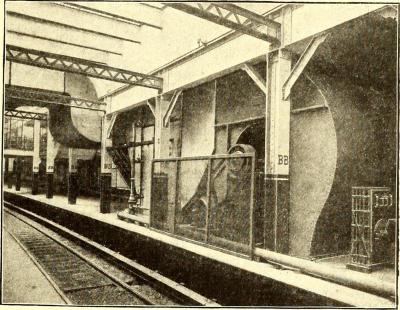
Now, typically, when a building gets too hot, we look at using air conditioning to bring temperatures down. However, the unique nature of subways makes this very difficult to execute. Subways have miles upon miles of tunnels that are open to the platforms, so an air conditioning system would just be pumping cold air off into these deep voids to little local effect. Subways are also full of open entrances which don’t help, either. As much as you could try and locally cool areas of the subway, even a bunch of large HVAC units would barely make a dent.
In New York, though, the problem has gotten to the point that the city and state have decided to act. The plan is to study the application of a Thermal Energy Network (TEN) to the subway, which will take place as part of upgrades being made to the Brooklyn Bridge 4/5/6 and Chambers Street J/Z station complex. Notably, Brooklyn Bridge 4/5/6 regularly hits temperatures of 96 °F (35 °C) during the summer months, giving it the unenviable title of one of the hottest stations in the subway network. This makes it a prime candidate for any sort of heat mitigation effort.
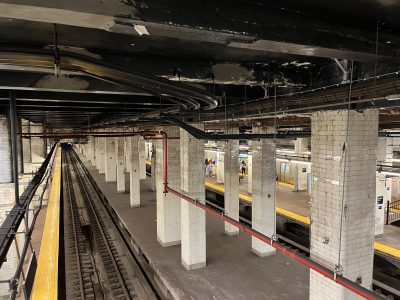
A thermal energy network (TEN) is designed to move heat between buildings, taking it from where it isn’t wanted and moving it to somewhere it can be more useful. It involves drilling grids of boreholes hundreds of feet deep into the ground, where temperatures stay much cooler and more stable—as low as 55 °F (12 °C). Pipes are then installed around the subway station that run into those boreholes. Circulate fluid through the station pipes, and the fluid picks up heat from the subway station. That fluid is then run into the boreholes, where it gives up its heat and is chilled, and then the fluid is recirculated to the station to continue the cycle.
Over time, the bedrock around the boreholes heats up, and it can then be used as a sort of thermal battery in winter. Fluid can then be circulated into the boreholes to heat it up, and then that fluid can be pumped to other municipal buildings that need heat in the cooler months.
The technology isn’t new—geothermal boreholes have been used for some time across Europe and Canada as a way to achieve cooling. There’s even a system in Coney Island, where 153 geothermal wells are used to provide comfort for a condo built in 2019. Still, implementing a system big enough to bring down the excessively high temperatures in New York’s subway system could yet prove a challenge. For now, the project is a study to explore whether such a concept could make a meaningful difference to user comfort in the station. If it proves workable, though, expect there to be huge demand from commuters to roll out similar systems across other stations in New York and beyond. The sweaty subway could yet be a thing of the past, merely requiring the engineering and will to do so.
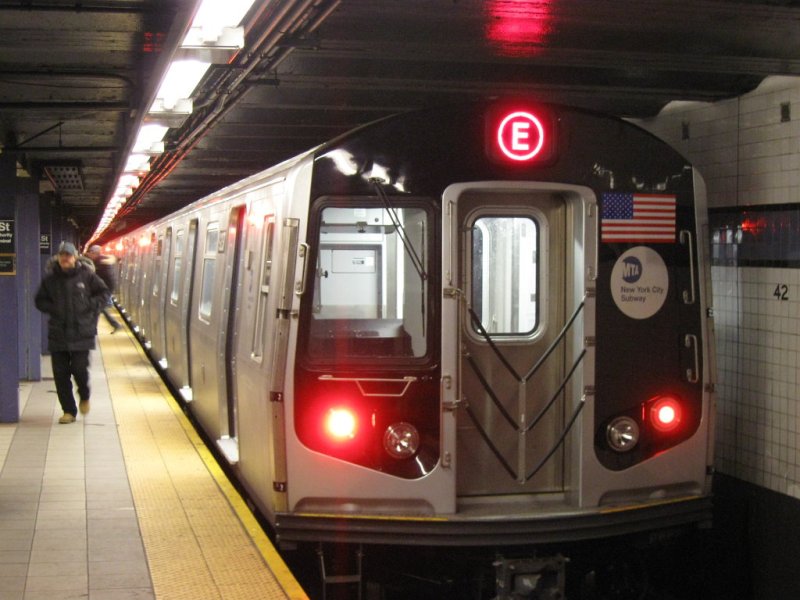
Featured image: “NYC Subway R160A 9237 on the E” by [Adam E. Moreira].












“In New York, though, the problem has gotten to the point that the city and state have decided to act.”
This, translated to normal human language means that it got so bad that the municipality and the state can’t delay the solution no more, or elections are coming.
On the Elizabeth Line, we had massive fans to push the train from behind and also create a low pressure in front. This was controlled with massive vents and fans which helped evacuate the heat.
So there is one tube per direction ? And what happens at the stations ? it goes circular ?
Cue the reference to NYC’s experimental Beach line back in the day. “What if we scaled up that pneumatic tube thing at the bank and put people in it?”
Former NYC resident.
This is hilarious.
Never going to happen.
And this is not a conservative “all public works are bad” … this is someone who lived in NYC for 20 years.
Just a few points about the current state of NYC’s subway: (1) there are approximately 100 track fires per day, (2) the infrastructure is ancient, there are still manual signals everywhere, they still rely on OS/2, the pumps are shot, (3) the 2nd avenue extension recently cost $4 BILLION PER MILE.
This is literally a boondoggle that will never ever ever happen.
Recently saw a video on this on YT. Got the impressions most of those “fires” happen because many NYCers thrown their trash on the tracks.
Does this impression fit your information/experience/observations?
No idea. Smoking isn’t permitted in the stations so I don’t know how much open flame there is. I’ve never heard about people starting subway fires for fun — NYC cops are not known for their indulgence of youthful hijinks.
On the other hand, the cars spark like crazy both from the third rail and the steel wheels and there’s trash everywhere — I’ve always assumed it’s a combination of sparks, trash and lack of fire suppression.
I should’ve been more specific because the video implied exactly that: trash + sparks = fire
Not people starting fires or any relation to smoking.
Third rail = power source? Guess many regret that design decision.
This is just a personal anecdote, but on the G train I once saw a nest of charred rats down on the track. They were curled up in a massive pile of discarded hypodermic needles.
RIP pizza rat and family.
Lived in NYC for quite a few years. People absolutely throw trash on the tracks, plus the train causes air to whip through the stations, and stuff gets sucked down on to the tracks. Add the arc flash – remember the trains use a 3rd rail, so the fun arc flashes are like 8 inches off the ground tops. And people just throw trash on the ground. I seen a dude just pull the batteries out of his Walkman and chuck them down. Lots of cities are like that, it’s not just NYC, it’s not just America.
Good damn. I lived ~7 years in the “non-existing city” with a relatively small combined subway / streetcar system (only four lines, overhead line – no third rail), made heavy use of its public transportation for >10 years and don’t remember seeing any significant/noteable amount of trash on the tracks.
No idea how different our cultures are exactly (on trash etc.) but it seems excessive anyway.
Our public services aren’t perfect (trash man, street sweepers?) and we the citizens aren’t either. I get the impression its getting worse too – not just individual people throwing personal trash on the ground but illegal dumping in woods and wherever.
It still seems ridiculous that NYC has 100rds of fires in the subway and NYCers still keep throwing their trash on the tracks…
You awnsered your own question. I don’t think you understand the scale of NYC. When you put that many millions of people in the same place you end up with statistics like 100 fires a day. I believe that commenter. That person from NYC is probably like me as a Chicagoan and we get sick of people bashing our hometowns. A lot like how I get pissed when people think we have a lot of murders here when per capita we do not. There are towns in friggin iowa you are more likely to be killed. It’s the numbers. It’s millions of people. Scaled down to whatever size your city is it would likely have similar numbers. There are tons of factors at play and always outliers though.
I can’t find any statistics for hundreds of fires per day, more like hundreds per year. About 2-3 across the entire network per day.
there are about 1000 track fires per year and nothing is running OS/2. thanks for playing, bud.
They may not do that much overall, but a few well-placed AC units can have a pretty significant local impact. The 4/5/6 platforms under Grand Central have cooling units mounted overhead. Standing under one of those provides an oasis of comfort rarely experienced while waiting to catch a train.
There have also been plans floated to enclose subway platforms by walling off the trackside edges. Automatic doors in the wall would open in tandem with the train doors, only when a train is in the station. (Basically like an elevator shaft, but horizontal.) Which is a big project, sure, but not nearly on the scale of geothermal cooling. And it could be done on a station-by-station basis as needed / funded. The cost to enclose any one platform wouldn’t be that high, it’s only when you multiply that by the total number of (underground) platforms in the system that you start getting into defense-budget territory.
That’s probably “central heating line” in London, because in the U.K. we call heating for a whole house (radiators, etc) “central heating”, Not “central heat”.
London tubes have managed to a certain extent by being big pistons to push hot/stale air out and pull cool/fresh air in, but now we’re getting days where the surface temperature is too high for this to solve it.
Except that Manhattan floats on a pile of schist, gneiss, and marble. Drilling through that lot is difficult in the extreme, particularly if you think it’s just going to become a thermal battery (lots of volume & area required). Manhattan’s central steam system has been powering building cooling for decades via turbines or absorption chillers so chilling parts of the rail system would be another layer.
Remember, “The plan is to study the application of a Thermal Energy Network (TEN) to the subway…” We should see meaningful action on this around 2050.
Couldn’t heat pumps on a moving subway car pump heat into a phase change material (like a modern version of Rochelle salt) and then take that heat to a place where it can be used? Maybe that’s silly as far as moving a mass in a car, but would think that all that waste heat should be able to be moved/pumped somewhere where it is “useful heat” to do work. Steam maybe?
It feels like this is a problem that has built up over decades. Heat is introduced into the environment of the station by trains, bodies, power use, etc. Now the idea is to pump that heat elsewhere, but I wonder if there will come a time where the destination will reach equilibrium, and the whole problem will resurface?
There is mention of using the displaced energy for heating in cooler months, but if that would balance out, surely that effect would be visible already, and the gradual increase in baseline temperature would not have happened? The only thing that would make sense would be to divert that stored summer heat to heating colder buildings on the surface, perhaps 🤔
ISTR in the London Underground that the oldest tunnels were built for steam trains and are therefore actually well ventilated. It’s the younger ones built for the electric trains before anyone considered the ventilation issue which are the smallest tunnels and now becoming a problem.
At some point, the subway in Buenos Aires had vents to the streets and the stations where kind of cool. With time, vents got paved over and the heat problem got worse. I remember, line D being always hot. Line A being kind of ok.
There are certainly problems but the rivers aren’t far from anywhere in Manhattan. Why not circulate water directly or at least use them as heat sinks? 80°F water in summer is not close to 55 but it could carry a lot of heat away easier. Cool the hottest spots (might not be the stations and everything will drop a bit.
Ignorance from me perhaps; maybe that’s already done as it seems too simple.
There are fish in water that would clog and damage water pumps requiring constant mantenace like in power plants. If you want to save money, it’s better to use air cooling as it’s available everywhere.
My 2023 Chevy Bolt has regenerative braking in addition to traditional brakes. If the train cars were individually powered and braked some of the heat generated could be stored and reused to power the cars.
I should reword this. Some of the energy used to stop can be used to regenerate electricity to brake the cars instead of using mechanical brakes that create heat. Reducing the amount of heat generated would help.