

We’ve yet to find any definitive evidence that there’s biological life on present-day Mars, but to say it’s a dead planet isn’t exactly accurate. Since the first Viking lander touched down in 1976, a revolving cast of humanity’s robotic envoys have worked on and around the Red Planet — and as access to space becomes cheaper and more routine, the mechatronic population of Mars will continue to grow.
Given the number of landers, rovers, and orbiting spacecraft that have been sent to study Mars over the last 50 years, you might be surprised to find that the communications systems in place to transmit all that critical scientific data back to Earth aren’t nearly as robust as you’d think. While it’s understandable that the first craft to arrive at Mars had to operate in isolation, even the flagship Perseverance and Curiosity rovers carry their own high-gain radio systems so they can communicate directly with Earth. Given the incredible premium put on the mass of an interplanetary craft, each mission that needs to bring along its own link back to Earth effectively reduces its payload of much scientific equipment.
It’s not that satellites in orbit around the planet aren’t used to relay signals between Martian ground assets and their controllers back on Earth. In fact these relay links are used extensively for bandwidth-intensive tasks such as image transfers. But it’s also true that the craft currently available to act as intermediaries between the two planets aren’t terribly well suited to the task. The current fleet of Mars orbiters were conceived primary as research vehicles, and so every decision regarding their design and positioning around the planet was made with that goal in mind. What relatively limited capability they do have as communication relays is further hindered by the age of their hardware.
But after decades of false starts and shifting budgets, NASA is closer than ever to finally establishing the Mars Telecommunications Network, a dedicated high-bandwidth communication relay that will ensure current and future missions always have a way to phone home.
The Fragile Mars Relay Network
Mars Odyssey, Mars Express, the ExoMars Trace Gas Orbiter, and the Mars Reconnaissance Orbiter currently make up what’s known as the Mars Relay Network (MRN). The Mars Atmosphere and Volatile Evolution (MAVEN) spacecraft was also part of the MRN, but communication was lost with the vehicle in December of 2025 and as of this summer NASA officially declared the mission over.
The MRN has been absolutely invaluable for many high profile missions, and there’s an excellent chance nearly every picture you’ve ever seen of the Martian surface was at one point routed through it on its way back to Earth. But for the spacecraft that comprise the MRN, shuttling bits across the black is more of a part-time job. Their individual primary missions are scientific in nature, and it shows.
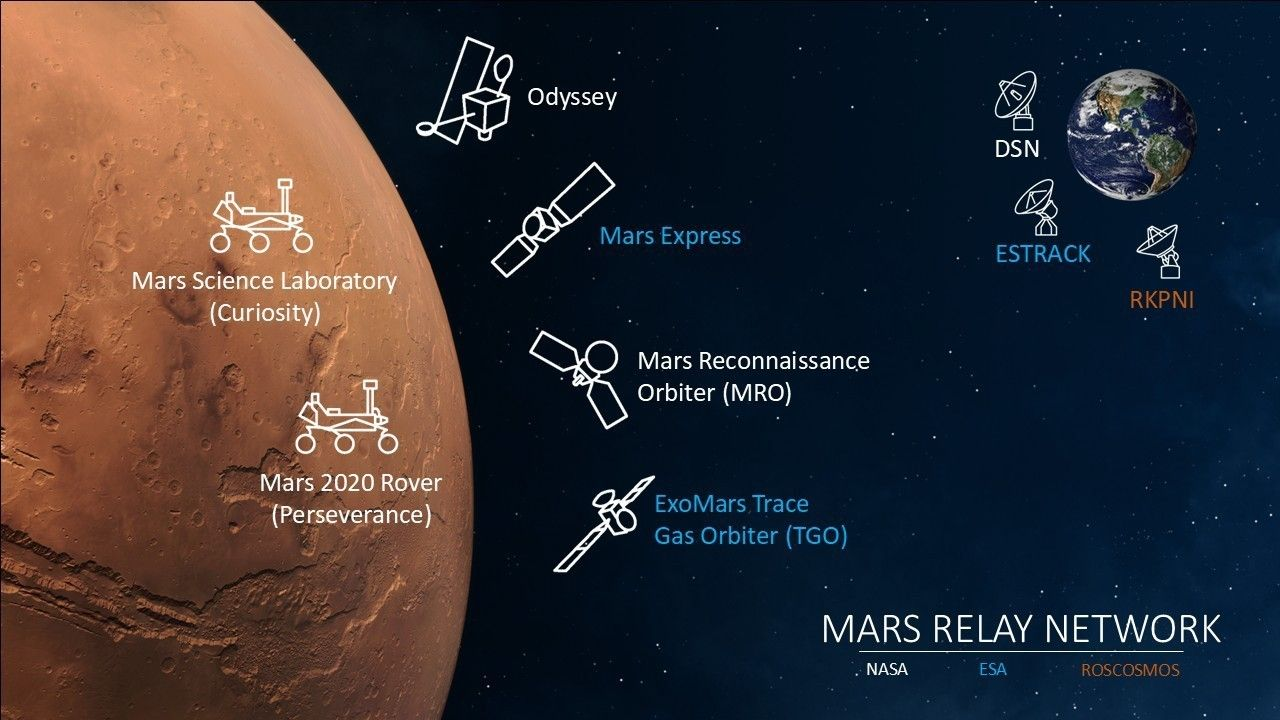
Consider the Mars Express. Launched by the European Space Agency in 2003, it’s primary mission goals included releasing a small rover, analyzing the Martian atmosphere, and studying the planet’s closest moon, Phobos. To accomplish these tasks and to reduce the amount of propellant needed, the ESA put Mars Express into a highly elliptical orbit that sees the spacecraft swoop down to within 300 kilometers (185 miles) of the surface before heading back out to a distance of 10,000 km (6200 miles). Unfortunately, the rotation of Mars in combination with this exaggerated orbit means that rovers on the surface can’t maintain a consistent link to the vehicle, and as such its usefulness as a communications relay is limited to relatively narrow windows.
But in 2026, the real problem with the MRN is how old its constituent members are. MAVEN had already been flying for 12 years when it went offline, but that’s nothing compared to its peers. Mars Express has been on the job for 23 years, while Mars Odyssey has been in orbit for an incredible 25 years. Even the baby of the group, ESA’s ExoMars Trace Gas Orbiter, was launched over a decade ago.
Those are very impressive durations for missions of this type, so much so that Mars Express and Mars Odyssey are the two oldest operational spacecraft in orbit around a planet other than Earth. While their continued operation is a testament to the engineering that went into them, the Mars Relay Network has more than earned its retirement.
An Overdue Upgrade
Given their age, it’s not as if there’s any disagreement about whether or not the spacecraft of the MRN are due for a replacement. Similarly, few would deny the operational benefit of a dedicated communications relay in orbit over Mars. Unsurprisingly, discussions on both points have been going on since the early 2000s.
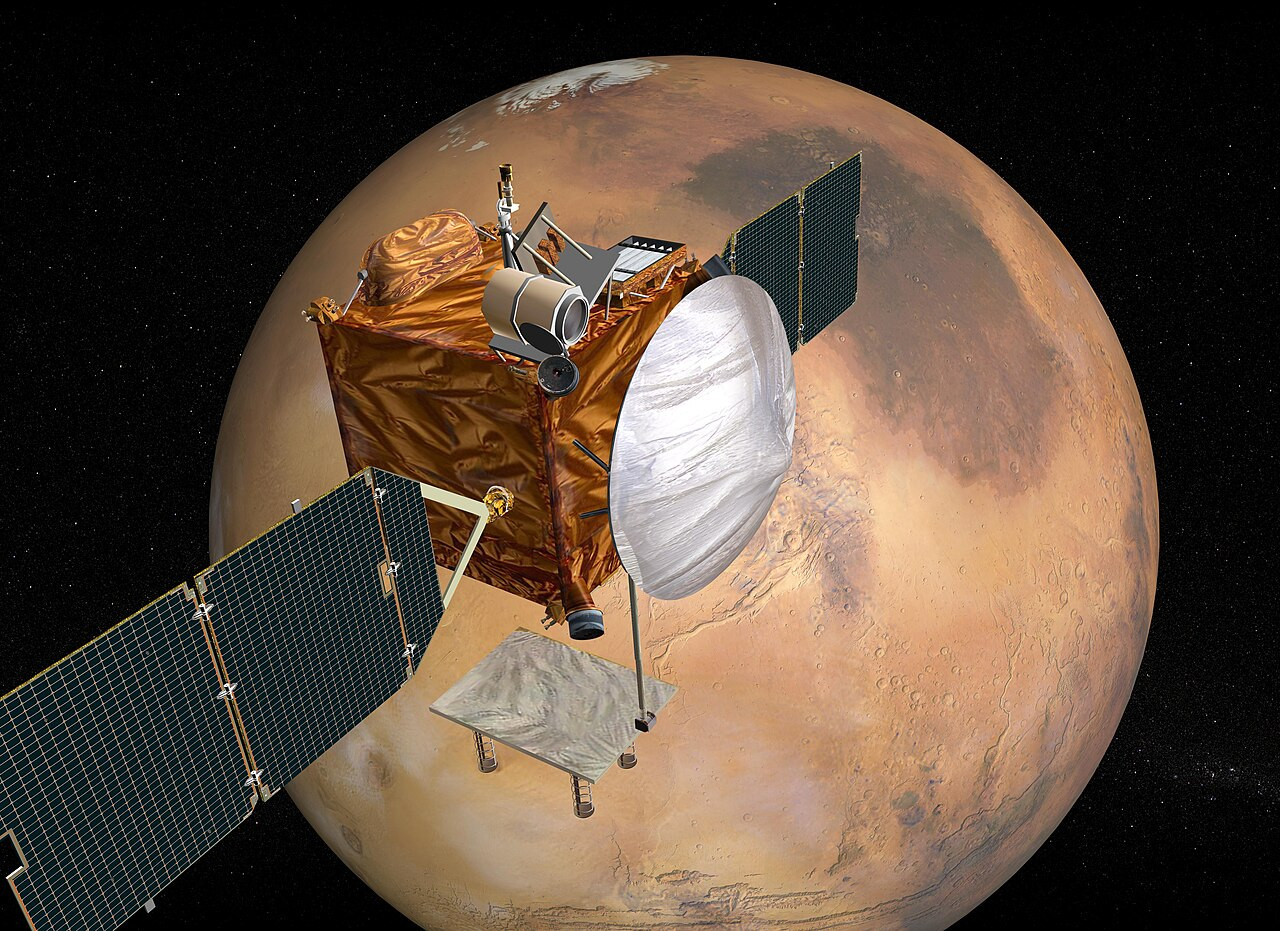
NASA’s original plan for what they called the Mars Telecommunications Orbiter (MTO) would have put the spacecraft in orbit around the Red Planet back in 2010. The design concept for the vehicle called for two X-band transmitters and two Ka-band radios, in addition to an experimental laser communication system that could return data to Earth at an unprecedented rate.
Unfortunately, the MTO concept was cancelled just a few years after its inception as NASA needed to allocate the money towards other missions such as the final servicing mission for Hubble and the then in development Mars Science Laboratory (MSL) mission which would go on to deliver Curiosity to the surface in 2012.
The general idea has been floating around ever since, being reintroduced in budget discussions every few years. Each proposal has failed to gain the necessary support, in part due to the vague nature of the mission. Usually when NASA or the ESA spends hundreds of millions of dollars to send a spacecraft to Mars, it has a long list of science objectives to justify the price tag. But a communications relay that carries few if any secondary science payloads is a harder sell.
Sample Return Consolation Prize
Given all the false starts the project has had over the last two decades, it’s somewhat ironic that the only reason the space agency is able to allocate significant funds for the mission now is because of the collapse of the Mars Sample Return (MSR) initiative. A budget reconciliation package passed by Congress in July of 2025 allocated $700 million to revive the Mars Telecommunications Orbiter program, but stipulated it had to be built by one of the commercial companies that had contributed towards the MSR mission, and that it should be ready to launch by 2028.
In May of this year NASA put out a request for proposals to build what it was now calling the Mars Telecommunications Orbiter (MTN), and earlier this month they awarded Blue Origin with a fixed-price contract to develop, build, launch, and operate the spacecraft.
As with previous incarnations of the MTO, Blue Origin’s spacecraft will provide a high-bandwidth link back to Earth which can be utilized by multiple current and future Mars missions. The vehicle itself will feature a number of ports which can mount scientific instruments, deployable sub-relays, or potentially even a lander. Technically the contract only requires that the orbiter be capable of carrying a 20 kilogram science payload, but presumably Blue Origin has expanded on that idea so they can offer Martian “rideshare” opportunities for other companies while still achieving NASA’s stated design requirements.
Given how quickly all of this is coming together, there’s still not a lot of public information on Blue Origin’s spacecraft. But we can glean a few interesting technical details from NASA’s original proposal request, such as the requirement that the relay must offer at least one terabyte of non-volatile store-and-forward capability, and should be able to achieve a 150 Mbps link from Mars to Earth.
Interestingly, despite the impressive demonstration of the Artemis II Optical Communications System (O2O) earlier this year, NASA specifically noted that support for optical communication was not a requirement of the Mars Telecommunications Network contract — though it would consider the feature a bonus should it be included.
Not Everyone is Happy
With the funds guaranteed by federal mandate and a contractor already building hardware, it seems like the Mars Telecommunications Orbiter is now closer to reality than ever before. But of course, nothing is ever truly guaranteed when it comes to space. Production runs into snags, bugs are discovered in software, and occasionally rockets explode on the launchpad. In addition to this general uncertainty, the revived Mars Telecommunications Orbiter will also have to contend with politics.
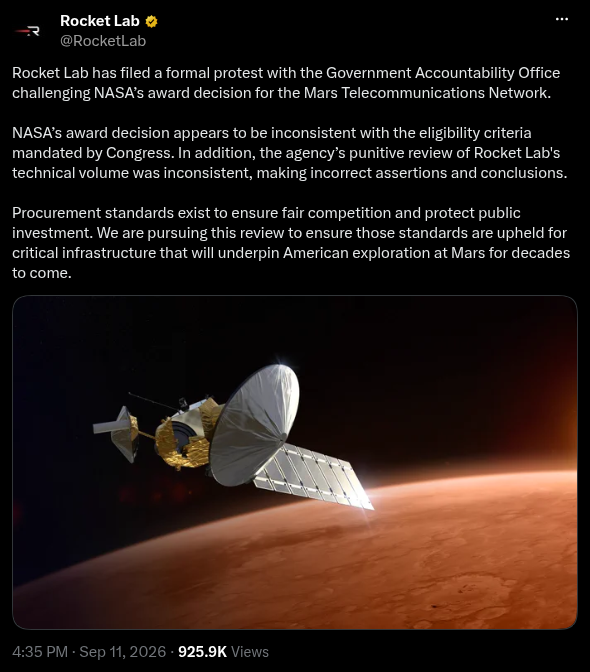 Since the announcement that Blue Origin was selected for the MTN contract, Rocket Lab filed a formal protest with the Government Accountability Office. They claim that design presented by Blue Origin is “inconsistent with the eligibility criteria mandated by Congress” and that NASA made incorrect assertions about RocketLab’s own proposal.
Because Rocket Lab is protesting the decision, both NASA and Blue Origin must legally stop all work on the MTN project until the Government Accountability Office can review the selection process and make their determination. This process can last up to 100 days, meaning there might not be a ruling until the end of the year.
Under normal circumstances this might simply be a bureaucratic annoyance, but when it comes to a mission that needs to leave Earth during the periodic Mars launch windows that only come around every 26 months, a lengthy delay could ultimately push the project into the next decade.












meanwhile a starship full of souped up starlinks heads to mars.
Using lawfare to force us to miss a valuable launch window sounds like a great way to get taken out of consideration for contracts
As opposed to not filing a complaint and getting taken out of consideration for contracts because Blue Origin and SpaceX have enough lobbying to push NASA to ignore government procurement standards?
Filing complaints and using lawfare is, unfortunately, standard operating procedure.
SpaceX nearly derailed the Lucy mission (launched on ULA) which had a literal once-in-a-lifetime launch window by filing not one but two complaints on the same contract. Fortunately, they backed down at the last minute, and one can imagine that there was sincere pressure from the gov’t to do so, but that was just the earliest and most memorable.
They are all in court more than they are in space.
This is pretty much a natural consequence of how effed the grant/contract/etc. process is with the US now, sadly. All the timescales are aggressively short and the goals and targets for the review process sometimes change after the submission (not like… publicly, but when you read the reviews and look at the selections it’s obvious).
The laws are there to prevent government corruption and, well, uh, looks at current government. Yeah.
And unless I’m missing something, Rocket Lab currently doesn’t even have a suitable launch vehicle. Their Neutron vehicle is delayed and unproven, and has a payload capacity of 13,000 kg. The article says the requirement is 20k kg. Wha?
I’m all for the pursuit of knowledge, however…. what exactly is the point of this? Taking pictures of a bunch of dust on some planet we don’t even live on is already a big waste of time and money, but paying money to get a higher bandwidth just so the kids at NASA can make memes about those pictures faster is totally pointless. This money would be better spent on our planet! Or better yet, my already wealthy neighborhood! What exactly does this bring to the table in terms of “scientific advancement”? Tired of NASA LYINGTISTS justifying thir job with nonsense science.
(Do you guys like my hackaday science article commentator impression?)
Fortunately, I read to the end of your missive before reaching for my mouse. As I get older, it may be that my flame reflex is the first thing to go.
He would have had a point though, I think it’s obvious people will not go to Mars since it’s a pointless suicide mission, so that leaves normal planetary science, and that is interesting but can be done modestly and a dedicated relay system would be something for doing very intensive research with a lot of missions to make use of it to justify the cost and effort, and I don’t quite see that as a thing.
Of course if the people deciding to invest in that relay also want to invest in a hundred missions to Mars I guess it would make sense, but that’s a lot of money.
And it’s always possible that at some point the world will realize that the US just printing make-believe money isn’t quite so realistic and fair. Although (dissapointingly) so far there is no indication that they won’t continue to prop up US nonsense. Although, countries are moving their gold reserves out of the US, perhaps we could make ourselves believe that’s a sign.
I know it’s an old story, but some people thought same about Kolumbus’ undertaking to find a new route to India.
They found it suicidal, too to take a new route that could lead them to fall off the edge of the earth. Or something like that. :)
Seriously, though. Mars is closest friendly planet there is
and finding a new home for humanity is fundamental for human survival, it can’t remain forever in the cradle.
If humanity stays on a single celestial body only it won’t last much longer.
– An idea which some of the readers here seem to rejoice.
Those people in Columbus’s time were ignorant about the world, we have enough scientific knowledge from previous probes on Mars about Mars to determine basics.
As for human survival needing a new planet (if that is so damn important to you) then I think we can relagate efforts towards that to a few hundred years in the future where it might perhaps have a viable chance to work in any way.
Personally I don’t think huamnity has evolved to any point, nor is there any indication that it will, where one would want to ensure its survival so far.
By the time of Columbus, most seafarers already believed the Earth was spherical. Columbus could not find any crew members in his homeland because he believed the Earth was significantly smaller than other sailors did, and there were no ships capable of making the long voyage to India without a stopover.
I want a little desk wedge with my name and “Senior Lyingtist” engraved in bronze to display to visitors
Better spend the money to bomb foreign children, right?
Even if the US economy derails entirely, the relay network will be usable to humanity even in 50 years, if they’re well designed.
If they are to grow up into religious zealots and commit acts of terror in our countries – yes. Bombing them might be the most humane solution.
Bombing them is the surest way to ensure the survivors grow up into religious zealots that commit acts of terror against those responsible. Not bombing them, and instead helping them, is the surest way to ensure they won’t.
Absolutely right. Education and respect make friends, not weapons.
Great article :-)
Supernatural creatures such as gremlins or goblins are usually to blame
If so, they are apparently hypersensitive to any reference to the first sentence of the article, having so far deleted four comments about it with no explanation provided.
Spending decades discussing implementing fixes and replacing outdated equipment but not actually doing anything? Holy crap! The managers and engineers at my place of employment are actually rocket scientists! Mind. Blown.