
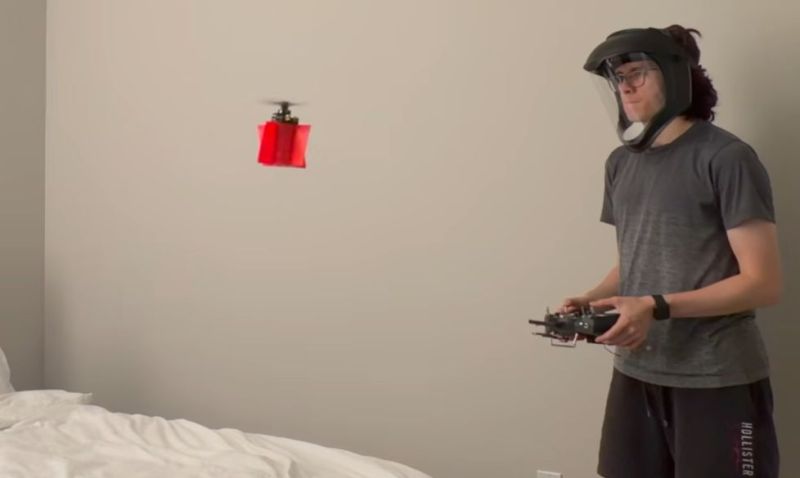
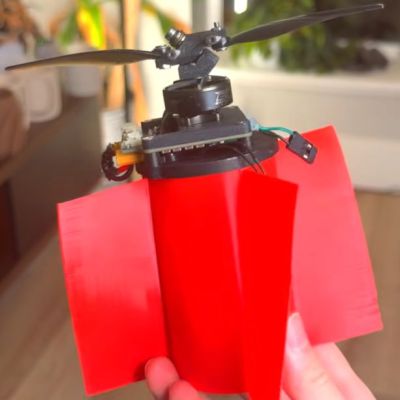
 Technically all that you need in order to make a drone fly is a single motor and single propeller, but realistically it becomes basically impossible to fly it at that point. In the case of helicopters you therefore need a second rotor somewhere to provide counterbalance to the first and to be able to steer.
There are of course a number of ways to make a drone fly with a single propeller, but the compromise usually is to use very large propellers, as well as other mechanisms that make for a very large drone. This wasn’t good enough for [Joshua Bird] who wanted to have a very small, single propeller drone.
Key to making it work is not only a very high RPM, but also a hinged propeller hub that manipulates the angle of the blades in such a way that both pitch and roll can be controlled if you react quickly enough. This turned out to be impossible using standard motor ESCs that do not directly measure the motor’s speed and position but rely on back EMF.
In the final prototype of the drone such details had to be measured directly, with super-fast adjustments to the motor’s speed only possible with custom controller code and a lot of trial and error. Even then the drone would often lose track of its position and crash once more. The solution there was to add an infrared beacon in the room and a sensor on the drone, to give it a fixed reference point.
You can find the project files so far on the GitHub project page, with upcoming changes to the drone design involving improvements like adding a scanner to the drone so that it can autonomously use features in its environment as fixed reference points. That way it might conceivably be able to fly outside as well, which would be quite exciting to see.












How far does the magnetometer need to be from the motor to avoid interference? Maybe you can mount it at the bottom of the big anti-spin vanes.
Now to carefully counterbalance and make one with a single blade.
There is only one practical use I see – for this type of drone – but it is not nice.
i suppose the ethics of drone warfare depend on offense vs defense. it must be a burden on the inventor to know such things will take lives.
I’d say: It’s on the user.
A hammer can be used to build stuff or take lives.
Such a drone could be used for aerial photography or deliver a payload (explosives, drugs, medical supplies etc.)
Personally, when I invent/develop stuff, I don’t care what, it’s being used for.
Not nice? The one reason you’d make a propeller setup like this is for the engineering challenge. It’s not going to be more efficient than 2-4 motors + regular props.
And the constraint of having it fly in a room with an IR lighthouse?
This is a great, fun, project. Please don’t bring the rest of the problems in the world into it. It is not asking for them.