
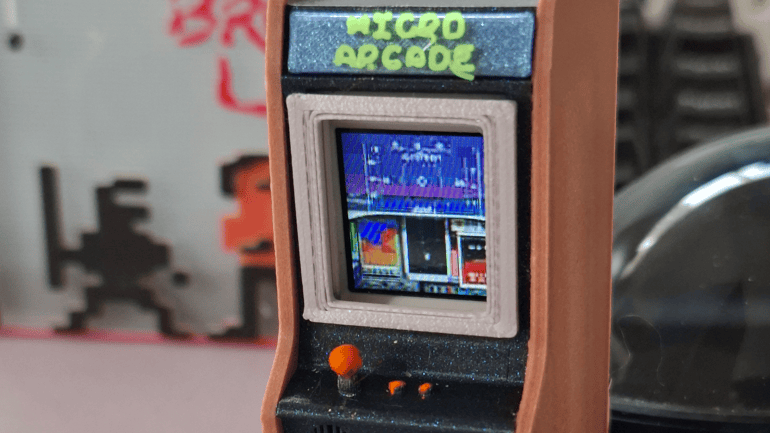
Classic DOS games never ran from within stand-up arcade cabinets in dollhouses, but [Juha Lilja] imagines a world in which they did. His Micro DOS arcade cabinet is described as a device that “runs nothing” because the tiny unit is actually streaming the games over Wi-Fi from a nearby PC. That doesn’t mean it’s just a glorified movie player, though — the cabinet is playable, if a bit awkward to do so.
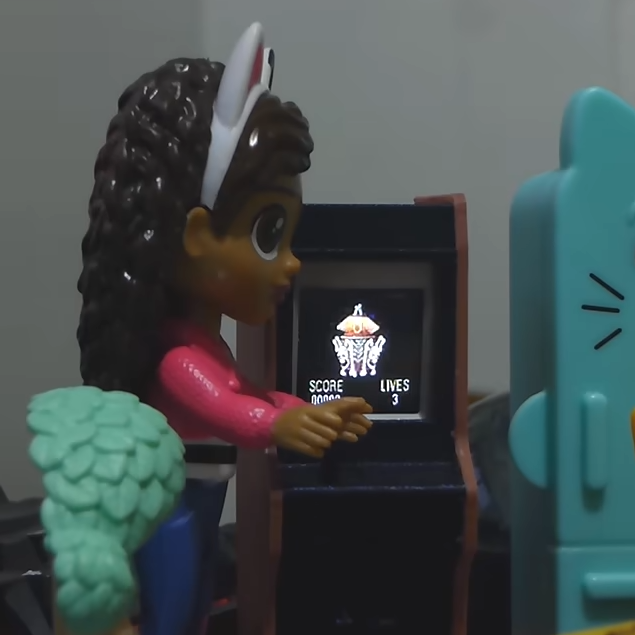
The core of the micro arcade cabinet is a M5Stack AtomS3R running as an embedded remote terminal. One tilts the whole cabinet as if it were a virtual joystick to send up, down, left, and right. Button presses are done by pushing on the physical screen; it supports single, double, and long-clicks. While in theory one could install a micro joystick and buttons instead, [Juha] aimed to keep everything self-contained and use only what was already built into the AtomS3R. In this case, that’s a motion sensor and the single button which is activated by pressing the screen.
The games themselves run on a PC, with screen contents being streamed wirelessly to the little display and inputs being sent back. The firmware on the AtomS3R doesn’t know or care what game is being played; all it does is display what it’s told, and send back input events. The back end does the rest. This makes it pretty flexible, and a tiny arcade cabinet is a handy way to demonstrate the whole system. It’s a pretty slick addition to his daughter’s dollhouse, too.
If streaming DOS games (or whatever else) to economical endpoints is giving you some ideas, the GitHub repository holds code and a fuller explanation of how it works. There’s a deeper discussion on some of the finer technical points, as well. Watch it in action in the video embedded just below the page break.













Kids with tech dads always have jealous friends! Back in the day I built my kids a proper LAN party setup so multiple friends could get in on the action. Lots of Diablo II and HL2 Deathmatch was played in the dining room. It’s such a good feeling to be able to do stuff like that for the kids so they can have a good time!
My dad was born in the 40s that tech didn’t exist in his day and I was born in the 70s. But Tech or not, I’d trade it all to go back to the 80s and 90s.
Hi, I’m younger than you but I think I can relate to this.
It’s not exactly the technology but what you make of it.
For example, being stuck in CP/M era instead of the modern DOS days wouldn’t have been that bad.
In the 70s, there already were EPROMs, diode matrixes, microcontrollers, video character generatos and 8″ floppy drives.
So it was possible to make our dreams come true, albeit things being more modest.
For example, gaming or chatting via serial cables and acoustic couplers was possible.
Two simple data terminals (serial glass terminals) were enough; they were common because of their use in mainframes.
Playing text-adventures or chess thus was possible by 1976 already.
The 8″ floppy held enough information and a CP/M style OS for microcomputer was good enough.
By late 70s, there even was MP/M, the power user version of CP/M!
Sure, expensive, but what are friends and backup copies are for!? ;)
But even by 1940s standard a lot was possible already using logic circuits.
Incandescent lamps, wires, switches, condensers and relays were sufficient.
The telegraph and telephone technology, basically.
A two player tic-tac-toe (oxo) game was possible using incandescent lamps, I do imagine.
Each side then had a tic-tac-toe display and a rotary dial (10 values, 0 to 9).
Via the rotary dial could be used to input the Os or Xes.
(Both displays are wired in parallel, showing same thing)
By using those pulses and storing bits using flip-flops (relays, some are wired for self-holding) it could be implemented somehow.
The 3×3 grid could be seen as a continous line in which the bits are flipped.
So the line would be reset first, then re-drawn each time (if a serial connection was used).
Flip-flops could save the state of each incandescent lamp (each field).
Using capacitors for a delay could help to address each field somehow.
For example, a long pulse could fully charges a capacitor that does power a relay that does a reset (power off to all self-holding relays).
It would help building a timer circuit, basically. A watchdog kind of circuit.
Alternatively, a ten wire cable could be used to attach to the displays.
9 for the each incandescent lamp, one remaining wire for ground.
If we use a floating 0v, for example.
Alternatively, we could have a second cable for 9 ground connections (each one per field/lamp).
By using reverse polarity (1, 0, -1) we would have three states (X, blank, O).
Diodes could help to select one of the two incandescent lamps per field.
Say, a red and yellow one to represent X and O.
If no voltage was applied, the incandescent lamps would be both unlit.
Okay, I admit that’s pretty vuage. It merely was an example, also.
Oh, look, another “I had Claude do this for me” project.
https://tinycircuits.com/products/tinyarcade?variant=39433606922324 is a little bigger