
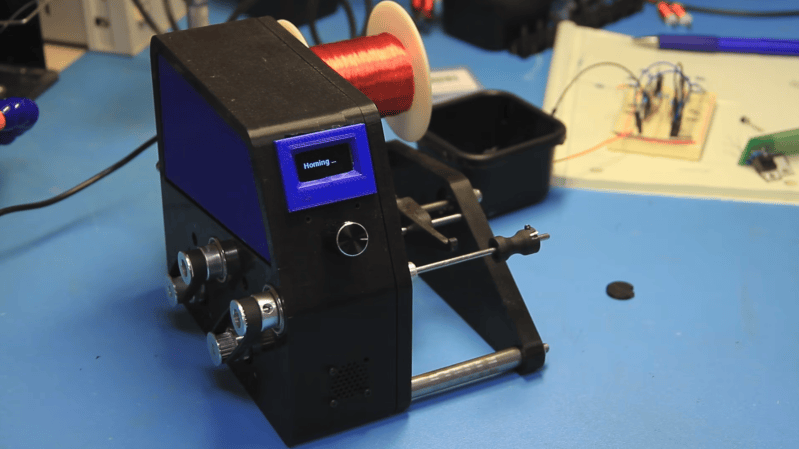
Anyone who’s ever built their own motors knows how tedious winding the coils soon becomes; in [Larry]’s case, the issue was even worse. He’s building his own flip-dot matrix display, and each dot uses two electromagnetic coils to flip a magnet in the dot. Rather than wind each of these by hand, therefore, he built his own coil-winding machine.
The coil winder uses two stepper motors: one to wind wire onto the bobbin, and one to move the wire guide carriage back and forth, distributing the wire evenly across the bobbin. The bobbin is held in place by a retainer, which doubles as a tie point for the end of the wire. The spool of wire rotates on a pair of bearings, and the wire is fed between two pieces of foam to provide adjustable tension. The housing is mostly 3D-printed, with some metal rods, bearings, and belt drives fleshing out the structure. On the electronics side, a Teensy controls the winder, with an OLED display and a rotary encoder for control. Before beginning on a coil, it homes the guide carriage against an end-stop switch, then winds on layers, keeping track of the number of layers applied.
We’ve seen a few coil winders here in the past, including a 3D printer adapted to winding stators. For more on this winder’s application, check out [Larry]’s flip-dot design.












How do the rest of you, who do no own similar winding machines get your custom inductors, motors and transformers?
I for example simply put off the manual hand winding until I no longer wish to continue the project.
Hamster wheel
It may be possible to reporpuse a level wind from a fishing reel to perform this task. By changing the gear ratio would compensate wire size. Hand crank or motorize it.
I like these sorts of projects, I did one similar when I had a contract that involved a lot of wiring – I built a machine that would spool out and cut a specified number of wires at a specified length. Then I’d just load the color and push the button. It had presets for different wire diameters. I think it might have even stripped one end.
Of course the math of just cutting the wires myself vs. building the machine didn’t quite work out but I figured I’d use it again which, so far, I haven’t but it was a great project and it’s still on the shelf.