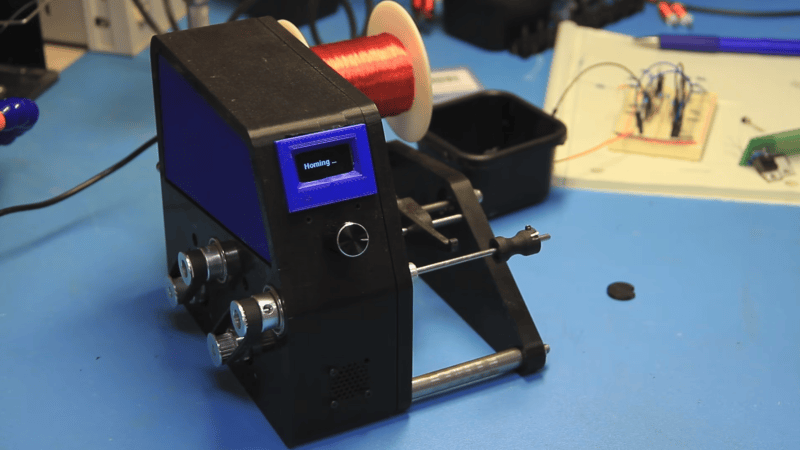
A black 3D printed machine sits on a workbench. A coil of copper wire is suspended from one side of it, and a screen on the front of it reads "Homing".

Automatic Coil Winder Takes The Tedium Out Of Actuators

Anyone who’s ever built their own motors knows how tedious winding the coils soon becomes; in [Larry]’s case, the issue was even worse. He’s building his own flip-dot matrix display, and each dot uses two electromagnetic coils to flip a magnet in the dot. Rather than wind each of these by hand, therefore, he built his own coil-winding machine.

The coil winder uses two stepper motors: one to wind wire onto the bobbin, and one to move the wire guide carriage back and forth, distributing the wire evenly across the bobbin. The bobbin is held in place by a retainer, which doubles as a tie point for the end of the wire. The spool of wire rotates on a pair of bearings, and the wire is fed between two pieces of foam to provide adjustable tension. The housing is mostly 3D-printed, with some metal rods, bearings, and belt drives fleshing out the structure. On the electronics side, a Teensy controls the winder, with an OLED display and a rotary encoder for control. Before beginning on a coil, it homes the guide carriage against an end-stop switch, then winds on layers, keeping track of the number of layers applied.

We’ve seen a few coil winders here in the past, including a 3D printer adapted to winding stators. For more on this winder’s application, check out [Larry]’s flip-dot design.
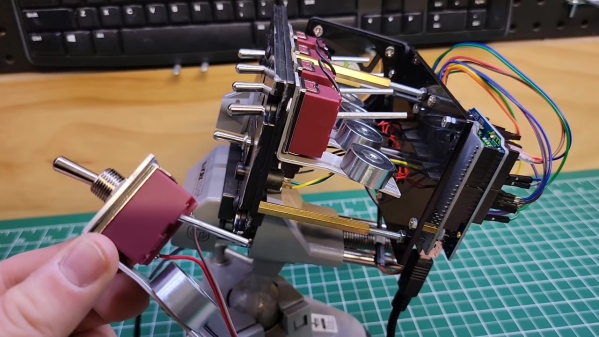

magnetic toggle swtches

Modified Toggle Switches Grace Hyper-Detailed Cockpit Simulator Panels

In the world of the cockpit simulator hobby, no detail is too small to obsess over. Getting the look and feel of each and every cockpit control just right is important, and often means shelling out for cockpit-accurate parts. But not always, as these DIY magnetically captured toggle switches show.

Chances are good you’ve seen [The Warthog Project]’s fantastically detailed A-10 Thunderbolt II cockpit simulator before; we’ve featured it recently, and videos from the ongoing build pop up regularly in our feeds. The sim addresses the tiniest of details, including the use of special toggle switches that lock into place automatically using electromagnets. They’re commercially available, but only for those with very deep pockets — depending on the supplier, up to several thousand dollars per unit!

The homebrew substitute is mercifully cheap and easy to build, though — a momentary DPST toggle switch is partially gutted, with a length of nail substituted for one of its poles. The nail sticks out of the back of the switch, where a bracket holds a small electromagnet. When energized, the electromagnet holds the nail firmly when the switch is toggled on; the simulated pilot can still manually toggle the switch off, or it can be released automatically by de-energizing the coil. Each switch cost less than $20 to make, including the MOSFETs needed to drive the coils and the Arduino to provide the logic. The panels they adorn look fantastic, and the switches add a level of functional detail that’s just right for the whole build.

Continue reading “Modified Toggle Switches Grace Hyper-Detailed Cockpit Simulator Panels” →