
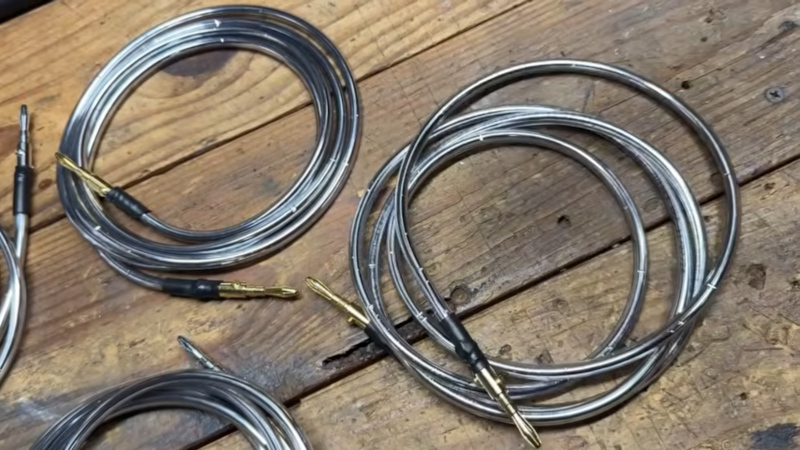
We’ve seen our fair share of audiophile tomfoolery here at Hackaday, and we’ve even poked fun at a few of them over the years. Perhaps one of the most outrageously over the top that we’ve so far seen comes from [Pierogi Engineering] who, we’ll grant you not in a spirit of audiophile expectation, has made a set of speaker interconnects using liquid mercury.
In terms of construction they’re transparent tubes filled with mercury and capped off with 4 mm plugs as you might expect. We hear them compared with copper cables and from where we’re sitting we can’t tell any difference, but as we’ve said in the past, the only metrics that matter in this field come from an audio analyzer.
But that’s not what we take away from the video below the break. Being honest for a minute, there was a discussion among Hackaday editors as to whether or not we should feature this story. He’s handling significant quantities of mercury, and it’s probably not over reacting to express concerns about his procedures. We wouldn’t handle mercury like that, and we’d suggest that unless you want to turn your home into a Superfund site, you shouldn’t either. But now someone has, so at least there’s no need for anyone else to answer the question as to whether mercury makes a good interconnect.












It’s triple distilled, what could possibly go wrong?
The only benchmark that’d matter here, is how pre-90s Queen sounds through such cables. Does it reproduce the late lead singer’s voice accurately? :-P
I see what you did there….
Shouldn’t one you use lead for the lead singer?
Lead really brings out the heavy notes in John Paul Jones’ work
Specifically NOT for Farouk Bulsara!
Farrokh**** NOT farouk 😅
Or Quicksilver Messenger Service.
It brings more shining to the sound
But ideal for those old heavy metal albums!
I’ll see myself out…..
Queen albums benefit quite significantly!
April 1….
such a stupid day…
Yeah, I noticed the day too… But the video seems older …
It is from 5 days ago… I heard about mercury cables for mad audiophiles some decades ago but never saw any.
Have been a Specialist for Mercury Analysis Systems in the 1990ies.I remember the high Vapor Pressure of Liquid Mercury. I doubt the ability of the used tubes to prevent mercury to evaporate. Once did a Mercury in air measurement in a laboratory with a mercury spillage years ago. Still very high mercury levels in air to be detected. Beware of that Idea !!! Poisenous !!!
Metallic mercury is not by itself all that dangerous that you should panic about it, because it’s not easily absorbed into the body. Of course you don’t want to spill it around willy nilly and contaminate everything for long term exposure, but the harms are often overstated.
It becomes a problem if you have organic mercury, like methylmercury. Those are immediately toxic.
Just as well… at school, late ’70s, UK, as an end of term “special treat” we were allowed to play with mercury in our hands (No we didn’t wash our hands afterwards.)
Now that could be dangerous. As all museum curators know, children’s hands are acid, and mercuric acetate is highly toxic.
There’s organic mercury and inorganic mercury. Organic is more dangerous. Some years ago a scientists handling it had a tiny droplet go through her glove and absorbed into her skin before she could clean it off. She was fine for about 5 months before feeling off and eventually died June 1997
And that is why i don’t eat organic foods. Can’t risk it.
Good thing too, since in most office buildings, they’re not very careful when disposing of the (mercury containing) fluorescent tube light bulbs that are omnipresent.
I hope that’s oxygen-free mercury!
I dunno. Using a liquid for a conductor, especially in a flexible housing, has problems all its own.
And audio cables? Really?
Now if he would’ve used gold-plated mercury…
There is one crucial step missing: boiling out the moisture 😂
I love that this article is just weird enough to straddle the divide between is it an april fool’s joke or serious, because people made mercury delay lines, so why not mercury cables?
:)
I’m sure there is a market for them, if you can get an “expert” to endorse them. After all, there’s an audiophile market for litz wire power cords!
One point is that mercury dissolves most metals, so this could give a reason to use some special componentes in the cable, and thus have the sound be improved.
Probably calls for titanium or tungsten jacks at the ends
They had better be gold plated. Also, make sure they’re plugged in the right direction.
These cables require proper maintenance and removal of the air inside the tubes to obtain the best audio quality.
Replacing the common air inside with magnetically-oriented bubbles of specific gases can give more warmth to the sound. One could also use special mixtures to achieve a better ressonance on the frequencies of the upper GHz range.
Mercury dissolves gold at room temperature.
Put a transducer at one end and a microphone at the other…
If you know, you know.
As expected, I hear no difference
I once upset a colleague by declaring I couldn’t hear the difference between an MP3 and FLAC/wav. He called in sick the next day, I must have broken him.
https://en.wikipedia.org/wiki/Delay-line_memory
and tilt switches. Mercury interconnects have a long electrical history.
Maybe this would make a self-repairing fuse.
Perhaps an Etch-A-Sketch style fuse: hold it upside down and shake it to reset.
In a blind test audiophiles couldn’t tell the difference between super expensive speaker cables and lengths of metal coat hangers carrying the signal to the speakers.
Do we know the audio performance of plutonium cables? We need to find out how they sound (just be very very careful to never roll them up into a tight spool or else very bad things will happen…)
How can a system that generates its own power for 1000 years be bad?
I long wondered what powers all those drive-by boomboxes on wheels flying past my place at like 2am, now I wonder no more. Must be the plutonium cables no less.
I love that guy! And I love me a pierogi!
Happy to see the vid made it on here. Many thanks to the editors
In my head, this is a plot to chastise “Audiophile” wankers, and I like it :D
It’s a new cable for the idiophiles?
That mercury is definitively not audiophile grade.
And besides that theres a big problem with those TRANSPARENT tubes that can catch noise from high energy photons hitting the mercury inside. Any audiophile can hear that.
One thing is sure, there is no space in the word overreact.
When I was a kid, I found a pound bottle of liquid mercury at a yard sale. I retired chemist had passed away and his wife was clearing out the garage. My grandmother bought it for me and I spilled that stuff everywhere. Somehow I grew up to be just fine, although that is questionable… I’m wondering if the sound changes if we coole the cables down and solidify them…
By what process of Alchemy can you turn a metal like Mercury into a metal like Lead? Why not use real Lead in the first place? Why do would an audiophile want Lead in the first place? All they do is sit around listening to music. Something’s off.
It’s a very foolish article…
Now do saltwater cables.
All of those little drops of spilled mercury will slowly evaporate into mercury vapor for many years.
Why not transport the audio signals as true acoustic waves? This was used in the early days of digital computing as delay-line memory (https://en.wikipedia.org/wiki/Delay-line_memory).
Perhaps one should consider using a liquid titanium alloy. It would certainly make Gustav Mahler’s (the ‘Titan’) First Symphony sound better! For Handel’s Water Music, one could try using pure water, and the same goes for Smetana’s The Moldau.
About what audiophiles IMAGINE they can hear:
What was the famous audio magazine test where it was determined that distortion levels far greater than the amplifier distortion levels during the hyped distortion wars going on at the time were required for golden ear audiophiles to detect it?
Grok 3 AI:
The famous test you’re referring to is from a 1973 article in Stereo Review magazine titled “The Great Distortion Delusion” (or sometimes referenced in discussions as part of the “distortion wars” era critiques). In that piece, editor Julian Hirsch (along with collaboration from four self-described “golden ears” on the Stereo Review staff) conducted listening tests where they deliberately introduced distortion into the audio chain.
The tests primarily used a modified Phase Linear 400 amplifier capable of introducing controlled amounts of notch (crossover-type) distortion, which is a harsh, odd-order form that produces significant IMD products alongside harmonic distortion. They played various program material and added distortion incrementally while the listeners (the golden ears themselves) tried to detect it.
Key results relevant to IMD:
• Simpler test tones revealed lower detection thresholds (e.g., “just barely” audible at ~0.15% on a 60Hz tone alone).
• With more complex two-tone mixes (e.g., 60Hz + 7kHz), distortion became obvious around 2.5%.
• Adding a third tone (60Hz + 3kHz + 7kHz) pushed the audible threshold to ~4%.
• On real music like solo voice, it took ~6% distortion to notice.
• On percussion, thresholds reached ~12% before any effect was perceived.
• With full orchestral material, distortion was essentially inaudible even at very high levels (the ear masked it effectively due to complexity).
I wonder how well galinstan would perform, it is literally mercury but non toxic (and as far as i know, without fumes)
Get 68.5% Gallium, 21.5% Indium, and 10.0% Tin (you can use 100% tin solder, ideally without rosin), mix it together, and you effectively have the same alloy that is used as liquid metal thermal ‘paste’, with a melting point of 11°C. Just don’t get it anywhere near aluminium, because it tends to dissolve that similarly to mercury.
I propose cesium wire cables for those sizzling high notes and explosive bass.