
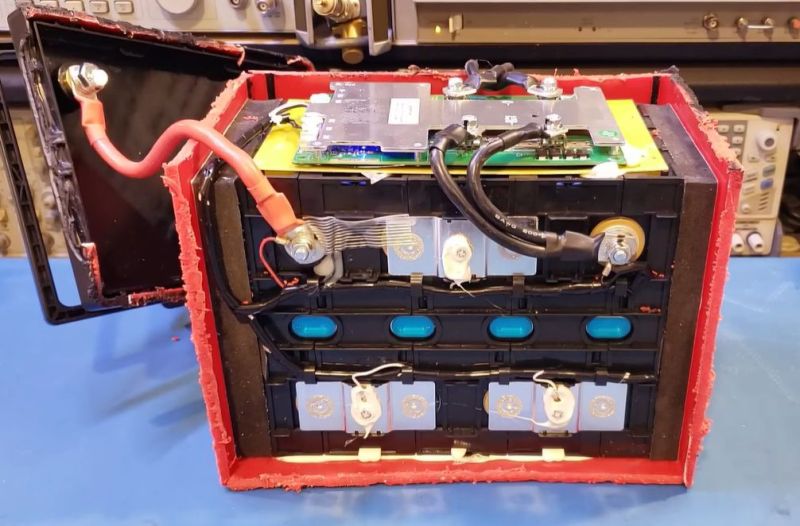
Recently [Kerry Wong] had one of his Cyclenbatt LiFePO4 batteries die after only a few dozen cycles, with a normal voltage still present on the terminals. One of the symptoms was that as soon as you try to charge it, the voltage goes up very rapidly to above 14 V due to what appears to be high internal resistance, and vice versa for discharging. In addition, the Bluetooth feature of the BMS appeared to have died as well, making non-invasive diagnostics somewhat tricky.
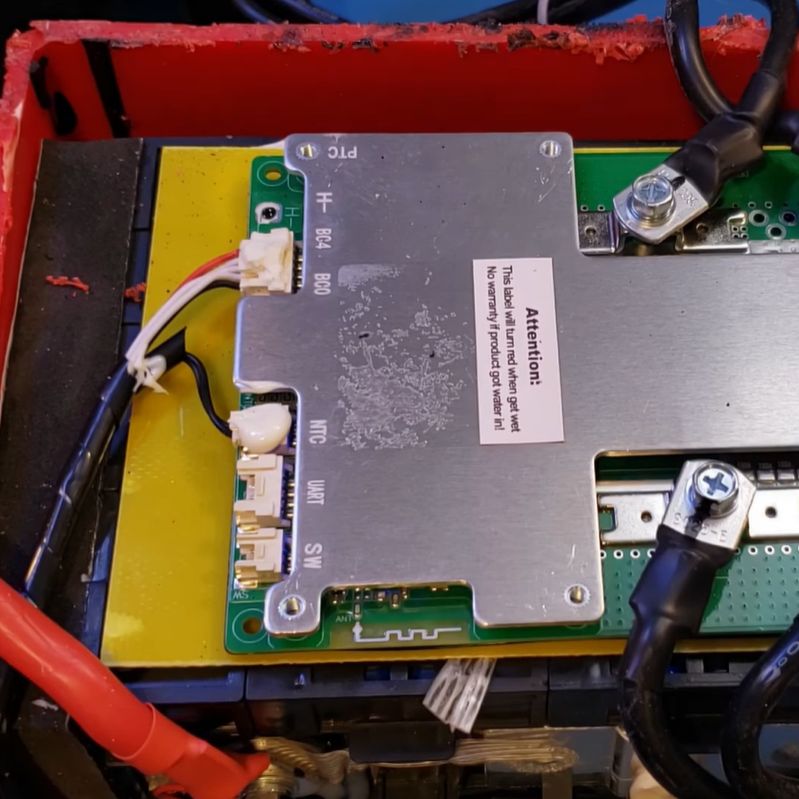
After gently cutting open the plastic case, [Kerry] was greeted by the happily blinking blue LED of the Bluetooth module and deepening the mystery. Overall the build quality looks to be pretty good, with no loose cables as seen with certain other LFP batteries.
Cell voltages measured normal, with no significant imbalance. Next was measuring the internal resistance, which showed a clear issue. One of the cells was reading over 3 Ohms, whereas the others were in the milli-Ohm range. This would definitely explain the issues with charging and discharging, with a single bad cell causing most of the issues.
Of course, why the Bluetooth feature failed remains a mystery, and there’s still a lingering question on whether the BMS practiced proper balancing between the cells, as this can also cause issues over time.












The LED on the Bluetooth module proves one thing for sure: The LED on the Bluetooth module is receiving power. Can’t say as much about the rest of it.
I’m not impressed with the QC in a lot of products nowadays. I don’t think it’s apathy per se. Perhaps methodology. I recall once reading a study on the semiconductor industry, specifically lithography, and the rejection rates for unviable chips, right off the line. It was an astounding number. One wonders if that’s still happening with modern processes.
Another thing I have noticed is how many designs have forgotten heat management. We recently upgraded our cable box, and the thing is absolutely tiny and totally lacks any kind of venting or structural features that helps dissipate heat or benefits air flow. The thing gets hot. Real hot. So hot that I wanted to move anything that might be flammable away from it and get a little fan to blow on it. 75C on the exterior. It’s prone to errors requiring a hard boot. We got a replacement and it does the same thing; it wasn’t a single faulty unit; it was the design.
Diagnostics should always be wired. Add a wireless module to the diagnostics port for remote diagnostics if you want remote diagnostics but there should always be a diagnostics port.
Agreed. And you can make it optically isolated too.
I had one of these from a brand called DC house and it was one that had like USB-C charging and all that stuff built into it and you know I would every now and again click the button to check the voltage and make sure it was still charged one day. I did that I got a blinking red light tried to charge. It wouldn’t do anything but respond wouldn’t allow any current flow into the battery. Got to a point where I was like I wanna try and get some warranty on this and it worked. They sent me a new battery so I cut the old one apart and all the cells were low but one was very low and I think that is what put the battery into a essentially permanent safety state until I charge that cell directly with a power supply then the whole thing would take voltage again and I charged a very gentle rate and it seems to work fine now I’m not able to effectively capacity test these, but I’m sure it’s more than zero it ran a 900 W load an hour before I stopped the test
Gotta wonder about the value of putting an active LED into a sealed case that is never meant to be opened by the end user.
Also, a reverse-biased power diode across each cell would still allow the battery to operate in the event of a failed cell. Obviously operation would be degraded, but it’s probably better than nothing.
The battery manufacturer probably bought whatever cheap BMS they could get that day and it happened to have an LED on it.
Adding diodes that could handle 100 amps to each cell would be expensive for something that’s not particularly useful. That money would be much better spent on higher quality cells.
Looks like a JBD BMS that they’ve yanked the sticker off.
Without proper balancing, a cell of a battery pack can easily be destroyed in a few (dis) charge cycles.
And putting a LED inside a sealed battery sounds pretty bonkers to me. But then again, If I was in need of a battery like this, I would probably buy loose cells and add a BMS circuit myself.