
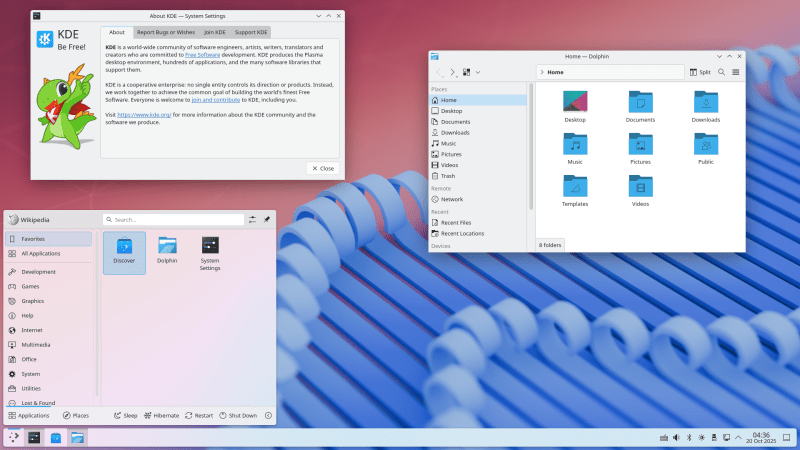
The KDE desktop’s new login manager (PLM) in the upcoming Plasma 6.6 will mark the first time that KDE requires that the underlying OS uses systemd, if one wishes for the full KDE experience. This has especially the FreeBSD community upset, but will also affect Linux distros that do not use systemd. The focus of the KDE team is clear, as stated in the referenced Reddit thread, where a KDE developer replies that the goal is to rely on systemd for more tasks in the future. This means that PLM is just the first step.
In the eyes of KDE it seems that OSes that do not use systemd are ‘niche’ and not worth supporting, with said niche Linux distros that would be cut out including everything from Gentoo to Alpine Linux and Slackware. Regardless of your stance on systemd’s merits or lack thereof, it would seem to be quite drastic for one of the major desktop environments across Linux and BSD to suddenly make this decision.
It also raises the question of in how far this is related to the push towards a distroless and similarly more integrated, singular version of Linux as an operating system. Although there are still many other DEs that will happily run for the foreseeable future on your flavor of GNU/Linux or BSD – regardless of whether you’re more about about a System V or OpenRC init-style environment – this might be one of the most controversial divides since systemd was first introduced.
Top image: KDE Plasma 6.4.5. (Credit: Michio.kawaii, Wikimedia)












It’s the Open Source world, I’m sure someone will either fork KDE or make a clone that runs on sysvinit and others.
And then probably dieba slow slow death.
SystemD isn’t the worst. Its not the enemy, it works quite well. Is it perfect? Probably not, but is sysvinit, etc etc? Probably neither.
The truth is, most people do not care enough I’d reccon.
In my gentoo days I went out of my way to avoid systems, I’ve now learned to accept it, and its not sa bad.
I tried switching to systemd on my latest install with an eye to learning it, a decision I deeply regret. It’s debatable if it works well, I’ve found it universally inferior to the alternative for every feature other than the “feature” of trying to do everything. And that’s the issue, it is trying to replace just about everything on the system… Control over network (at all levels), NTP, cron, logging, service monitoring, inetd, the list goes on.
The two big philosophies that makes *nix work are “Do one thing and do it well” and it’s complementary “Monopolies are bad for users, having multiple options for a given piece is encouraged” … It doesn’t promote standardised environments but the freedom is important. SystemD is a blatant and intentional violation of both goals and that is a problem. We’re still some distance from having only one option for DE, WM, terminal, shell, etc, but that is the trend SystemD represents. It’s already frustrating in how far it has tangled into the internals, it’s only going to get worse.
sysvinit has 1 huge problem.
runlevels
…
2 — Multiuser mode — Users can log in, only cli is available. >>>on some systems<<< network interfaces and services are started and on others they are not.
sysvinit has the problem that on some systems it behaves one way, while on other systems it behaves in other ways. It too much relies on the hope that system builders will do the right thing, instead of that thing that makes it work well enough to release “yesterday”.
It’s perfectly possible to make a sysvinit-based distro highly consistent; Debian managed it for decades, and I still run my debian boxes this way. It’s perfectly possible to make a single-runlevel config with sysv, as well. You can literally do that in 15 seconds, just by editing /etc/inittab, if you ever have the need. My router uses this configuration.
Likewise, it’s possible to make a as much of a mess of systemd units as it is with runlevel scripts. Why is one of these seen as a flaw with the system, while the other is just “an idiot misconfiguring things”? Even more odd, init.d stuff is not part of sysvinit in the first place; that’s simply one common way of orchestrating services, independent from choice of init.
The problem you mention for sysvinit is actually the core of its strength. We do not all solve the same problems with our computers; they are not fungible commodities. As such, the freedom to solve a problem as is appropriate under the circumstance is not to be undervalued.
Sysvinit or runit, a configuration with a very shallow service dependency graph, and care to start only what you must (at the service level) can dramatically reduce the memory and processor requirements, not to mention storage. That’s nice, when you’re stretching an old computer. It can be downright critical when you’re building a drone, or a data collector box you’re going to deploy outdoors. When there’s a real risk that you are going to have to replace the hardware regularly, cost is an important factor.
And the unix/linux paradigm of simple, do-one-thing, composible components makes this very easy. Systemd doesn’t share this paradigm, and while it may truly have value for those who need it, for the rest of us, it corrodes already-existing capabilities (due to systemd dependencies being added) while doing nothint to replace them effectively in all use cases.
And frankly, if you’re not interested in the highly composible, reusable, and reconfigurable nature of the unix ecosystem, linux might not be a good fit for you, anyway.
Systemd makes things convenient, if you need exactly what every other user needs. But, if you expect to be able to compose your software to solve other issues, it doesn’t just get in the way, it forces you to follow very opinionated prescriptions. Are they ideal for its common case? I don’t know, that’s not my situation. All I know is that, i have repeatedly been forced to find alternative solutions because something written to presume systemd cannot be bent to fit a system with different needs.
Much of what a computer does is not “desktop paradigm”. Promoting that paradigm to be the substrate upon which you build other components only ensures that the effort put into creating those components is wasted, if the paradigm itself is inflexible.
systemd, runit, syvinit, a simple shellscript as init: All of these work. In the right circumstances, any of these can be “the most ideal choice”. In the wrong circumstances, a bad choice makes other things more complex than they have to be.
There are features that systemd offers that I keep being attracted by. But, since systemd is monolithic and many of its requirements conflict with my needs, I can’t benefit from those specific features.
And I have been in few circumstances where systemd actually helped.
If your need is “something like” a windows box, systemd can be a pretty good fit, and I won’t even judge you for using it. But if that is your need, there is almost no overlap with my needs, so any effort that either of us expends will be unlikely to be useful to the other. I won’t be able to make use of your apps, and you would probably not find my focus on immutable-core, containerized runtime, dynamic pragmatic mesh communcation interesting.
A community is a group of individuals with overlapping needs, thus spreading costs and sharing gains. If you refuse to let anyone overlap with you, your community takes on many of the properties of a monoculture. It may dominate in the short term, but never in the long term.
There is great usefulness when a router or a drone controller are tiny, overlapping subsets with the same paradigm as the developer’s workstation (but different tasks, thus different running services). But I won’t belabor it. If this doesn’t resonate, it just means we live in different worlds.
Another fragmentation is all that we don’t need. Too many desktop environment already
The solution to fragmentation is to drop the old stuff when there is something new.
Too bad that so many people are so attached to “the old stuff” that they go into a cramp.
Mostly because they don’t perceive the “new” as “better”.
Which might actually be true. But by cramping on to “the old stuff”, you are putting your energy on keeping that old stuff alive, instead of putting it into improving that new stuff to really make it better. That is an awful waste of energy.
When something is not “better”, but does hold “promise”, it means it can be better, as long as people put their energy into it.
Sadly so many people keep trying to hang on “the old stuff”, instead of improving things, that now we are living with quite a lot of fragmentation.
Fight fragmentation – let go of old stuff, improve the new stuff.
:)
Well said.
whole fallacy exposed in >>When something is not “better”, but does hold “promise”, it means it can be better, as long as people put their energy into it.<<
Help me out! “Old stuff” doesn’t hold any such promise because… what? Why shouldn’t people rather put their energy into improving “old stuff” that seems more mature, proven, and already better than that “new stuff”?
:-S
Usually the new is far from better, a trend adopted from the proprietary software world.
You see fragmentation as the problem. I see it as the solution. It provides resilience, allows spreading the effort by reusing validated composible components, and means that even if there’s a big problem, it’s easy to just shift to some other implementation if something changes or goes wrong.
There is no good solution to all problems. If you insist on forcing your solution onto me, show good faith and live with my problem for a year. If your solution still seems ideal, i’ll salute you.
Oh, and try to get real useful work done in 512 megs of ram and 1024 megabytes of persistent storage. My solutions scale up to servers with terabytes of ram and (low) hundreds of cores, or down to hardware that you can reasonably tape to a paper airplane and not cry over when it gets lost. One of those is my professional duty, the other is my hobby. Neither benefits from “discarding the old”, and it takes enough care to safety-check and validate software in both environments that every “new” thing rarely pays off for the time and effort needed to recertify it.
And most of the new stuff is old stuff. Or if not the same exact thing, something that rhymes. Old stuff isn’t petrified into stone, as well. It can alter and improve if there’s an actual justifiable improvement to be had… and this regularly happens.
I’m not opposed to new stuff, in theory. But very little of it shows the foundations (technical or cultural) to lead me to believe that it will maintain relevance for nearly as long as the “old stuff” has.
New stuff can show promise. Old stuff has a track record. These both have their separate value, and neither is a full replacement for the other.
The new hotness has to actually consistently be more capable, reliable, and stable than the old and busted stuff, or it’s just a noisy cricket ;)
This is idiotic. There is absolutely no reason that a desktop environment should be dependent on any specific init system.
The problem is that one init system has had so much feature creep that it is like a cancer converting everything else to become it.
Yep. That’s the problem.
It was never intended to be an init system. That was just the excuse they used to get systemd’s foot in the door. And now it’s got its tendrils dug in deep so it can never be ripped out.
Windows registry idea ported over to linux. The same concept and drawbacks.
The registry is a single file where systemd is spread over a multitude of unit files. It’s nowhere near as fragile and is a poor comparison IMO.
The registry is not a single file –
HKEY_LOCAL_MACHINE\SYSTEM : \system32\config\systemHKEY_LOCAL_MACHINE\SAM : \system32\config\sam
HKEY_LOCAL_MACHINE\SECURITY : \system32\config\security
HKEY_LOCAL_MACHINE\SOFTWARE : \system32\config\software
HKEY_USERS\UserProfile : \winnt\profiles\username
HKEY_USERS.DEFAULT : \system32\config\default
Regedit.exe presents them collected for editing under one umbrella so to speak, but not “security”. That’s not available to normal user accounts, only (IIRC) SYSTEM and TRUSTEDINSTALLER.
You’ve chosen Pedantry over Usefulness! It’s not very effective…
It doesn’t matter if the registry is split over 4 different files, as they each are still a giant conglomeration of completely unrelated items.
That’s fundamentally different to systemd’s system of having each unit given it’s own file.
If I can grep and vi it, I can control it.
Once you realize what System D is, which init is only one part of, then you will understand.
Indeed:
https://unixdigest.com/articles/the-real-motivation-behind-systemd.html
I use Gnome and I use systemd, but this seems like a very non-unix decision. I like that nearly every part of my daily driver can be peeled away and replaced with some alternative, it might not be painless but there are lots of options. Having one major part totally reliant on some other major part makes your setup less resilient.
I’m not sure how many non-systemd KDE users there are, but it sucks when your favorite combination of projects is no longer supported.
Tell that the Black Rock/Vanguard/IBM/Microsoft/Red Hat crowd! They want everyone to use their bloated and unsecure stuff instead of superior alternatives. Their mooks become very aggressive when they can’t control a project like XLibre.
MGTOW Moment for linux, leave systemd and wayland behind you in the dustbin of historic mistakes.
Wayland it’s a great project, we literally have HDR on desktops only because of it, Xorg/x11 are brutally unequipped for modern display necessities
Last I checked, Wayland can’t even do x forwarding. Hard pass.
Waypipe has been a thing for years now.
Never let the facts get in the way of a good unhinged prejudice!
Yay, it only kills multi user systems
X11 is available on many platforms, can run on traditional graphics terminals, on modern thin clients, can be used for remote desktops etc.
Wayland by contrast is fatter than some whole operating systems.
Wayland+SystemD+Linux equals Windows Vista in terms of bloatness.
With the exception that Vista was pretty and ambitious, at very least. IMHO.
What a load of unsubstantiated garbage.
Wayland is just a specification, it can’t be “fatter than an operating system”.
And my local installation of Hyprland is ~15MB in total. The rest is libraries that are shared with any X11 server I would have run.
Tell me about these modern thingy?
Any HDR cap devices i tested and i have, including Apple Mini M4 never provide me a good UX with my HDR screen ( LG, Dell, Samsung).
HDR photo/video might enjoy it but your desktop/webbrowser not that much.
Don’t dare talking about fractional scaling… my 14″ 205 and 27″ 225ppi dual screen setup on Xorg will curse you. :)
Though, probably that Xorg codebase had too much legacy stuff for a maintainability PoV and Xlibre tends to do a clean up on this but, they dont throw X11 to the toilet neither.
HDR is an abomination too.
I don’t know why others don’t have issues or called you out with “MGTOW” That’s a sad, clueless meme that hasn’t ever had “a moment”. I am not okay with it being used casually like that, you could have expressed the idea in countless other ways.
Gonna cry?
Next step: SystemD becomes an operating system, and drops support for KDE.
The end is nigh!
Linux turned into the new Windows.
Locked in syndrome inclusive. Time to switch to and strengthen the BSDs.
TINA any more.
I miss the old days of KDE 3.x sometimes, when “Keramik” was the default style.
That’s when KDE felt like it had found its own personality.
But that was about 24 years ago.. 😢
I have the same feeling: KDE 3 with Motif’s Liquid theme waa better than Mac OS X :’(
But the line went down à long ago. Already around 2010, I think, I had the feeling the DE was less vibrant than the early 2000
Always found KDE to be a bit bloated…even in the early days (when compared to Gnome, before they released that “tablet-disaster” called Gnome 3).
Check out WindowMaker. I have been running it on-and-off since the late 90’s, and it still looks as elegant as ever. Very frugal on resources…I have a BLFS distro using WindowMaker, and after boot, X and WindowMaker started, logged in, and urxvt started, only around 80MB memory consumed. ☺
Great. Now I am sad.
Um, if you actually read the sources you’ll see the headline is totally wrong. Their new login manager is SystemD only (as stated in the first paragraph), but you can continue using any other login manager you like. The developer’s comment about replying on it more in the future is clearly in the context of the login manager, and to extrapolate it to the rest of KDE (like the first paragraph does) is directly contrary to other comments of theirs in that thread.
Yes, this.
It doesn’t make it less stupid…
I know about the shortcomings of the old init system, it has been around forever. However, the init system should do just that: init. Now systemd seems to do everything (or tries to do everything), hell, it even cares for the temporary files and had a bug related to that functionality once that deleted home-directories.
Exactly. Once there were scripts that did obscure things before a user logged in and started their viemac editor and do some coding on the system — because that’s about the scope that old init had in mind.
Now we have a solid operating system consisting of the Kernel and systemd and can put anything on top to get productive. A DE is just a convenience layer to get to the real applications.
This is exactly the kind of feature creep mentality that got us here in the first place. SystemD needs to go away. Why are we fighting against Unix mentality in a Unix-like operating system in the first place? SystemD needlessly and singularly started that fight.
@P:
Let’s talk about feature creep. You can happily stick with your 30 or 40 yo 16bit single core computer, its 64KB RAM, its non-existing network connection and one keyboard and a single application bringing that machine to its knees.
I”ll take even a moderate concurrent machine with 16GB of RAM, 8 to 16 cores, some networks, several wireless connections, multiple input and output devices, a stack of harddisks, two or three displays and whatever else I can connect to 8, 12 or 20 USB ports I wish to have. I can run several databases and webservers in the background and won’t notice most of the time. And all that is smaller and more energy efficient than even the screen of that old machine.
I’ll also take an init process that can handle that complexity without getting in the way of getting work done.
What part of that do you think sysvinit can’t handle? It’s just a collection of shell scripts, it can do literally anything. The only thing that’s really more awkward to express than its systemd equivalent would be dependencies between services, but you /don’t want that/. There’s a reason it’s called “dependency hell,” and it’s generally a symptom of poor design, not a feature to be supported.
Sysvinit follows the UNIX philosophy of being simple, scrutable, modular, decomposable, and adjustable/replaceable. Systemd is none of those things, and that’s a huge mistake. You can’t use just a little bit of it; if you want any of systemd, you just chained yourself to all of systemd. Unfortunately, it’s spread like cordyceps through a bunch of distros that somehow think “working more like Windows” is an attractive feature.
Hooray. Now I am less sad.
“This means that PLM is just the first step.”
I got the impression it was the first step towards more reliance on Systemd
Did you read the part of the summary where it links to the KDE developer stating that this is only the beginning, and that tighter coupling with Systemd across all of KDE is the goal?
Yes, you can use another login manager for now, but future Plasma desktops will likely require Systemd based on this statement.
Contrary to the slant above and below, it’s a good thing that KDE drops the SDDM login manager and rely on something that works and doesn’t reinvent the wheel again like SDDM did.
Yes, systemd is a large software, yes it was a PITA to learn a new tool, but let’s be honest, systemd works and it’s stable. It provides features that works the same across distro and desktop environments. Once you need to set up a virtual keyboard or change the layout of the keyboard in SDDM and that’ll break on next update, once you need to add Howdy for face recognition login, or a passkey, or you don’t want the stupid screen resolution/background flashing each time you login, you’ll realize that the issue is in SDDM redoing the work of PAM integration that systemd does. SDDM starts the graphical server and fight with plymouth while systemd can do it WAY earlier in the boot process and skip the successive splashscreen to have a desktop much earlier, systemd does the home folder decrypting and mounting on login (which could be done with SDDM but with a user-made script mess that’s very brittle) and so on.
In short, SDDM was a mess because it did 80% of what is currently done in systemd but its own and often poorly documented way. I perfectly understand that KDE devs don’t want to make the same mistake again and rely on an already battle tested software like systemd. The maintenance burden will be on systemd not KDE too.
The same goes for audio and video stuff that are correctly set up as systemd services recently. Pipewire solved the pulseaudio latency issues, and added video and desktop streaming support so that everything works out of the box. Even waypipe works well now.
The only thing missing, IMHO is a working window positionning protocol in Wayland and Wayland will not have a single feature missing from X11/Xorgs.
“Wayland will not have a single feature missing from X11/Xorgs”
Really? Cool.
I use xorgxrdp a lot for remote access.
• Clients exist for Android and even come default in Windows
• It’s a separate session from the desktop
– Sharing my 3-monitor desktop with my single monitor laptop would be very useless, I have zero interest in that sort of remote access.
• I can use all sorts of low-weight X window/desktop managers remotely while still defaulting to KDE on the local display.
• Sound just works
All that said, there are still rough edges. For example.. I just cannot get the ‘<‘ key to work correctly from any Android remote desktop client. It always seems to result in a ‘>’ character instead. I have to keep mashing both of those buttons alternately, and eventually I get a < in there somewhere. Then I have to delete all the rest.
So.. yah, I am always happy to try a new remote access solution. But they always seem to be lacking in one way or another.
So please, tell me how to get this on Wayland. Maybe the damn keyboard will work.
If I had my way remote access would be supported by the login manager. If I sit down at the machine and turn on the monitor.. I see the login manager. If I remote in via RDP or whatever protocol… I see the same login manager.
From the login manager I could choose a window/desktop manager from any that are installed. But.. I wouldn’t have to, there would be a default setting.
From the login manager by default when I log in I would resume an existing session if I have one, screens would resize if necessary and all applications move into locations that are accessible via the current display. Or if I don’t have an existing session it would start a new one.
But there would also be an option to list existing sessions and pick one to connect to.
What if I want to connect to an existing session but I also want to choose a different window/desktop manager/compositor than the original session?
This is definitely extra credit but it would be really cool if it could swap that out from under all the applications while still keeping them running.
But anyway.. yah, that’s all dreaming.
If Wayland has everything X has then what is the equivalent to xorgxrdp?
Yeah. This is one of the issues I have with Wayland – right now any RDP protocols are designed to remotely access the desktop of a logged-in user.
Wayland is barely functional at the moment for a multiuser system that is accessed remotely.
There’s hacks around with wayvnc, but the performance is absolute garbage – https://github.com/neutrinolabs/xrdp/issues/2637
That is exactly what I was referring to. Finish reading the comment in was in: it is clearly only talking about in PLM, with that same comment saying it was only happening where there are alternatives.
Also, on an official KDE social media account, there’s this: https://floss.social/@kde/115933236466022060
In other words, you’re completely wrong.
Using one API to its fullest extent doesn’t mean that the alternatives are being dropped. If you cared to actually ask the KDE developer in question to clarify his statement for you, or if you indeed asked anyone else in KDE who is involved with this effort, instead of freely interpreting your own fears into creative writing, then you could answer this with authority and truthfulness.
Alas, unbiased quality journalism seems to have died a long time ago.
Just fork the login manager and name it differently:
https://github.com/KDE/plasma-login-manager
Like “fusion-login-manager”.
It makes sense. Developer resources are limited, and when Debian/Ubuntu, Fedora/Red Hat, OpenSUSE/SUSE Enterprise, Arch/Manjaro…i.e. all the major distros and a hundred derivatives…already ship with systemd, why continue to support software that is only used by a fraction of their user base?
It has been 10 years or more since systemd was adopted by all the major distros, including enterprise systems, and what has happened? The “systemd virus” or “systemd cancer” as the anti-cult has called it hasn’t led to any of their predicted disasters. At this point, those whose religion won’t let them use with a distro with systemd need to put up or shut up.
Fork KDE and develop it yourselves without systemd or use something else, but please spare us a second decade of vitriolic comments in every internet article that even mentions systemd, waxing idiotic about UNIX philosophy or conspiracy theories about some underlying evil at work. We’ve heard it all a bazillion times. When are any of you actually going to do something about it, like contribute code to an alternative? Here is your opportunity.
I was a Slackware user 8 years, and already missed convenient features which other distros were able to ship easily because of System D. So, yes, agree with you.
systemd author is lonewolf now
Normally I run Slackware which is one of the few out there, who do not use an annoying method of managing systems. That decision is preposterous. It’ll be interesting to see which direction the people behind Slackware take things.
I am also the one of the few :)
We will see how this moves, I do not llike the idea “it can be only one”
Who needs a logins manager?
Our Debian are booting, automatically patching and starting gui right after console login.
Nothing best than a true verbose full text boot to feel at home…
LFS also dropping SysV init: https://lists.linuxfromscratch.org/sympa/arc/lfs-announce/2026-02/msg00000.html
The end of an era…I built my first LFS distro in 2000/2001, and still run up a fresh one every 4-5 years.
The whole “there can be only one” mentality is driving me nuts. One of the good things about open source is that it give us options. Now those options are slowly being removed for no concrete reasons at all. For LFS it is not such severe an issue, because I have been writing my own scripts for well over 2 decades now, but still…
Just look at Bruce’s email on LFS (your link)…systemd has 1200+ files to make it work…sysvinit is sitting at around 70 (scripts included), and each-and-every machine I have with Linux on runs sysvinit…without problems, and have done so for almost 30 years. Having to work with systemd in a professional capacity, I can confidently say that systemd breaks a lot more often than sysvinit…by orders of magnitude.
I am running freeBSD on one of my machines, so maybe it is time to move the rest over to BSD as well. There seem to be a lot less “politics” in the BSD world. Every single piece of software I need runs 100% fine on freeBSD…except Steam and Proton. So, you win some, you lose some…
Linux has more “politics” because it’s used by hundreds of times as many people.
systemd is simply superior. One of the few things outside the kernel that doesn’t feel like janky “year of the Linux desktop” garbageware.
If something feels janky, it’s probably cause you didn’t read the manpage entirely, did a patch job(if that) on the config, cried a bit then went back to unbuntu cause “it just works”. :D
Systemds entire M.O is to shit the bed and blame it on something else. Why else are those logs such a crime against everything?
Also, KDE has never touched a single bit on any of my Void, Gentoo or BSD boxes. So, Idc what they do.
Your take here seems overtly negative. Systemd has been on production systems for 15 years? For all the Big Bad Wolf scare stories, it’s mostly delivered reliable service management, and sped up boot. It also made managing complex webs of interdependent user services easy. It’s why they use them.
Honestly, the concern is well founded, but at this point, it kinda just makes sense.
“… sped up boot”
Sorry to say, that might have been true in 2005 (and only by a second or two), but not anymore. Doing an LFS distro on the same machine, once with sysvinit, and then with systemd?…systemd is starting to remind me of Windows95.
yep. looks like KDE is willing destroy DECADES of goodwill they built up different from Gnome/Gtk. I’m going to say I am switching to Icewm or even FVWM. KDE and their braindead decisions can go take a hike.
Well, maybe. It’s not how I remember it.
Around 2010 you had the first screenshots of Windows 8. It looks like the Gnome team hired a 3 year old, showed it pictures of Windows 8, then put a ton of alchol in the 3 year old and told it to redraw Windows 8 from memory. The end result was Gnome as you know it.
In all seriousness, I loved Gnome 1 and 2. They were amazing. But Gnome 3 (or whatever they call the revisionist version now, 50 or something), big yikes, no thanks. Even Windows 8 feels better, more refined. I don’t know what their reasoning is but without heavily modifying Gnome 3, it’s pretty unusable for me. I just get frustrated looking at it.
I like KDE on simple systems that everyone can use. No need to mod it to have a good simple nice looking working system. It’s refined. It’s sleek. It’s modern. Just point and click. It’s what Windows 11 should have looked like. I can get my elderly parents to use it. Now, I prefer the i3 window manager for doing actual work but I got one machine running KDE. It’s the workshop machine others can also use. Select a new movie, put it on, fire up the welder and have something to watch/listen to while doing weird stuff with tools.
I would consider KDE now that I see it evolving, instead of trying to be one size fit all. There is a lot to remove from KDE to let it properly evolve, like removing the ability for end user to customize it, which can be a developer pack; and add a really nice design system, which wouldn’t be just a copy of another Desktop environment (like KDE does today, copying small features from other desktops instead of building its own identity)
KDE is such an entangled mess anyway, so who cares? It’s not like you can use parts of KDE and come away unscathed. Either you go full in or you avoid anything with a ‘K’ like the plague.
Also, sure, systemd was quite awful in the beginning, but has become awesome. It’s just most people don’t grok it. Systemd is the real OS, a desktop environment is just another application running on top of it.
Can HackADay not repeat stupid misleading headline titles?
KDE IS NOT DROPING NON-SYSTEMD SUPPORT! They only component that does it is the login manager but it is entire optional, you can and will be able to use KDE with any other login manager that runs on anything else. More about it: https://www.youtube.com/watch?v=O15jcjr72Rg
That take is literally contradicted by what the KDE developer said in the Reddit comments linked in the article.
Having read that reddit thread, they still say it only affects the PLM and that SDDM and other login managers supported on non-systemd systems should work. I had seen news about the PLM thing early last week, and many were also confused about it being KDE Plasma going completely systemd, but that’s not the case. It’s just PLM.
Side note: FreeBSD and OpenBSD do have some preliminary support (if not further along) for Wayland, so that won’t be an issue if it comes to pass that Plasma won’t work on X at all down the road.
I guess it’s time for systemd emulators.
I also think that both systemd and KDE are growing bloat exponentially and are becoming Windows 11. I guess they add AI soon.
I gave up on KDE about a decade ago. Up until version 3, I LOVED it. I even stuck with it for the disasterous version 4 roll-out. But it got large, bloated, and seemed to be fighting me more than helping. I switched to XFCE; It’s not quite a flashy, but it does everything I need.
been on kde on Linux from kde3, stayed even on 4, changed to FreeBSD on 5 and made the switch to wayland now with 6. Seems the journey is slowly coming to an end.
But maybe kde folks come to their senses… Saw a link to a patch merge to remove a hard dependency for krdp over at the fediverse.
I always hear that Linux will never grow above a few percent of all desktops because it has too much diversity. But when KDE decides to streamline just a tad, the act is suddenly an affront to humanity.
Imitating the flaws of modern Windows isn’t very sexy to many, I guess.
I fully support individuals’ right to run whatever they want…on their systems. That said, there does seem to be an entire generation of superficially competent programmers that just don’t grasp the full costs of obligatory gratuitous complexity (nor the Unix philosophy). Much like the peddlers of AI, the systemd folks just want us to trust all the many tentacles of their metastasizing monstrosity. They don’t even realize they’re just recreating Microsoft’s “vision,” and they’ve even birthed a new corporate entity on their delusion. Good luck with that. I’ll just be over here by myself with voidlinux when y’all set your house on fire.
But let’s not conflate this with the X vs Wayland battle. I run both, on different systems, for different reasons. They’re tools, like most software, with different priorities and therefore different strengths and weaknesses. Systemd isn’t a tool. It wants to be all your tools.
I started out with Linux with some very old version of RedHat back in the late 90s. I quickly moved from that to Mandrake.
Anyway, back in those days if I wanted something to run automatically I just added it to inittab. I kept doing that for a while after “they” said it was bad practice. It was so simple to do. It was bad practice because it could keep going and going and so lock up your system supposedly or some such… Whatever. If I wanted something to be always running that the OS didn’t already set up to do so for me via the package manager I was probably building an appliance anyway. If the OS went down because the application went down… who cared? The application was the whole point in the first place.
Then came initscripts. I thought it was ‘cool’ that they were bash and that bash was basically a full featured programming languages so I could write in whatever smarts I wanted. Cool.
But Bash is such a WEIRD language with such a WEIRD syntax. Plus it’s not like init scripts were from-scratch. There were all sorts of helper functions and specific things an initscript was supposed to implement. It was all very distro specific. And trying to figure out how to actually do anything… You could dedicate a couple years to memorizing all the manpages. Or you could try finding an online tutorial.
I don’t know about everyone else but when I did find myself interested in writing an init script it was because I had a specific task I wanted to accomplish. Starting out with a hello-world tutorial, working through all sorts of stuff I didn’t care about hoping it would eventually take me to what I needed to know… that was as bad as trying to jump into the middle of the man files and find how to do what I wanted to do among all the minutia.
I was not very successful with custom init scripts.
Systemd… I wanted to HATE it. I still wanted to some day master writing init scripts! Then I could code in whatever sort of conditions or whatever I wanted something to be ran with.
But.. writing a Systemd unit… still not as simple as the old inittab was. (And inittab handled 99% of my use cases). But it’s not that hard. If I want it to do something I can figure it out that day! And it’s pretty much the same distro to distro.
Yah, I still think DEs marrying themselves to a particular init system sucks. But Sysetemd has grown on me.
See the end of the OP in the linked FreeBSD thread:
Its just another step towards “Windowizing” Linux. If systemd was designed properly according to Unix principles it should just be another component, albeit a useful one for desktop oriented systems. Unfortunately a generation or more weaned on PCs seem really incapable of understanding the fundamental elegance behind the Unix philosophy. Its a nuisance but it does clear the competitive landscape for others to build elegant, efficient, systems when they need to.
This, incidentally, is why I avoid “IoT” even though I’ve spent my working life developing embedded systems used to control stuff. IoT is an unwelcome incursion of desktop methodology that bulks up firmware with the resulting bloat compromising both performance and reliability. The results of this are all around us, especially in vehicles and domestic appliances, but as you learn from long experience you never try to argue with (applications) programmers. They know, they always have known, they always will know and anyone who doubts this is an ignorant lesser being (they’re more like a cult than a profession, honestly!).
To make a cohesive GUI, the trend across all of the different OSes is to make big monolithic undocumented tendrils-everywhere stateful programs at the core of it. Systemd fills that role, and KDE obviously aims to be that kind of system. Not surprising in the least. Especially for login management.
I can’t stand systemd, nor can i stand KDE. Not that crazy about graphical login either. So no skin off my teeth!
Login keeps getting more complicated all around, and to no obvious benefit. But so far i’ve been lucky that i can just accept whatever garbage comes stock, with only minor downsides. Login and udev on my system are both derived from systemd (apparently), even though i use sysvinit. Pretty sure it’s just a simple hack to extract these tools from the jaws of misfactoring, and if that changes, they aren’t too big to re-implement. Open source doesn’t provide the perfect system, it provides the system you can hack.
postmarket OS is based on Alpine, and is kindof the main distro for Plasma Mobile. So maybe there will be some pushback.
Yeah, I don’t think I like the idea of them increasing their dependency. Can’t say I’ve had major problems with systemd in practice, but it feels wrong. But Linux always had a tendency to snowball: maintaining minimalism is actual work, against the mainstream.
I still boot up to a console, log in, and type “startx” usually (if I don’t want to run a wayland compositor). I don’t need a login manager. My openbox/X11 desktop itself remains as bloat-free as ever, even if I tend to pile up too many open applications and windows over time. For Wayland, labwc and sway are quite alright. Either way, I can run whatever KDE/plasma apps as needed. Especially lots of instances of konsole.
If you think Linux is turning into Windows, try Plan 9 for something different. It feels a bit like returning to the beginning of Linux: quirky, small, fast, inspiring, has quite a learning curve, and you will probably find an itch to scratch and feel the need to write some code. Don’t bring baggage. Do bring a thick skin. But I’m too busy, haven’t put in enough time. I just keep expecting that I will have practical everyday use for it soon. I think I felt that way about Linux in the beginning, a long time ago.
This whole article is idiotic and its only purpose is to be inflammatory. The KDE desktop will not depend on systemd being installed. Only the new login manager, and in order to integrate it fully into the desktop with all the features being added, it needs to make that compromise. SDDM and other login managers are still fully supported as have been stated repeatedly by KDE devs every time this asenine opinion gets brought up. This will not hurt anyone on any way, they simply will continue to use whichever login manager that have been using all along. SDDM is still being maintained but the KDE team as well, funny how there was no mention of that.
PostmarketOS is based on Alpine, but they don’t follow the Alpine creed of small, simple, secure. They have switched to systemd instead of to the superior s6. Besides, bloated sudo was a requirement last time I used it instead of doas.
GrapheneOS or AXP OS are the better alternatives. At least they support phone calls and cameras.
KDE isn’t forcing SystemD to use the desktop, it’s just the new login manager and you can use any alternative. This is a move to have a tightly integrated login and desktop, which macOS, Windows, and GNOME already have. But this is Linux and you can choose to not use it and still use KDE.
Some thoughts:
– Laurent Bercot’s well thought-out s6 (a fully modular suite of init system, service manager and additional packages) would have been the smart choice as systemd is badly programmed and designed. Besides, it is one of the most unsecure, broken and slowest init systems. Not to mention that the systemd alternatives are often inferior and missing basic features compared to the old components. Bercot is open for technical discussions regarding init systems and service management, but the systemd crowd don’t dare.
https://skarnet.org/software/systemd.html
The problem is, Linux is controlled by GAFAM. Microsoft and other GPL hating or violating companies have infiltrated the Linux Foundation. They command, others have to follow. Call it Red Hat, IBM or Microsoft, in the end it’s Black Rock, Vanguard etc.
Niklaus Wirth’s essay “a plea for lean software” is not well known: https://daringfireball.net/linked/2024/01/11/wirth-plea-for-lean-software
Many newer programmers don’t understand the FOSS idea and the GPL or don’t care about it. They are blind believers of corporate propaganda.
There are still people who get it and resist (the suckless movement, Alpine Linux, Gentoo, Artix, Obarun, Devuan, alternative packages like s6, dinit, seatd, turnstile, etc.), but it looks like a losing battle.
I don’t really feel like GAFAM controls Linux, though they certainly have a huge influence specifically on kernel development, especially drivers. For example, an Intel employee rejected a patch necessary to use the (probably counterfeit) wifi in my laptop. Big conflict of interest, imo.
But i don’t feel as pessimistic about it as you seem to…in the 1990s, i used Linux mostly because i could get to the bottom of every problem. And i still find that to be largely true today, at least for PC Linux. I don’t use whatever is hot these days, but it isn’t really swimming against the stream to do things in the 1990s-ish way that i want to. There’s never gonna be a mass-market OS that i really agree with, and so the fact that Ubuntu / Redhat / Android / etc still isn’t that thing doesn’t bug me at all. A few anecdotes though…
I have always used fvwm, and kind of without me noticing, “fvwm” got replaced with “fvwm2.” shrug. A couple months ago, i ran into a desire which simply can’t be fulfilled with fvwm. So i found fvwm3, a modern fork of fvwm2. fvwm3 didn’t fix my problem, and had a bunch of bugs. So i switched back, which is why Debian maintains separate fvwm and fvwm3 packages. Easy peasy.
I also have always used xlock for screensaver. Debian abandoned xlock, so now i build it from source, which is still easy to do.
In the 1990s, i switched from xterm to rxvt. But at some point, i found out modern urxvt has become shamefully perceptibly slow. So i switched to eterm, which was the fastest circa 2012ish. Eterm is now abandonware (i think), so i switched to xterm, which today is fast. I thought, if they’re gonna put me on a merry-go-round, i’d rather use something simple like suckless’s stterm. I really liked looking at the source to stterm. But one of the reasons stterm is so simple is that it relies on the simplest interface to an extremely complicated font library, and as a result, i can’t use the font i want. So on the one hand, today i can still effortlessly use xterm. But in the future, if it comes to it, i can just hack clean and simple stterm to use a better font interface.
FWIW i really really really hate complicated font libraries and as a result, about half of the X11 programs i write use a custom font-rendering engine that i write from scratch each time. Did you hear me say the word ‘ugly’ :)
Oh, come on! It’s only the new login manager that relies on systemd.
Feel free to use another login manager (like lightdm or just stay with sddm).
KDE Plasma will still run fine also on other operating systems (like FreeBSD).