
Sunlight Powered, Sunlight Readable: Solar Case For Nook Simple Touch

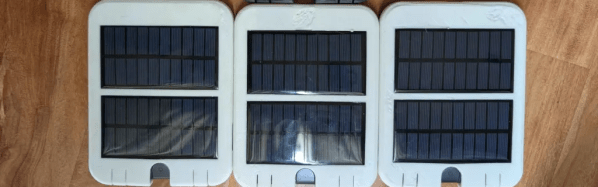
When life gives you lemons, you make lemonade. What if life gives you a pile of old e-book readers? Well, when [spiritplumber] got box of old Nook Simple Touch devices, he decided to design solar-powered cases to help boost the old batteries. It makes perfect sense to us: sunlight readable screen, sunlight chargeable battery.

It looks like he’s got a pair of panels built into the 3D printed case. He recommends using any TP4056-based charger, and tying into the battery test points, not the 5 V supply. It won’t hurt anything if you do, apparently, but the device will think it’s plugged in an refuse to turn off the WiFi. That’s no big deal when you’ve got a continental power grid on the other end of the cable, but charging from a small panel on the back of the case doesn’t always give you enough juice to waste on unneeded radio activity. Especially indoors — these panels are apparently big enough to trickle-charge the device under artificial light, which is a nice, if doubtless slow feature.

The design is open source, and includes SketchUp design files as well as the exported .STL, so if you’ve got a hankering to edit this to fit a different e-book reader, you can. He also provides a handy-dandy guide to root this model of Nook, and if you’re on Hackaday we probably don’t need to explain why you might want to.

We’ve seen the Nook Simple Touch go some interesting places — like into the clouds as a glider computer — but solar power is a new hack for this device, at least on this site. We don’t know if [spiritplumber] has a green thumb, but he’s evidently got some environmental bones in his body: his last featured project was about improving quadcopter efficiency with a wing and a prayer.

Simulating The Game Boy Printer’s Actual Paper Output

Sometimes, we appreciate electronic devices not for their outright performance and crystal clear output, but precisely because they kind of suck in a unique and charming way. The Game Boy Camera, and its companion the Game Boy Printer, are much loved for precisely this reason. [Raphael BOICHOT] decided that he wanted to simulate the analog reality of the latter printer’s output in code, and set about the hefty coding task.

The result is the Game Boy Printer Paper Simulation, and it does a great job of reproducing the grainy, somewhat noisy output of the original thermal printer. The simulation was coded with the assistance of multiple high-resolution scans of the original printer’s output, which allowed [Raphael] to create a mathematical model of how the original digital pixelized image came out when hot thermal print head was put to paper.

What started with a single dot became a fully-fledged simulation package that can be run in MATLAB and Octave. It allows the end user to generate legitimate-looking images of Game Boy Printer output without actually having to own the printer and a roll of thermal paper.

We’ve seen Nintendo’s much-beloved printer before, such as this hack that turns it into an 8-bit photo gun. If you’re meddling with thermal printers yourself, be sure to let us know!


Nook Simple Touch As A Glider Computer

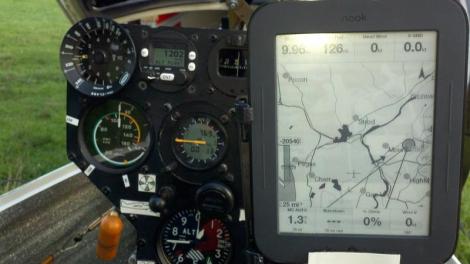
Look at the beautiful screen on that Nook Simple Touch. It has a lot of advantages over other hardware when used as a glider computer running the open source XCSoar software. The contrast of the display is excellent when compared to an LCD or AOMLED. That’s quite important as gliding through the wild blue yonder often includes intense sunlight. The display is also larger than many of the Android devices that have been used for this purpose. There are a few drawbacks though. One is that unlike other Android devices, this doesn’t have a GPS module built into it. But the price point makes up for the fact that you need to source an external module yourself.

This isn’t the first time we’ve seen the device used as a navigational display. This other hack put a simple touch on a sailboat for the same direct-sunlight-readability reason. For $100, and with the ability to root the system for use as an Android device, we expect to see this to keep popping up all over the place as a simple interface for a multitude of projects.

After the break you can see a video comparing the software running on a Nook display to one on a Dell Streak 5 LCD tablet.

Continue reading “Nook Simple Touch As A Glider Computer”









