Retrocomputing On A Chip

New electrical components enable us to reconstruct old wiring more efficiently. Especially, the accessible and cheap FPGA kits which offer the possibility to put together wiring of many old computers as an “on-a-chip” solution.

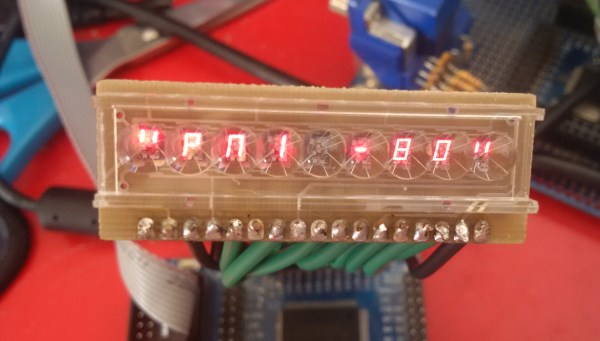
When I managed to get a hold of an old bubble LED display and a pretty mechanical matrix keyboard, I decided to build a replica of an old single board computer. Logical options seemed to be to build either KIM-1 or Heathkit ET-3400. Replicas of KIM-1 already exist, even for Arduino, so my task would be reduced to connect the keyboard and display. But then I told myself that I would use the fact that my bubble display has 9 positions as an excuse to build the legendary Czechoslovak Single Board Computer PMI-80 which used the same display. My replica is an FPGA, or rather an FPGA emulator of this very computer.
Continue reading “Retrocomputing On A Chip”

A Z80 Computer With Switches And Blinkenlights

While most people who build their own computer from chips want the finished product to do something useful, there’s something to be said about a huge bank of switches and a bunch of blinkenlights. They’re incredibly simple – most of the time, you don’t even need RAM – and have a great classic look about them.

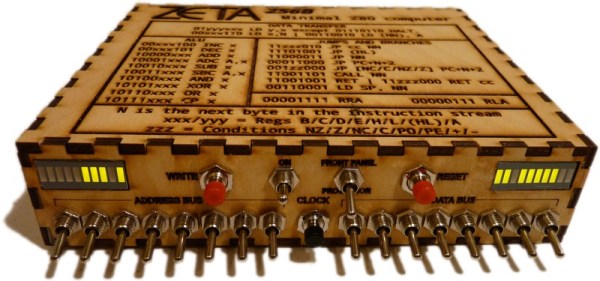
[Jim] wanted to build one of these computers and wound up creating a minimal system with switches and blinkenlights. It’s based on the Z80 CPU, has only 256 bytes of RAM, and not much else. Apart from a few extra chips to output data and address lines to LEDs and a few more to read switches, there are only two major chips in this computer.

With the circuit complete, [Jim] laser cut a small enclosure big enough to house his stripboard PCB, the switches and LEDs, and a few buttons to write to an address, perform a soft reset, and cycle the clock. One of the most practical additions to this switch/blinkenlight setup is a hand crank. There’s no crystal inside this computer, and all clock cycles are done manually. Instead of pushing a button hundreds of times to calculate something. [Jim] added a small hand crank that cycles the clock once per revolution. Crazy, but strangely practical.

[Jim] made a demo video of his computer in action, demonstrating how it’s able to calculate the greatest common divisor of two numbers. You can check that video out below.

Continue reading “A Z80 Computer With Switches And Blinkenlights”

Multi-target IDE For 8-Bit CPUs

A long time ago, [Martin] played with old 8-bit computers. Recently, he’s been honing his assembly skills again, and the idea of an IDE for a boatload of old systems came to him. After a year of work, he announced a multitarget IDE for 8-bit computers that works in your browser.

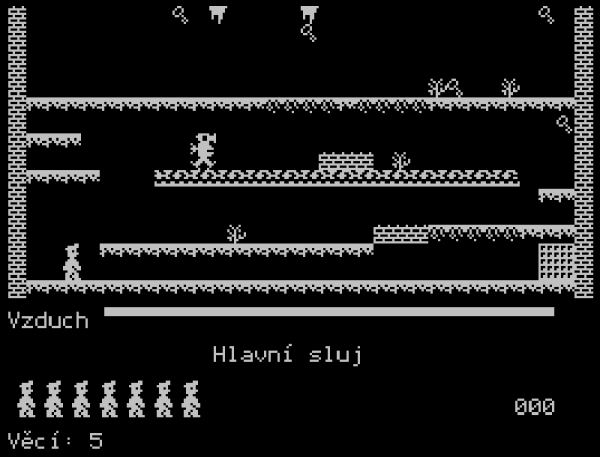
The project is called ASM80, and includes a code editor, a workspace to put all your code, compilers for the 8080/8085, Z80, 6502, 6800 and 6809 CPUs, emulators for all these CPUs, and emulators for a few Czech computers, the ZX Spectrum, and a few of [Grant Searle]’s single board computers.

What makes this project interesting is the syntax for all the different CPUs is pretty much the same. It’s a real, modular code editor that supports macros and everything you would expect for a code editor for ancient computers.

You can check out an assembler description here. [Martin] also has an offline, desktop-based version of ASM80 called IDE80, with a video demo of that below.

Continue reading “Multi-target IDE For 8-Bit CPUs”