The Trains With Rubber Tires

The train was one of the game-changing inventions that defined the Industrial Age. No more would humanity rely on tempestuous animals to haul goods and passengers great distances across the land. Fire and steam came along to rapidly increase the speed of travel and transformed the very fabric of society itself.

To this day, the vast majority of train networks rely on the same basic principle—heavy locomotives and carriages running steel wheels on steel tracks. Yet, there is a curious alternative twist on this concept that sees trains of carriages riding on tires instead. But what would possess anyone to build a rubber tired train?

Continue reading “The Trains With Rubber Tires”

The Windows Interface You Didn’t Like, For Linux

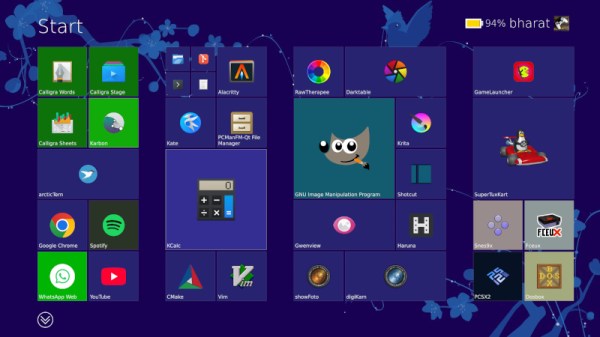
If you were asked to pick the most annoying of the various Microsoft Windows interfaces that have appeared over the years, there’s a reasonable chance that Windows 8’s Metro start screen and interface design language would make it your choice. In 2012 the software company abandoned their tried-and-tested desktop whose roots extended back to Windows 95 in favor of the colorful blocks it had created for its line of music players and mobile phones.

Consumers weren’t impressed and it was quickly shelved in subsequent versions, but should you wish to revisit Metro you can now get the experience on Linux. [er-bharat] has created Win8DE, a shell for Wayland window managers that brings the Metro interface — or something very like it — to the open source operating system.

We have to admire his chutzpah in bringing the most Microsoft of things to Linux, and for doing so with such a universally despised interface. But once the jibes about Windows 8 have stopped, we can oddly see a point here. The trouble with Metro was that it wasn’t a bad interface for a computer at all, in fact it was a truly great one. Unfortunately the computers it was and is great for are handheld and touchscreen devices where its large and easy to click blocks are an asset. Microsoft’s mistake was to assume that also made it great for a desktop machine, where it was anything but.

We can see that this desktop environment for Linux could really come into its own where the original did, such as for tablets or other touch interfaces. Sadly we expect the Windows 8 connection to kill it before it has a chance to catch on. Perhaps someone will install it on a machine with the Linux version of .net installed, and make a better Windows 8 than Windows 8 itself.


Interactive Subway Map Talks You Through The Route

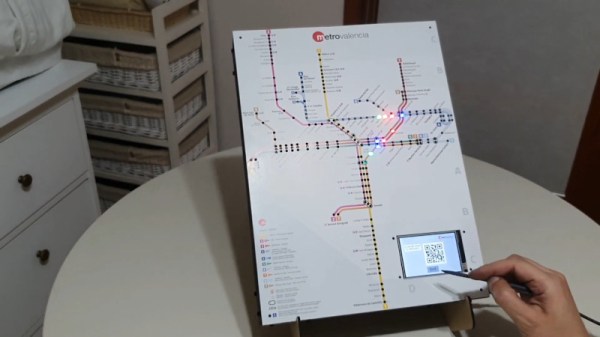
Old-school rail monitoring systems had amazing displays of stations and tracks covered in flashing lights that tracked the progress of trains along a route. While it’s unlikely you’ll fit such big iron from the mid-20th century in your home, you can get a similar aesthetic with [Kothe’s] interactive subway information display.

The display relies on an Arduino Mega 2560 Pro Mini as the brains of the operation. It drives strings of WS2812B LEDs which correspond to stations along the various metro lines in the area. Additionally, the microcontroller drives a 4.3″ Nextion LCD display. The Nextion displays have the benefit of acting as a self-contained human machine interface, running their own controller on board. This means the Arduino doesn’t have to spend cycles driving the display, and the Nextion hardware comes with a useful software package for quickly and easily designing GUI interfaces. For further feedback, a DFPlayer MP3 module is used to allow the system to playback prerecorded voice samples that provide information on the rail system. The attractive front panel is made with lasercut acrylic and a color printed acetate sheet.

It’s a build that bears striking similarity to real rail information systems fielded by railways around the world. We can imagine such a device being particularly useful in a backpacker’s hostel or university dorm to help those new to town find their way around. If you prefer a more stripped-back aesthetic, we’ve seen a barebones PCB build done as well. Video after the break.

Continue reading “Interactive Subway Map Talks You Through The Route”

Aerodynamic Tail Makes Geo Metro Even Cooler

[MetroMPG], an environmentally friendly car enthusiast from Ontario, added a tail to his car to increase gas mileage. This 1998 Pontiac Firefly is a sibling of the cheap and popular Geo Metro. He had already done some work to cover a portion of the rear wheel wells to reduce drag. Using cardboard, duct tape, and an aluminum frame he extended the rear of the car by around six feet.

The results are pretty impressive. His extensive testing can be seen in the video after the break and reveals a Miles Per Gallon increase of 15.1% at 90 km/h to get to 64 MPG. The tail is removable but we’re thinking it’s a pain to keep relocating the tail lights from the original body to the removable one.

Now we’re wondering if someone is doing this to our Smurf-blue Metro that we sold to the junk man for $100 back in 2001. It ran great, if you weren’t caught in the cloud of blue smoke coming out the back.

Continue reading “Aerodynamic Tail Makes Geo Metro Even Cooler”

Geo Metro Halved For Better Mileage


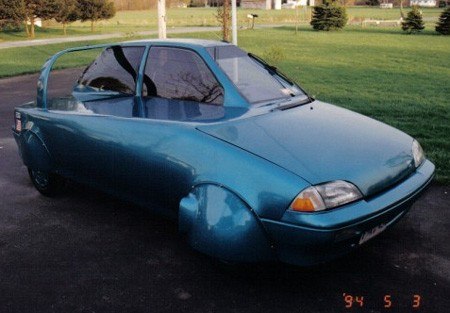
[Doug Heffron] modified this 1989 Geo Metro way back in 1993. Gas prices had just started breaking $1.00/gallon and he wanted to show manufacturers how to build a fuel efficient vehicle in such troubling times. The car already got 58mpg (Prius: 46mpg), but [Doug] decided he could do better with some aero modifications. The car was converted to tandem seating and stripped of any extra weight. In its final form, it got 75mpg, but then gas prices stabilized and it was laid to rest in a shed. You can find out more about the car and see photos from the build on its site (painful resizing).

[via Autoblog]