On The Wisdom Of Replacing A NiMH Module In A Prius Battery Pack

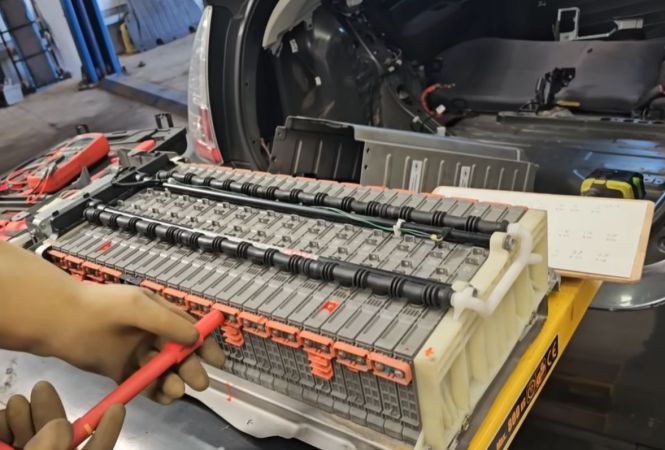
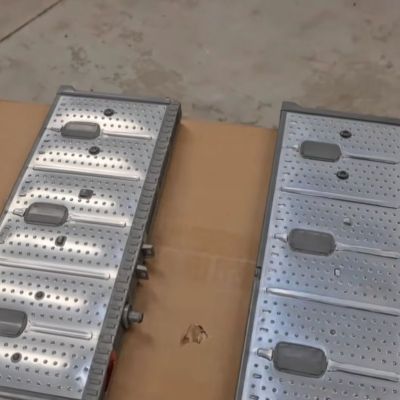
Old versus new Prius NiMH module. (Credit: HubNut, YouTube)

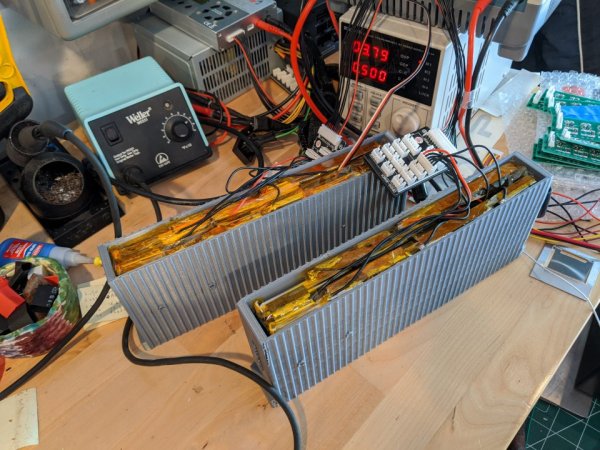
It’s possible to get a pretty good deal on used Toyota Prius cars, but as with all hybrid cars that also means a used battery pack and resulting issues. In the case of the Gen 2 Prius that [HubNut] recently acquired it was clear that its battery was effectively toast, with the engine running constantly and the car often giving up due to detected issues with the pack. After getting to an EV-focused garage for repairs, a spare NiMH module was used to replace a problematic module to bring it back to good health, while raising the question of how sensible such a repair is.

Certainly, compared to the average BEV where a much larger battery is generally integrated well into the frame, a Prius makes things very easy, with the compact battery readily accessible and removable from the trunk. It is also a very modular battery, with some elbow grease and bolt-twisting enough to disassemble it.

Even with that it still a high-voltage battery with all the associated risks, and as raised in the comments there’s a big question about putting a new(er) cell into a pack with more worn-out NiMH cells as generally the cells wear out fairly evenly. While this fix can give the pack some more life, the new cell won’t match the internal resistance and other parameters of the pack, leading to issues like voltage drift. Then there’s the issue that if one cell failed, others probably aren’t far behind, so this hack would soon become a regular ritual.

Much like swapping one bad 18650 Li-ion cell in a bigger battery, it’s probably a more sustainable solution to simply replace the entire battery at once, or at least replace all modules or cells to properly refurbish it. For [HubNut] this fix suffices because he suspects that this pack was already assembled from random modules, it’s an important consideration to make if you don’t enjoy ending up stranded during a trip.

Continue reading “On The Wisdom Of Replacing A NiMH Module In A Prius Battery Pack”
Electric Jeep With Modified Prius Hardware

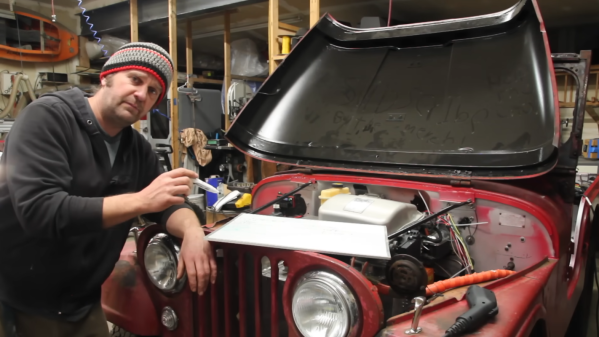
On the list of cars widely regarded as the most reliable vehicles ever built, up there with the Toyota Land Cruiser, the Honda Civic, and the Mercedes W123 diesels, is the unassuming Toyota Prius. Although it adds a bit of complexity with its hybrid drivetrain, its design eliminates a number of common wear items and also tunes it for extreme efficiency, lengthening its life and causing minimal mechanical stress. The Prius has a number of other tricks up its sleeve as well, which is why parts of its hybrid systems are often used in EV conversions like [Jeremy]’s electric CJ-5 Jeep.

Inside the Prius inverter is a buck/boost converter used for stepping up the battery voltage to power the inverter and supply power to the electric motor. [Jeremy]’s battery is much higher voltage than the stock Prius battery pack, though, which means he can bypass the converter and supply energy from his battery directly to the inverter. Since the buck/boost converter isn’t being used, he can put it to work doing other things. In this case, he’s using it as a charger. Sending the AC from a standard EV charging cord through a rectifier and then to this converter allows the Prius hardware to charge the Jeep’s battery, without adding much in the way of extra expensive electronics.

There are some other modifications to the Prius equipment in this Jeep, though, namely that [Jeremy] is using an open-source controller as the brain of this conversion. Although this video only goes into detail on some of the quirks of the Prius hardware, he has a number of other videos documenting his journey to convert this antique Jeep over to a useful electric farm vehicle which are worth checking out as well. There are plenty of other useful things that equipment from hybrid and electric vehicles can do beyond EV conversions as well, like being used for DIY powerwalls.

Continue reading “Electric Jeep With Modified Prius Hardware”

Teardown Of A 5th Generation Prius Inverter

The best part about BEV and hybrid cars is probably the bit where their electronics are taken out for a good teardown and comparison with previous generations and competing designs. Case in point: This [Denki Otaku] teardown of a fifth-generation Prius inverter and motor controller, which you can see in the video below. First released in 2022, this remains the current platform used in modern Prius hybrid cars.

Compared to the fourth-generation design from 2015, the fifth generation saw about half of its design changed or updated, including the stack-up and liquid cooling layout. Once [Otaku] popped open the big aluminium box containing the dual motor controller and inverters, we could see the controller card, which connects to the power cards that handle the heavy power conversion. These are directly coupled to a serious aluminium liquid-cooled heatsink.

At the bottom of the Prius sandwich is the 12VDC inverter board, which does pretty much what it says on the tin. With less severe cooling requirements, it couples its heat-producing parts into the aluminium enclosure from where the liquid cooling loop can pick up that bit of thermal waste. Overall, it looks like a very clean and modular design, which, as noted in the video, still leaves plenty of room inside the housing.

Regardless of what you think of the Prius on the road, you have to admit it’s fun to hack.

Continue reading “Teardown Of A 5th Generation Prius Inverter”

Old Prius Gets Upgraded Batteries

So many of the batteries made today are lithium batteries of some sort, from mobile phones, laptops, and drones to electric cars and grid storage solutions. But this technology is relatively new; even as late as the 90s and early 00s the only widely-available batteries for things like power tools or the new hybrid vehicles coming on the market were nickel-metal hydride (NiMH). While it was good for the time, they don’t hold up to all of the advantages lithium has. There’s still plenty of hybrid vehicles on the road using these batteries, so if you’re driving an older Prius and want to give it a modern refresh, there’s a quick option to swap your old batteries.

Despite lithium technology being available for several decades, the switch to lithium for the Toyota Prius wasn’t instant, with many variants still using NiMH batteries as late as the 2020s largely because the NiMH batteries are less expensive and less maintenance-intensive than lithium batteries are. As these batteries lose capacity, the cars are still driveable but the advantages of the hybrid drivetrain won’t be as accessible anymore. The upgrade, from a company called Project Lithium, replaces these batteries with modern lithium technology that can improve the efficiency and performance of these cars even above their original capabilities since lithium batteries have more power density.

With the Toyota Prius being among the most reliable vehicles on the road thanks to the electric motor in the hybrid drivetrain taking a lot of stress off of the internal combustion engine, it’s often worth upgrading these old batteries to modern ones to squeeze every last mile from these workhorses as possible. With many of the replacement processes being almost as simple as lifting out an old battery and placing a new one in, it can be a no-brainer if that’s the only issue with the vehicle otherwise. This is also true of all-electric vehicles as well, although the process to replace the battery can be a little more involved.

Thanks to [JohnU] for the tip!

Using Super-Efficient Solar Cells To Keep Your Electric Car’s Battery Topped Up

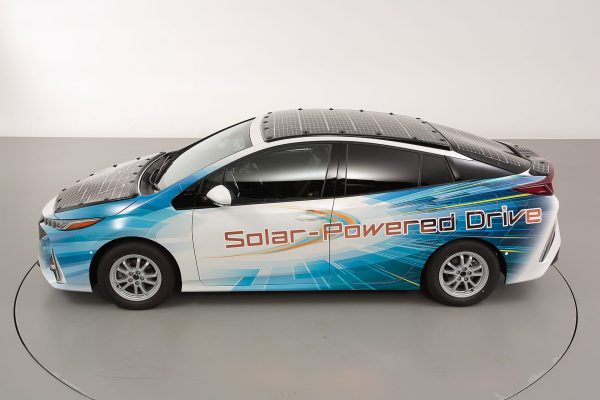
Who hasn’t thought of sticking a couple of solar panels onto an electric car’s roof to keep its battery at 100% charge while it’s parked out in the sun? While usually deemed impossible due to the large number and weight of PV solar cells required to get the necessary amount of energy, this hasn’t kept Toyota’s engineers from covering one of their Prius cars with 34+% efficient solar cells.

Some may remember the solar roof option which Toyota previously offered years ago. That system produced a mere 50 W and was only used for things like running the AC fans, indirectly extending the battery charge. In 2016 Toyota brought back this system, in a much improved version. This upped the power output to 180 W, allowing it to power all secondary electronics in the Prius, even allowing it to add a few extra kilometers (roughly 6.1 km/day) to the Prius’ range if one were so inclined.

This newest prototype pretty much goes for broke, reminding us of the cars used in the World Solar Challenge, such as the Dutch Stella and Stella Lux positive-energy solar cars by the team at the University of Eindhoven. Who coincidentally have done a spin-off, setting up a company to produce the Lightyear One, which at least on paper sounds amazing, and potentially may never have to plug it in.

Continue reading “Using Super-Efficient Solar Cells To Keep Your Electric Car’s Battery Topped Up”

Hackaday Links Column Banner

Hackaday Links: September 23, 2018

In the spirit of Nintendo’s NES mini and Super NES mini, Sony is releasing a tiny version of the Playstation. It’s a hundred bucks in December and it comes with Final Fantasy VII, what more do you want? While that’s marginally cool, check out the forums and comments of gaming blogs for some real entertainment — those damn kids won’t get off my lawn and are complaining the included controllers don’t have analog sticks.

This man has solved the range problem for electric cars. He hacked a Prius to run off the overhead wires for San Francisco’s Muni system. Yes, if you want something amazing, here it is. The pantograph/pole/whatever it’s called was acquired ‘somehow’, with the implication that it was stolen. The overhead lines are 600 V, and a Prius’ battery pack is usually 273 V; apparently he “uses up the excess power on a whole lot of resistors, full-time headlights, and a kick-ass stereo system.”. Dear lord, we need a real technical write-up for this one.

get on my level

Humanity’s most impressive accomplishment to date is Twitch Plays Pokemon. This was a cooperative game of Pokemon, with thousands of people mashing buttons. Everyone (eventually) beat the Final Four, but the most impressive part was the Power Plant. We made it through the Power Plant, and we got Zapdos. I was there. It was incredible. Twitch Plays Pokemon has been reborn and rebranded several times, but this one might be good: Twitch Programs a Commodore 64. It’s a (virtual) C64 hooked up to Twitch. If there’s one person watching the channel, you can slowly type out a BASIC program one… character… at… a… time. If there’s more than one person watching, the entire ordeal devolves into the horrors of a democracy, but you might be able to get something done. Have fun.

Slimline Proximity Fob Makes Life Easier

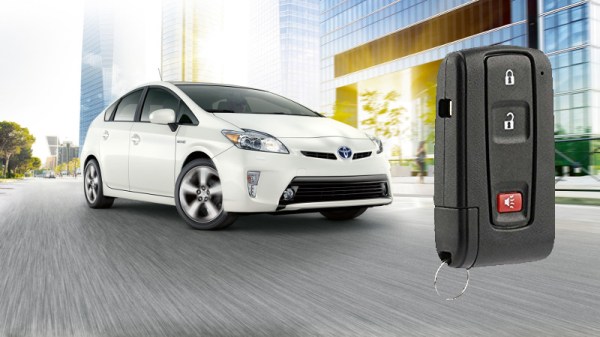
Modern cars these days tend to come with proximity keys, which allow the driver to unlock and start the vehicle without having to remove the key from one’s pocket. While this is a great usability upgrade, for some reason key fobs continue to be bulky plastic monstrosities that when stuffed into a pocket can easily ruin the lines of a well-chosen outfit. This wasn’t good enough so [Patrick] decided to sort it out.

Starting with a Prius key, the first step was to disassemble the already broken key fob and separate out the PCB from the case and battery holder. With those removed, a coin cell was soldered to some wires connected to the PCB. As a substitute for the original case, a plastic card was cut up and the PCB inserted within, allowing the setup to fit neatly in a wallet’s card pocket. Lashings of tape bring the project home.

Unsurprisingly, it works, and works well. It raises the question why key fobs are so large and ungainly, taking up so much precious pocket space. We’d love to see even slimmer takes on this with 3D printed enclosures or even completely redesigned PCBs. Give it a go, and hit up the tip line. Else, check out how key fobs are routinely hacked to steal cars.