Comparing 12 VDC Air Fryers With Regular 240 VAC Ones

That boiling water is a contentious topic of discussion is clear, but what about hot air? When you take a 12 VDC, 280 Watt-rated air fryer and pit it against a bog-standard 240 VAC, 1400 Watt unit, which one would you want to use when you’re doing some camping or other exciting off-the-grid opportunities? Unlike with boiling water the physics aren’t as clear-cut here, so [Cahn] did some testing to figure out exactly what the efficiency numbers look like

Since air fryers rely on the transfer of thermal energy from the resistive heating element into the food, any thermal energy that’s not immediately transferred is effectively wasted. This, combined with the relatively low power rating and thus much higher time demand of the low-voltage air fryer is enough to set one’s expectations pretty low.

As scientific test samples chicken nuggets were used with the test, following a preheating period for the 12 VDC unit. Both units managed to hit a safe temperature inside the nuggets after 20 minutes, thus successfully staving off food poisoning, but the browning with the 240 VAC air fryer was much better.

As for the efficiency, the 12 VDC unit required 150 Wh for 20 minutes plus the 10 minutes of preheating, with 45 minutes total at 225 Watt to get proper browning. Meanwhile the 240 VAC unit burned through 250 Wh in 20 minutes, with no pre-heating, though only 230 Wh with no inverter losses included. As a final test, the 12 VDC unit was run at 400 Watt using 14.6 VDC input, which did indeed get it up to temperature much faster.

Thus both are equivalent, just with the caveat that the low-voltage unit will take considerably more time to get the same result. This mirrors the results with boiling water, where most options mostly vary in how much time they require to get water up to a boiling temperature.

Continue reading “Comparing 12 VDC Air Fryers With Regular 240 VAC Ones”

How A Belkin USB Charger Pulls Off A 3 Milliwatt Standby Usage

Belkin charger standby power. (Credit: Denki Otaku, YouTube)

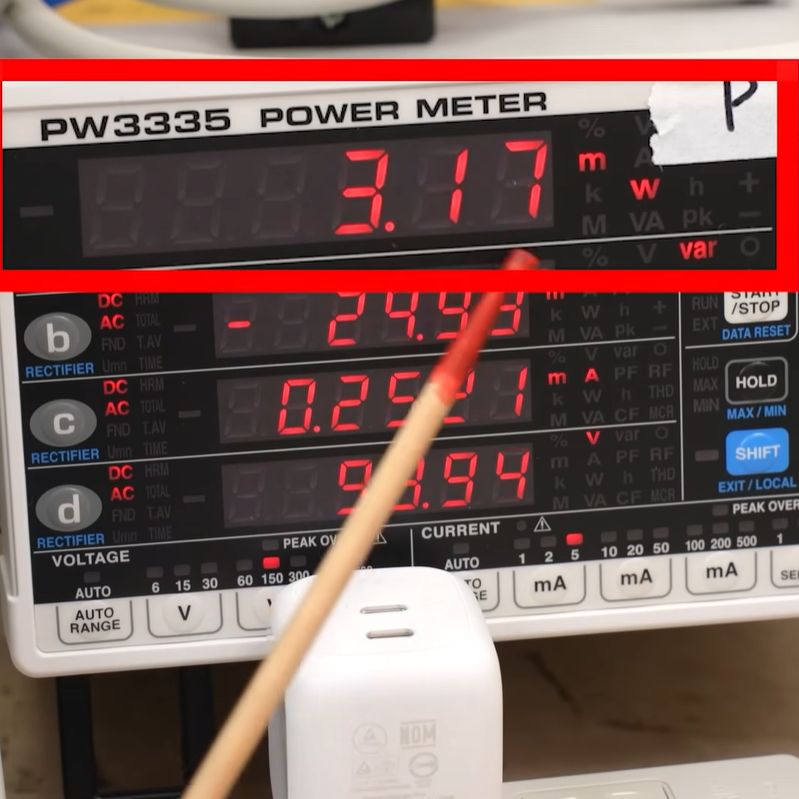
A well-known property of wall warts like power bricks and USB chargers is that they always consume some amount of power even when there’s no connected device drawing power from them. This feels rather wasteful when you have a gaggle of USB chargers constantly plugged in, especially on a nation-sized scale. This is where a new USB-C wall charger by Belkin, the BoostCharger Pro, is interesting, as it claims ‘zero standby power’, which sounds pretty boastful and rather suspect. Fortunately, [Denki Otaku] saw fit to put one to the test and even tear one down to inspect the work of Belkin’s engineers.

Naturally, no laws of physics were harmed in the construction of the device, as ‘zero standby power’ translated from marketing speak simply means ‘very low standby power usage’, or about 3 milliwatt with 0.3 mA at the applied 100 VAC.

Fascinatingly, plugging in an e-marker equipped USB-C cable with no device on the other end caused this standby usage to increase to about 30 mW, clearly disabling the ‘zero standby’ feature. With that detail noted, it was time to tear down the charger, revealing its four PCBs.

Continue reading “How A Belkin USB Charger Pulls Off A 3 Milliwatt Standby Usage”

A Linux Server That Tweets Power Changes

apcupsd_twitter

Twitter has been used for lots of experiments, both useful and just for fun. [FIRESTORM_v1] sent in his project that falls under the useful category. When he wanted a way to monitor his server’s power statistics, Twitter was a logical choice. Similar to the Tweet-a-Watt, he wrote a script that posts messages from APCUPSd to a Twitter account that he follows, and gets the updates on his phone. [FIRESTORM_v1] documents all of the scripts he used and the steps to get your server up and tweeting.