50MHz to 100Mhz scope conversion

posted Mar 10th 2010 2:00pm by
filed under: classic hacks, tool hacks

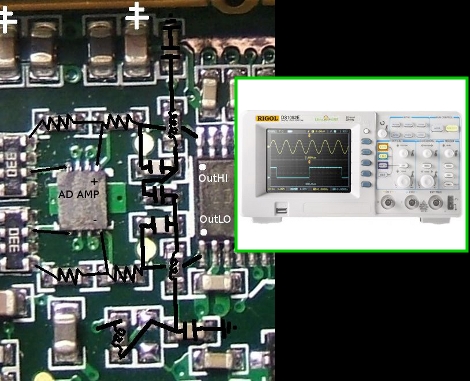
[Ross] is the proud owner of a 50 MHz Rigol DS1052E oscilloscope. He’d like to have the 100 MHz version but the $400 difference in price puts it out of his reach. After some extensive poking around on the PCB and pouring over datasheets, he managed to reverse engineer the design and upgrade to a 100 MHz version. This is as easy as desoldering one capacitor to deactivate a high-pass filter present in the lesser model of scope, unlocking the faster potential of its bigger brother.


95 Responses to 50MHz to 100Mhz scope conversion

  • poiso says:

    that is pretty damn snazzy!

  • mrgoogfan says:

    then why does it cost $400 for a few resistors?

  • poiso says:

    because its cheaper to create a single pcb and change parts for each model type. manufacturers do it all the time

  • Qhartman says:

    Edit: it’s “pored over data sheets” not “poured”.

  • jc says:

    It costs $400 more because of perceived value. It’s not uncommon for “lesser” models to be the same as a higher end model of a product, with parts omitted, a slower clock, or different software.

    Why would you manufacturer two completely different boards, when you can make one, change one part, and sell the lesser one at a discount (or the better one at a price increase, depending on which way you want to look at it).

    Back in the olden days, IBM doubled the speed of one of their mainframes by clipping a single wire. And that was a multi-thousand dollar upgrade.

  • rallen71366 says:

    Yes, we did something similar all the time on a communications monitor (shortwave to microwave, man-portable) by entering into a configuration screen and entering a passcode. BOOM! That’s a $5000 dollar upgrade. Pay us now.

  • Now this, THIS is exactly the type of thing that I think typifies Hack-a-Day. Turning cheap things into expensive/better things is what I fell in love with so many years ago!

  • Haku says:

    That’s simply mega! (hz)

    Best get an identical one soon before the manufacturers cotton on to the fact we know how to save $400 with a simple soldering iron.

  • sheetforbrains says:

    @poiso: It’s called profit margin

    All companies do it but for PR reasons it’s kept discreet.

  • RJSC says:

    Damn greedy cheating bastards!
    People who do this should be put in jail!

  • therian says:

    this was long suspected in hobby community, FINALLY it proves to be true, I was waiting for this

  • taylor says:

    Yeah, on the HAAS CNC mills, a lot of the upgrades just require an unlock code. And these are $2000 upgrades!

    Frustrates me. I wish someone could hack the things!
    -taylor

  • David says:

    RJSC, they shouldn’t. It’s a perfectly valid technique, you chose what to buy after all.

  • mungewell says:

    When it comes to unlock codes, doesn’t it make sense to recover all that software development time by allowing ‘me’ to sell you upgrades – otherwise I’d have to charge everyone extra.

    When it comes to the physical, it might be that the other hardware on the board does not support ‘correct’ operation at the higher sample rates. Although it’s more likely that they are selling at the price the market can sustain.

  • Dorkhead says:

    Shouldn’t that be: “deactivate a low-pass filter”? Current synopsis says: “deactivate a high-pass filter”.

  • Skitchin says:

    Diagnosing the original circuit presents a problem similar to photographing your only camera. I would expect a money saving shortcut such as this to remain implemented only until the public catches on and they see it cut into their sales index.

    @Jack of All Trades: Same

  • kristian says:

    wouldn’t you need to remove a LOW-pass filter in order to get a higher frequency response? high-pass doesn’t make sense…

  • kristian says:

    @Dorkhead: oops, i didn’t see your comment before i posted

  • Odin84gk says:

    “Damn greedy cheating bastards!
    People who do this should be put in jail!”

    Grow up and enter the real world. If I’m designing a scope like this, I need to make $. The way to make money is to charge a lot of money for your hard work.

    Well, how about the guy who really wants your hardware, but can’t afford paying the full amount? Well, we will give them a price cut, but it won’t totally pay for all of the R&D we put into the hardware. Plus, if I give you the same item for less, then EVERYONE will want this great scope for less.

    I’ll cut you a deal: I’ll give you the scope, but I’m going to limit it to 50MHz. Don’t like it? Don’t buy it.

    Tektronix has a line of scopes that all have the same hardware/firmware. If you want to unlock their full potential, you have to pay extra for little security tabs that unlocks the special features. If it wasn’t for this “trick”, I wouldn’t be able to afford any kind of a scope, especially one that can do full USB, SPI, and UART decoding while doing x y and z.

  • SparcMX says:

    Reminds me of the ol’ budget Radeon cards, where removing 1 cap and relocating another turned it into a top end behemoth.
    These hacks are gold, like an easter egg hunt :D

  • SparcMX says:

    @Odin84gk
    Why hack? because we can. Heres an analogy. My V8 car has an exhaust system that reduces power output slightly. What do I do? Chop it out and replace it with a better system, because the design allows for it.

    If manufactures allow this to happen by design, then its Stiff s–t to them. Cry all you like about profit loss, if you base a company on just that then you deserve the nastiest of hacks.

    Wouldn’t a company that designs scopes realize their primary customer base are engineers (duh) more reason to pump up some on-chip security or a limiting system (not just high and low pass filters that can be blow off smd style).

    Only the manufacturers and retailers will cry.
    Customers rejoice!

  • danmukk says:

    From what I could tell in the forum thread the hack was still being tested, some signal ghosting apparent. Any confirmation?

  • Adam says:

    It’s called market segmentation, virtually everyone does it. I bought more than one Nvidia GeForce card that with a minimal amount of soldering was easily transformed into the higher-end Quadro and much more expensive variant.

    This same thing applies to CPUs from Intel and AMD. All the chips in a series are more or less exactly the same. Granted due to incredibly small differences some chips are able to run faster than others but as the manufacturing process is perfected more and more are able to run at the top speeds. This is the reason companies introduced multiplier locks, it makes overclocking a much coarser grain game.

    Welcome to the “free market”, enjoy your stay.

  • ross says:

    The signal ghosting was from testing the channels in parallel without isolation. Normally a 50 ohm terminator is used at the end of each BNC cable when coming off of a single signal source, I didn’t know that when I constructed my home-made cables. When testing with probes, that doesn’t happen as much. I think there’s really no way around that because I’m essentially testing the scopes response using itself.

    My concern is that there may still yet be some filter somewhere on the underside of the board, because another person with a 100 MHz model found the same filter on his board. There are two vias travelling to unknown locations, however, which may enable/disable the filter by some command. If there is another filter, it’s curious that the bandwidth response seems to be exactly what it would be in a 100 MHz scope already.

    The internal model number may be changed with NI VISA commands and the firmware for the Mixed-signal version (also identical hardware) is out in the wild too. More on that to come, after I graduate probably!

  • Nik says:

    I have one of those scopes sitting on my desk, most tempting.

  • reboots says:

    Guess what? Those expensive Tektronix feature dongles contain nothing more than a 24C02 serial eeprom. The eeprom contains a simple hex string with the name of the feature. For example, this is the string for the DPO4VID HDTV triggering module:

    ff ff ff ff 44 50 4f 34 56 49 44 00 ff ff ff ff

    Substitute DPO4AUTO, DPO4COMP, or DPO4EMBD for fun and profit. Tested with Tek DPO4000 scopes.

  • dooglehead says:

    It would be funny if someone who doesn’t know about this unintentionally drops it or something, knocking the cap out of the pcb. When they go to use it again, they realize that it can go up to 100mhz.

  • Stephen says:

    Too bad my 30+ y/o Tektronix can’t be “upgraded” this easily.

  • xorpunk says:

    This is kind of like demo software that can be patched to unlock full functionality. Release teams call ones with the actual code removed ‘true-demos’. Making a ‘true-demo’ or streaming content with SID salted crypto marginally reduces the likelihood your software will be pirated via reversing. Same applies to hardware logic.

  • AlmostThere says:

    We ran in to this way back in the 1980′s; a positive only programmable power supply cost hundreds more with an extra relay (and a DIP switch setting) to make it go positive & negative. We were told it would be against the law to modify it ourselves, so we paid the extra.

  • Jack Sprat says:

    This site needs a new category for hacks like this, something like Get Cheap Stuff and Hack It to Awesomeness. Of course, feel free to come up with a better name.

  • anon says:

    @AlmostThere

    “We were told it would be against the law to modify it ourselves, so we paid the extra.”

    You seriously bought that?

  • Jay says:

    @Jack Sprat

    How about:

    From Norm to Awesome ?

  • Pierce Nichols says:

    The term for this is price discrimination, and it’s perfectly legal. They charge the people who are willing to pay more an extra $400 and still get some profit from the people who aren’t. Realistically, not enough people will hack their scopes to change this dynamic at all. The people who hack for the $400 upgrade weren’t really willing to pay up in the first place, so they don’t actually lose anything.

    Personally, measurement tools are the one thing in my shop I won’t hack. It’s more important for me to be able to really trust the output than to save a few bucks. Unreliable measurement tools can cost you a hell of a lot more than $400 in lost time and components.

  • AlmostThere says:

    anon;
    >You seriously bought that?

    I didn’t, my company did.

  • blizzarddemon says:

    Interesting how your paying $400 for the uncrippled version of the same hardware. lol

  • cantido says:

    When you buy “features” you also buy support for those features and some sort of warranty that they work according to the terms agreed during the purchase… so yeah, you can get that feature by fiddling with bits in an eeprom or moving some jumpers around; All that is actually beside the point.

    In the scope situation.. yeah you can move jumpers around and make your 50mhz scope into a 100mhz scope. You have no come back if it turns out the ADCs etc in your scope can’t actually handle sampling at that rate.

    You get what you pay for.

  • pwsome says:

    @Adam
    “Welcome to the “free market”, enjoy your stay.”

    Here we go – bitch and moan about the free market.

    Yes, it is the free market – Rigol is free to manufacture whatever they like, however they like and charge whatever they like for their products, and you’re free to buy it or not. Get over it.

  • ross says:

    The ADCs are identical in both versions, as are all of the other chips (so far as I can tell). The sampling rate is the same for both versions too, that’s what tipped everyone off that the front-end could probably be hacked.

  • fenwick says:

    In an oscilloscope of all things. I can see if you have extra features on a TV, and shorting a couple points unlocks the expensive features, but on a scope? Everyone that uses a scope has some at least minor electronics experience, and would be able to pull this off. It’s just funny.

  • anon says:

    @pwsome
    “@Adam
    “Welcome to the “free market”, enjoy your stay.”

    Here we go – bitch and moan about the free market.

    Yes, it is the free market – Rigol is free to manufacture whatever they like, however they like and charge whatever they like for their products, and you’re free to buy it or not. Get over it.”

    You mean buy it and hack it or not.

  • Buzz Bannister says:

    I seem to recall Intel Celeron chips having a math feature deactivated and with a pretty simple fix the chip could be upgraded.
    Any of you higher qualified people remember that??

  • jproach says:

    Great post/hack, but I would recommend against following the procedure until he’s verified the actual difference between the two versions.

  • ross says:

    @Kristian
    @Dorkhead
    BTW, it is a high-pass filter. Read the post, there is a schematic. The high-pass filter is located between the hi/lo outputs of an amplifier, rather than a low-pass filter between the amplifier and the output.

  • ross says:

    @jproach
    The difference isn’t verified, that’s true.. but if you read the post you will see that someone with the 100 MHz version didn’t notice any apparently harmful difference, while I see very noticeable bandwidth gains proportionate to what they should be if the unit is now operating at 100 MHz. They’re graphed, but ignore the second time I tried that as I didn’t use proper cabling. Either way, the filter is in a place where it won’t affect the scopes operation, unless you can explain otherwise. It’s right between the ADC buffer and the amplifier.. the ADC in an oscilloscope has no reason to see a filtered signal that I know of.

    I hope someone tries this and plots the output to a 200 MHz scope, as someone at the EEVBlog forums has already done this and plotted the 50 MHz scope output. The two could be compared and it would be the final verification of the hack, IMO.

    If it turns out to be a bad hack, it’s easy enough to replace the capacitors.

  • nrp says:

    Perfect timing! I got the 50Mhz Rigol yesterday.

  • threepointone says:

    i don’t think the story is over yet–but this is a good start to hacking this guy. i’ve been waiting for someone to start work on this for a while.

    this practice is done everywhere, and really it’s completely fair. it’s just that most people find it difficult to grasp that they’re not only paying for the physical product they buy. with all the software pirating these days and low cost products from china, it’s even harder for people to remember that it costs money to design things.

    look at intel cpus, for example. Or any cpus. the same family is often the exact same die, with some resistor/fuse set. of course, it’s a bit difference here, because of the variance in maximum speed among dies, and each processor is tested for maximum speed. but the same principle holds–you are not directly paying for the price of hardware.

  • steve-o says:

    What a great hack!

  • therian says:

    It give me again two reasons: 1)blame myself for buying pc based scope long time ago and getting 1/10 of rigol abilities spending almost twice 2)get rigol

    any one want to buy bitscope BS310N & logic POD add-on for half price ? :D

  • therian says:

    By the way there is rumors that Rigol DS1052E only 250-300$ on Chinese ebay-like site but you have to do all manually by contacting seller who agree to send it to us. Anyone have experience with taobao.com ?

  • ross says:

    @therian
    I considered that, but there are Rigol knock-offs also, with the same face and everything. Careful.

  • octel says:

    @ross
    If it’s an almost-indistinguishable knockoff then it’s probably made in the same exact factory as the “official” version. It’s probably just as good, too.

  • Wonko says:

    Mobile Phone RF testers…
    They have lots of options…

    To upgrade you get a quote, after giving the S/N – the dealer passes the info to the Manufacture, and they list the Hardware changes needed (if any)…

    If Hardware is require – the unit is sent back and returned upgraded…

    If no Hardware is require – you run a upgrade utility and enter a unlock code – which is locked to the serial number of the tester…

    Depending on what is requires the upgrade can cost up to £30,000… (This on test equipment costing from £20,000!)

  • asdf says:

    Just another proof that our economic system that worked acceptably with solid goods in the past is totally incompatible with the cost reduction brought by the digital age.

    As for that scope… damnit! I was going to buy it a few months ago then David at eevblog gave his enthusiastic review and the price went up everywhere, and now this hack makes it even more appealing. Let’s hope in a few months it won’t end up costing like a Tek.

  • SparcMX says:

    If the company can turn a profit on both models, and both are technically the same (minus 40c worth of components) Then that additional $400 is sweet cream on the cake for the companies bottom line.

    Providing you dont circumvent a copyright mechanism in the device, its open slather (sic).

  • James says:

    “This site needs a new category for hacks like this, something like Get Cheap Stuff and Hack It to Awesomeness. Of course, feel free to come up with a better name.”

    This site already has a name for hacks like this, I would suggest names for the other sorts of “hacks”. I think this is why they now have how-tos and reviews etc.

  • cantido says:

    @Buzz Bannister

    >I seem to recall Intel Celeron
    >chips having a math feature deactivated

    Every vendor has done this since integration got the level that there was enough stuff on a single chip that even if some parts don’t work it has value. I.e. Motorola used to sell cheap “EC” 68030 parts that “didn’t have an MMU” but a good percentage of those chips have an MMU and it works. If bought a batch of those chips and used them in a product that required a working MMU you wouldn’t have a leg to stand on if it turned out the batch of parts you got all had duff MMU’s though.

    The opposite also happens.. there a plenty of products with devices running overclocked or otherwise overrated.

  • cornelius785 says:

    @ross

    There should be an anti-aliasing filter between the signal source and ADC. An impedance matching filter may be needed to, but could also be lumped into the anti-aliasing filter.

  • jeff-o says:

    Excellent timing indeed. My Rigol DS1052 (from DX) is on its way to me as I type! Very tempting hack. I’ll wait until it’s been verified, and if all goes well I’ll try it myself.

  • xorpunk says:

    The whole support and compatibility argument to this is irrelevant. It’s the same circuit with trivial differences in one block. This is just an example of enhanced profit margin.

    If there was noteworthy affect on other components I could see the whole company-Bob type argument. Even then though the manufacturing cost is still well below selling price per unit.

    You think a $150 MATX board for a PC costs $60 to manufacture per unit?

  • therian says:

    @ross
    When both channels modified do they show in phase ?

  • Odin84gk says:

    @SparcMX

    I was not degrading the quality of this hack. I was trying to tell RJSC that price segregation was a legit tactic to maximize profit yet help the people with less money.

  • Don says:

    As several people have pointed out- I’m not willing to risk the calibration of my scope. It’s the one instrument I need to be able to rely on.

    @ross: I realize the scope has the same ADC’s and other components- but it could be that they teted the board and it didn’t meet specs so they derated it. As cantido pointed out- this happens all the time.

    @reboots: Any more information on hacking those DPO4k modules? Now I’m curious what’s in them and how they’re pinned out.

  • ross says:

    @therian
    I haven’t modified both channels. I’ve left the other alone for testing.

    The phase difference is restricted to two regions, if you look at my graph that I made immediately after the hack you’ll see spikes at 20 MHz and 65 MHz. That’s where the Butterworth filter edges are apparent about the cutoff frequency. When I move away from those areas in frequency the phase locks back into place.

  • ross says:

    @Don
    The calibration is fine, I have tested the two channels against one another. If you look at the first test data I took with unmodified vs. modified according to frequency, you’ll see they stay pretty much the same until approaching 50 MHz and about the two points I mention above. After that, it’s a little up in the air until another scope is used to verify, but it clearly hasn’t made it worse. It’s only eight bits of resolution anyhow, any discrepancies you see in the data can easily be explained by that alone.

    The test data I took was verified against test data someone else took of a 50 MHz Rigol scope vs. a 200 MHz Tektronix. If you look at his curves linked in my posts, you can see he has roughly the same measurements I do, which is why I took them in the first place, to verify against his data. My data isn’t as clean, I only took every 2 MHz or so, but it still seems legit to me.

  • reboots says:

    @Don
    I have no more information on the DPO modules. I haven’t handled them myself. However, I don’t believe there’s anything beside the serial eeprom. With pictures of the PCB, it should be trivial to build a “dock” to reprogram the dongles–or make your own from scratch.

    Dell also used a “key” with a serial eeprom to enable expensive RAID features on certain disk array chassis. These keys were widely counterfeited for commercial purposes and are probably still available via eBay. Details here:

    http://www.g-cipher.net/~resin/dp/

  • regulatre says:

    Nice – now it goes “up to eleven”! http://en.wikipedia.org/wiki/Up_to_eleven :) :)

  • The question here is whether this is, actually, a case of the manufacturer artificially handicapping the hardware or whether the 50mhz model of the unit serves as a way for the manufacturer to sell units that failed their QA test at, the more stressful, 100mhz but worked just fine at 50mhz. Companies like Intel, AMD, nVidia, and ATI do this all the time, especially at the beginning of a new product line where semiconductor yields aren’t as good as they can be (though they also, often, continue to handicap perfectly good chips later on in order to produce profitable market tiering). It’s possible that the “ghosting” that some of these mod-ers are seeing is the result of units that failed to pass muster as 100mhz units when they came off the manufacturing line (whether it’s due to a slightly sub-par solder joint/IC somewhere in the circuitry or something else).

  • John says:

    Using the same PCB for various models is pretty common because there’s almost no price difference between a complicated board and a simple one. High quality, low error components can get stupid expensive, though. I’m not even talking ICs – 0.1% and lower caps and resistors can be a hundred times more expensive than the lower tolerance version. Maybe they cheaped out on components?
    Not that it’s a bad hack, but like was said above, I want to trust the calibration of my tools.

  • superbatfish says:

    I was sifting through this thread to see if anyone had made the obvious and yet most important observation here. And no one had — until the last post. I couldn’t agree more with colecoman.

    RF devices are very finicky. My company outsources our PCB manufacture and assembly, but tests and repairs each module in-house to make sure it meets spec. After R&D, testing is BY FAR the most expensive part of producing our products.

    For the company that makes this scope, guaranteeing proper functionality at all frequencies up to 100MHz is undoubtedly more expensive than guaranteeing only half of that. That’s why you have to pay more for the 100MHz version.

    This hack is really neat, but any results you get for signals over 50MHz will have to be presented with an asterisk: “Figures may not be accurate to the o-scope datasheet tolerances.” In fact, once you’ve touched a soldering iron to the scope’s PCB, you could argue that the asterisk would apply for all results.

  • bothersaidpooh says:

    hmm… wonder how many other ‘scopes can be hacked in this way.

    The Tek ones are bulletproof FWIW, if you are able to buy one at auction get it.

    the main headache here would be if results were unreliable (running outside specs could cause unwanted glitches same as overclocking)

    still, if it saves $400 in a hobbyist application its worth it.

  • therian says:

    This is what I was afraid to be since it reminded diode switching filter


    Hello everybody.

    I am new to the forum – but I think I have to correct a few things here…

    The circuit between pins 8 and 9 and the ADC amp indeed limits the bandwidth to about 20MHz – when you activate the “BW limit” from the channel menu!

    When you take a close look on the part in the middle (D1), you see a small grey bar on the right hand side – as this is neither a cap nor a coil, but a diode, supposedly a varactor diode! And the parts at the upper and lower end of the “filter” are no caps either, they are simple resistors (R1 and R2). R1 goes to ground, R2 is HF-shunted to ground via C3. The control signal comes from somewhere via R3 and biases the diode.

    The series circuit of C1, C2 and D1 is a small condenser in the range of well below 1pF to some pF – depending on the control voltage and thus the capacitance of D1.

    When you remove C1 you do not only remove this serial capacitance that limits the bandwidth in any case (at any value of the control voltage) – but you also disable the BW Limit function from the menu altogether!

    Btw., when you look at the real circuit, it now is obvious, that after removing C1 a removal of C2 doesn’t change anything more…

    Andreas

  • Hmmmmm…

    (begins to eye his TDS2002B)…..

    hmmmmmm i wonder…..

  • Don says:

    @ross: I’m sure the calibration is probably fine. The problem is you’ve only checked your readings using a _very_ limited sample set. What happens at different temperature and different waveforms. Are there now waveforms that might introduce ringing in the filters or something else that’s hard to track down?

    In my case the scope I’m using is an MSO 4054. It’s just too expensive to experiment with and risk a loss of accuracy or warranty even if it got me another 500MHz.

  • Don says:

    @reboots: Thanks- I have a couple of modules in my scope and now I’m curious. I don’t actually need any other modules but it would be amusing to experiment.

  • ross says:

    @Don
    The warranty is worthless to me, because I purchased it from a Chinese reseller (Dealextreme) I don’t expect I could get any support. Rigol is upfront about not supporting Chinese imported products, because of the price difference. Even beyond that, the warranty only covers the very limited scope of manufacturing defects, which are such a statistical anomaly that I wasn’t worried about that either. If something electronic works out of the box, under most circumstances it’s going to continue to work indefinitely.

    Beside that, the C model scopes previous to this had bad logic analyser issues that were never fixed under warranty, so I don’t expect much in that department even if something were to go wrong.

    It’s all in good fun anyway, apparently there is more to this than it seemed to me after all, considering the latest forum post. All I have to do to repair the hack if I choose is solder the caps back on.

    Anyhow, I understand completely why some people wouldn’t mess with their scopes, I just don’t see any harm in doing a few well-tested mods myself, for my purposes. Even if the BW limit is disabled, I won’t care if it gives me increased bandwidth overall, others might not either. IIRC, the digital filter was working fine on the modded channel, but I’ll have to do some more tests now.

  • Don says:

    @ross:

    Oh I totally understand- if you can increase your bandwidth and performance- why not?

    In my case I do a lot of higher frequency work and the margin for error gets a lot smaller when you’re working with a 500MHz signal. Add to that a crazy price tag and Tektronix’s awesome warranty and it’s definitely not something I would risk with my scope.

  • JonDoe says:

    I work for a scope company. The fundamental design is the same for the same family of scopes (and indeed, often several families). However, there are a few component changes, typically filters, amplifiers. The BOM cost between the entry level scope might be $400, but sell for $1,000; whereas the high-end version BOM will be $440 and sell for $3,000. You should really try and barter with the manufacture knowing this… and in most cases, they’ll give you a “free” bandwidth upgrade.

    I’m not surprised that the original poster has managed to change a 50MHz scope to 100MHz, it is really that easy. However, the calibration at the factory will only have been done to the B/W limit of the badged spec, so the measurements will not be as accurate above 50MHz.

    Lastly, Rigol manufacture for Agilent. What you have for $500 with a Rigol badge is the same $1,000 Agilent DS01000 model.

  • therian says:

    DAM YOU HaD! for 2 days I was unable to study sleep or think knowing this information, I just had to get it, and now all my weed and booz savings for summer are gone.

  • alm says:

    @Don:

    I just tried it, and I can confirm what reboots said. I have a TDS3052 with TDS3VID module. I don’t do any video-related work, and some of the features are standard anyway in recent firmware versions, so I tried to replace it with something more useful. The pin-out is here:
    http://herzogmuehlweg.de/TDS3UAM/TDS3UAM.html

    The author of that page makes a module with four EEPROM’s to have an all-in-one module, I just reprogrammed the module I had. A2 is permanently tied to ground. I tied A0 and A1 to ground, and connected it to a Bus Pirate in I2C mode. Was able to read the EEPROM (it’s 256 bytes, starts with +++ TDS3VID, a clear-text description ‘Advanced Video Application Module’ and some binary stuff). I just modified the TDS3VID to TDS3AAM with single byte writes (I also changed the description to read ‘Advanced Anala Application Module’, but that doesn’t show up anywhere). The scope detects it and enables all TDS3AAM functions, so it seems to work fine. Features like integration, differentiation and statistics are a lot more useful for me than analog video triggers.

    The pin-out might be different for other series, but should be easy to figure out, it’s just I2C + power + a few address lines that are permanently attached to either VCC or GND, depending on the slot.

  • das says:

    Check the thread, it’s been updated and you can do this with a software hack opposed to having to open the thing up.

  • Dimlow says:

    The Hardware hack is not needed, simple software hack is all that is needed now.

    Here is the detail for you.

    Connect a straight through serial cable to scope and computer.

    Open up a terminal program on the PC, set to 9600 baud 8 data bits, no parity,1 stop bit, no flow control, set it to echo back what you type and send only Linefeeds.

    to test coms send :IO:TEST testing
    it should come back with “testing”

    great, now to hack your scope

    :INFO:MODEL DS1102E

    Now change the serial (X is your own serial Numbers)

    :INFO:SERIAL DS1EBXXXXXXXXX

    Switch off the scope then back on and auto calibrate from the utils menu.

    Job Done, you now have a 100Mhz DS1102E

  • Dimlow says:

    Forgot to add that you can check that the update worked by going to utils menu and checking the system info. Also you can leave the scope on the system info screen as you do the update, and you can see your progress as you do the update. ie you can see the model number and the serial change.

    you can also check it but seeing that the time base now goes down to 2ns not 5ns as in the 50Mhz scope

  • Matt says:

    For those of you with a 1052D to convert to 1102D the previous instructions don’t work. You need to do the following.
    Connect Rs232 at same 9600 as in previous message.
    Send -
    :INFO:MODEL DS1102D(followed by 3xLine feeds)
    :INFO:SERIAL DS1EA1xxxxxx(followed by 3xLine feeds)

    Switch off and on (If you miss the line feeds things start going crazy)

    I actually did a little more than this but I can’t be bothered working out if a it makes a difference (I started with an :INFO:MODEL? 2xline feeds, and at the end pressed RUN/STOP and AUTO).

  • Matt says:

    btw, you shouldn’t be doing this to your scope as it’ll probably break.

  • anli says:

    Has anybody tried the hack with DS1022C?

  • M says:

    Don’t do the hack. It broke my scope, all adcs dead.

  • chippy says:

    YAY software hack works for me!
    Got it in 6 days, I ordered from dealextreme for 400ish.

  • shafri says:

    please help! i’ve an overdone/stupid upgrade 1052e to 1102d resulting in vertical system error. pls goto

    http://www.rcgroups.com/forums/showthread.php?t=1222045

    for more details. plssssssss, fellows EEs gurus here, plssss help!

  • zlabsoft says:

    Pls, precisely which capacitor have to be desolder?

  • willem says:

    @reboots and @alm

    I own a tektronix dpo2014.
    So a made also a module stick but it doesn’t work.
    @roboots: are you sure the DPO4VID HDTV triggering module string is:
    ff ff ff ff 44 50 4f 34 56 49 44 00 ff ff ff ff ?

    My modules are named DPO2COMP, DPO2EMBD, etc.
    The problem is dat your string is exactly 16 bytes and mine 17 bytes.

    I programmed the following string beginning at eeprom adress 0: ff ff ff ff 44 50 4f 32 45 4d 42 44 00 ff ff ff ff

    It is 17 bytes and contains the module name DPO2EMBD.

    I’m wondering if the Null byte after the module name is needed and from where your string is programmed in the chip?
    Centered inside the first memory page?

  • danw says:

    @reboots, @alm, @willem,

    Have you guys considered using a 24C08 instead of a 24C02.In this way you can have one dongle for all four features (or two if you use a 24C04). Seems like this is theoretically possible?

    Also, can someone post the hex dump of one of the DPO2xxxx modules so we can see what else is in there? Thanks.

  • Cobra71 says:

    Hello, I own a DS1022CD, did anybody know a hack for this DSO?

    regards

    Marc

  • Leave a Reply

    XHTML: You can use these tags: <a href="" title="" rel=""> <abbr title=""> <acronym title=""> <b> <blockquote cite=""> <cite> <code> <pre> <del datetime=""> <em> <i> <q cite=""> <strike> <strong>

    Hack a Day serves up fresh hacks each day, every day from around the web as well as hacking related news.

    Send us your hacks


    Hacks

    Resources