

Pity the poor Australians. Isolated on a jagged hunk of land far from everywhere else, these industrious people have to take two-legged flights (or more) to reach a great many destinations in the northern hemisphere. It’s expensive, time consuming, and makes planning a trip a complete headache when wars break out around popular hub airports.
One airline is trying to solve this problem. The nation’s flag carrier, Qantas, has been hard at work on Project Sunrise. The goal is to run some of the longest non-stop commercial passenger flights ever, with great effort going into solving the technical and economic challenges involved.
No Stops
When travelling from Australia’s major capital cities, flights to destinations like London, the rest of Europe, or the US, all involve stopovers in intermediate airports along the way. A great many routes stop in Dubai or Qatar, while others transit through Hong Kong, Singapore, or Thailand. The need for stopovers complicates air travel for the passenger, particularly when delays cause missed connections or baggage gets lost from one flight to another. It can also just be tedious—sometimes a stopover can last 10 hours or more, which is an incredibly uncomfortable amount of time to spend in even the nicest airport. The reason behind stopovers is simple enough—the average commercial airliner just doesn’t have the fuel range to haul many hundreds of passengers from Australia to Europe in a single hop.

Qantas has been trying to improve Australia’s passenger airline links for quite some time by finding ways to eliminate these tedious stopovers entirely. Thus was born Project Sunrise, which hoped to find more direct routes between popular world cities and suitable airliners that could fly those routes without stopping.
An early 2019 test flight probed the practicality of flying from New York to Sydney in a single hop. Due to the limitations of contemporary aircraft, sacrifices were made to get the flight over the line. Where the Boeing 787-9 would normally carry up to 280 passengers, the test flight would only haul 40 to save weight, and thus save fuel. No cargo was on board, and the tanks were brimmed to ensure maximum range was available. Even then, the 16,250 km route was considered to be at 115% of the plane’s normal range, and there was only 90 minutes of contingency when it came to fuel onboard if something went awry. Despite the challenges, the test was a success, and provided useful learnings on how to handle things like crew fatigue on a 19-hour continuous flight.
Qantas was also experimenting with practical revenue services at this time, too. In 2018, the airline had established a direct route from Perth to London, flying the Boeing 787-9 in a 236-seat configuration. Flying the 14,484-kilometer route was just within the practical range of the aircraft. It was a useful route that made travel easier for passengers departing Australia’s west coast, but far from the golden ideal of allowing direct flights to major international destinations from the major capitals of Melbourne and Sydney. The route has also since fell victim to geopolitical strife, as the Iran War shut down large swathes of airspace in early 2026. Qantas was forced to alter its flight paths, which added 30 to 45 minutes to the usual flight time—just enough to tip the route over the practical limitations of the aircraft’s range.
Future Goals
However, the crowing achievement of Project Sunrise is still yet to come. 39% of Australia’s population is concentrated in Sydney and Melbourne alone, with both capitals situated on the country’s east coast. It would be most advantageous from a business perspective for these cities to have direct links to major world destinations, and it would benefit the broadest swathe of Qantas’s customer base. Only, the problem comes back to geography, with these two capitals being over 16,000 kilometers from popular destinations like New York and London.
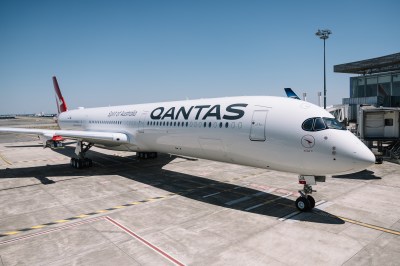
Qantas has risen to the challenge, regardless. The airline challenged both Boeing and Airbus to develop aircraft intended to fly routes from Sydney, Melbourne, and Brisbane, to destinations like New York, London, Cape Town, Paris, and Rio de Janeiro. This was later whittled down to a narrower focus on the Sydney to New York and Sydney to London routes. Airbus would come out victorious, with Qantas ordering twelve examples of the Airbus A350-1000ULR. The specially-configured model features an additional rear centre fuel tank and a higher maximum take-off weight in order to fly routes up to 22 hours non-stop, along with a reduced seat configuration serving just 238 passengers. The extra range makes for a huge difference compared to more conventional routes out of Australia, which often pair two flights up to 14 hours each. The extra range of the new aircraft saves passengers both hours of flight time, along with the hours normally spent sitting around on layover in a hub airport along the way.
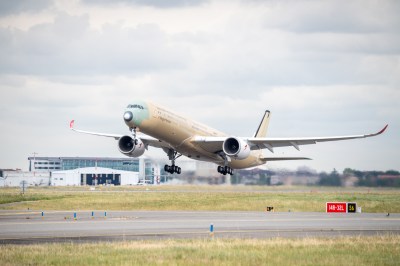
A typical flight from Sydney to New York or Sydney to London is expected to take 19 to 22 hours. The no-stop nature of the route will enable 99% of Australians to access either destination either direct, or with one-stop—such as by flying in from another major capital on a domestic flight. The flights are expected to run with a higher-than-usual ratio of premium seats, based on the expected demand for these services.
The main thing holding back the new service is aircraft delivery. Production is underway in earnest, with the first A350-1000ULR to be delivered in April 2027. Daily non-stop flights between Sydney and London will begin from October 2027, with tickets to be on sale from February.
Aircraft cabins will be optimized to have more space and amenity to keep passengers comfortable on ultra-long-range routes.
The new Project Sunrise services will be a gamechanger for many people travelling to and from Sydney, and other Australian capitals. It will relieve a major pain point—layovers—that have become a dreaded fact of life for Australians headed far abroad. It will still perhaps be some time before Australians get more direct services to a wider range of destinations, because these new services will have to prove themselves. If the passenger numbers aren’t there, the services won’t make money, and it may not prove worth the hassle to operate these ultra-long-range routes. If, however, convenience truly is king, then there may be much greater investment in this area to link Sydney and Melbourne with more cities directly. The only losers in this case will be the hub airports across the world, which will grow just a little quieter for the loss of Aussie accents in the terminal.












Why not just setup a Boeing KC-46 Pegasus: somewhere along the route to intercept the plane and refuel it in air, They have a maximum transfer capacity is about 212,299 lbs. Thats about 95% of the fuel capacity of a 787 Dreamliner.
What is the percentage of Quantas pilots who are trained to be on the receiving end of a midair refueling? How many passengers would want to be on such a flight? Now we have two planes and at least 4 pilots. Where will the KC be stationed? How would this affect the airline’s insurance costs and ticket prices? These are some of the reasons “Why not just”.
also there aren’t any western commercial airliners designed for in flight refueling. It’s not like you just stick a tube on the front of a plane and run a hose into the fuel tank. Most commercial aircraft don’t even carry fuel in the fuselage, it’s all in the wings, so running fuel lines through the fuselage is a big safety design change.
That’s exaclty what Marshall Aerospace did to the C-130 Herc during the Falklands war.
Lockheed said it couldn’t be done.
Hawaii looks like it is in a good position.
787 doesn’t have the necessary hardware for mid-air refueling.
That is pretty pointless in the civilian world – it doesn’t really free you as an operator of effectively needing a layover or flying basically to the layover airport, its just the tanker aircraft doing the cycling. But now you have to pay for an extra crew, aircraft, more hardware on the passenger aircraft and the maintenance for all those added flight hours on the other aircraft. Not to mention that many airports almost certainly won’t have enough take off and landing slots for the tankers that are only in the air a few hours at a time!
The only way to make long long haul flight make sense is a much more efficient aircraft, perhaps that blended body is part of the wing type concepts. As then you are still only running most likely the same number of engines for much the same maintenance cost, but consuming less fuel in total as a more direct flightpath would take out that dog-leg in the optimum flight paths. Or maybe something like the solar and/or lighter than air cruise ship of the sky type concepts I suppose – which would have to be much much slower to keep the drag down so the flight is more efficient. But then your long haul flights would end up being more like a continental railway or ship journey and take days, might still be similar total travel time to the annoying layovers, certainly less hassle but would customers really want that?
GEV using WIGE: advantages of speed, and fuel efficiency.
Bring back dirigibles and make the journey part of the holiday trip.
I’ll second this one.
It would be like a sleeper train but FLYING! I would travel this way if I could.
The reason tanker mid-air refueling makes sense is the high cost in fuel of military aircraft to takeoff and attain altitude. Tanker aircraft are much more fuel efficient to takeoff and attain altitude.
https://www.simplethread.com/why-don-t-they-just/
Insurance would be an issue.
Quantas thanks you for the free ad.
.. and also a heads up for the expected eye watering ticket prices as a result of their ‘premium’ service and the vastly reduced seating capacity of the plane. Got to make their profits somewhere don’t they.
I’ll stick with the usual connected stopovers, they are less than 4 hours in most cases, and its nice to get off the tin can and walk around a bit anyway. And I’ll probably get 3 trips for the price of one of the new service, just for giving up that 3 or 4 extra hours of my time.
Yep – BNE – SIN – LHR and return is a pretty good way to break up the tedium. 8 hours BNE – SIN, then a 4-hour wait, then 13 hours SIN-LHR, mostly overnight so you sleep a lot of it. Slightly longer stopover on the way back. Changi has lots of things to see and do while you’re waiting, including shopping, eating, massage, and even one of those pools with tiny fish that nibble at your lower legs. Being able to get up, stretch properly, and walk around after 8 or 13 hours in an aircraft is a good thing. I would not like to spend 18-22 hours on a single flight unless I could afford business class.
If only they didn’t make you pass through security a second time, with different rules from the place you boarded.
You’ve got to deplane the passengers before you can start refueling. Then you’ve got to get them on board again. More like 2-3 hours.
You’ve got to deplane the passengers before you can start refueling. Then you’ve got to get them on board again. More like 2-3 hours.
How does this compare economically and time-wise to a direct, one-stop-to-refuel flight? The layover should be well under an hour and you can use existing planes. Plus you can swap crews and reload meal service.
Why don’t they just stop somewhere and refuel? Passengers could disembark for an hour and stretch their legs?
As a kid (1962) I flew from DC to Sydney. We stopped in LA, Honolulu and Fiji. 707 (PanAm, I think).
A couple of years ago, I flew direct from Honolulu to Sydney (get the extra legroom, you won’t be sorry). What a change.
If you’re going East Coast of the US to Sydney, I would recommend spending a few days in Honolulu. Lots of sights to see, and things to do. Also helps make the jet lag less of an issue.
Presumably it costs a lot to land, get everyone off the plane, refuel, get everyone back on, and take off again.
Airports charge money for all of that stuff AND you burn a load of extra fuel and crew time doing it.
Apart from the safety precautions (apperently you cannot refuel a plane with passengers in it) it is not commercially interesting for any airport to allow refuel-only stops.
It gives the airport only the noise and perhaps some landing fees, while a full stopover gives two connections to different places on the world, which makes all other destinations from that aiport more attractive.
Since pretty much every airport where Quantas might refuel on a Australia-Europe flight is in a country where government, national airliner and airport are at least slightly connected, there is no chance that Quantas could get an economical deal for refueling only.
For Australia-US routes, this might be different (Trump might have less influence on Honolulu), but I doubt Honolulu is strategically located for all Australia-US routes in all wheather/jetstream conditions.
The Buenos Aires – Shanghai via Auckland works like this. 2 hour stopover for refuel only. China Eastern.
It’s the rocket equation all over again. If you can’t stop to refuel, you have to pay to carry all the fuel at takeoff.
Maybe, and I realize this is a radical idea, you could find a way to make layovers take one hour instead of ten, and not suck so much. You’ll benefit everyone AND save a literal planeload of money on fuel.
This… Absolutely!
The problem is that the regular stop in a two legged flight is organized as two separate flights. Take all the luggage out, re-sort and lose some, chase everyone to a different gate and stack the delays from the first flight make the second one a pain. So you add 4+ hours between flight.
What about a fuel stop – disembark, stretch your legs and serve one meal on the ground (no need to fly that weight and entertain everyone!), have everyone use a restroom on the ground and board the same plane again. Keep the luggage on board and make sure nobody leaves.
I expect an increase of flight time of maybe 1 hour on the ground and 1 hour airport approach/landing/taxi/takeoff/gain height.
Does anyone know how the fuel economy goes? Flying through thicker air for landing and ascent will hurt. Also takeoff might burn much more fuel, compared to flying straight through.
But you would need to carry only half the fuel and save from that maybe?
By not allowing passengers to take only one leg, they’re asking something very different from the airport. In practice, that probably means dedicated infrastructure, and at that point it might be cheaper to just run with fewer but more premium seats.
Breguet Range Equation, actually.
Why not invent floating concrete sleepers and build a railway on the sea? It would be much cheaper to run EN57 on a regular service to Japan, America, Africa and Europe than it is to fly a fleet of Boeing 787 planes.
They plan a tunnel between Alaska and Russia. The shortest connection between 2 continents under water. It may help Australians a little. https://www.yahoo.com/news/politics/articles/underwater-tunnel-russia-alaska-built-185910791.html
The distance between Australia’s northernmost airport—the Northern Peninsula Airport (ABM) in Bamaga, Queensland—and the nearest Russian airport to the Bering Strait, Provideniya Bay Airport (PVS), is roughly 6,245 miles “as the crow flies”
The closest mainland town in russia to alaska is Cape Dezhnev 155 miles from Provideniya Bay Airport Cape Dezhnev.
The closest airport in Alaska to the Bering Strait is the Wales Airport (WAA / PAIW) in the community of Wales. Wales, Alaska to Seattle, Washington is approximately 2,081 miles
so a 6235 mile flight, then 155 miles of ????? travel to a 50 mile tunnel, to a 2081 mile fliht to arrive in Seattle WA
8521 milrs.
The straight-line distance between Horn Island Airport (HID) in Queensland, Australia, and Los Angeles International Airport (LAX) is approximately 7,157 miles .
a 50 mile tunnel between Russia and Alasaka wont help austrailians at all.
As someone who makes frequent use of regional Aussie airports, I can confirm:
Horn Island Airport is also one of the slowest in the country
Any northern (Cape York) peninsula airports are likely to be cut off by flooding for a few months a year.
If you believe that would not get immediately cancelled (either for engineering or geopolitical reasons–take your pick) I have an underwater trans-Bering tunnel to sell you.
You mean that literally?
It’s a damn shame though. Such a tunnel would be amazing. You could take a train from London to LA or New York.
A TGV train can do this the 16000 km at 330km/h in 48 hours!
But I highly doubt building a floating railway through the pacific would be cheaper. That ocean is deep and not peaceful at all. anchoring cables would be long and very strong, reaquiring very much floaty stuff, which then becomes.a hindrance to shipping.
Just build it to submerge when a ship or a hurricane wants to pass over! Of course, your train scheduling gets a little complex then.
or just build it at a depth low enough that no boats draft would ever possibly be an issue.
The deepest draft ever recorded belongs to the supertanker formerly known as the Seawise Giant Fully loaded, this colossal ship possessed a record-breaking draft of 24.6 meters (just over 80 feet).
During severe storms or extreme “rogue waves” that can reach 100 feet in height, troughs can temporarily drop the surface 50 feet or more below the average level.
So if you built a floating “train tube” anchored to the ocean floor that was around 200 feet from the surface you shouldnt have to be concerned with surface traffic or weather.
Of course that would be quite an engineering challenge in and of itself.
I can’t bear the idea of being 22 hours in a plane! I already found 11 hours in the worlds longest intranational flight (Charles de Gaulle, Paris, France to Roland Garros, Saint-Denis, Réunion, France at 9500-ish km) horrible.
Pretty sure the flights I took from Atlanta to Inchon were around 13 hours.
Is that really officially an International flight? Or did you mean something like the longest regularly scheduled non-internation flight?
Believe me you do not want to do air refueling with comercial aircraft. Its a risk you would not want to take, trust me been there on both ends of that process.
“Tim Williams … It’s people like you that drove Breivik to cleanse the Utoya.”
And you Sir are exactly like Jeffrey Dahmer. I’m not reporting your comment because it provides an interestng if creepy lesson. What the lesson is I’m not quite sure.
“Tim Williams says: …”
It’s sad that there is no one with the requisite skills to add an “Edit” option to this board.
If that were to happen I’d want the people in the front plane, fuel in the back plane.
Boomer?
I myself feel like I would not want to be 22 hours on an airplane in one go. 10 hours is already quite long. After 10 hours, I’d like to have some pause, have a walk, whatever. A stopover of 10 hours is way too long. But 2, at most 3 hours is great. So why not make sure that it’s never more than 3 hours? It’s a logistics problem that can be solved.
I do understand that takeoff and landing use the most fuel. And if you do have a stopover, you’re basically wasting fuel compared to if you’d fly non-stop.
Ignoring fuel capacity. A Boeing 787 cruising at a typical speed of Mach 0.85 (roughly 560 mph / 900 km/h) would travel approximately 11,200 miles in 20 hours.
In reality the the maximum range of the Boeing 787 Dreamliner varies by variant, spanning from 6,330 to 7,900 nautical miles So it would need a fuel stop or an in air refuelling along the way.
The Boom Overture is the leading modern supersonic airliner, designed to cruise at Mach 1.7 (about 1,300 mph) carrying 64 to 80 passengers. At that speed it could turn a 20 hour flight into a 8 hour 37 minute flight.
Unfortunately it only has has a maximum range of 4,250 nautical miles so it would take two fuel stops to make it. But at 43% of the airtime of a 787 it would be worth it.
“The route has also since fell victim”
Fallen?
” the crowing achievement”
Crowning?
having done these flights many many times I strongly support a direct flight. Every time you have a stopover is another point of failure… Not to mention that the stop over may be in the middle of the night when you’d prefer to be sleeping in the plane..
When they introduced syd to la direct years ago it was a significant improvement even though I had to fly from Melb to Syd first.. Even better was the return trip as they could never fill the plane up to full weight, so spare seats everywhere…
Pity not Australians, but airlines who with their megabajiullion greenbuck in profits found no spares to invest into proper Concorde follow up. Revolution that was shutdown in its wake and profit-mining turned into fierce race who can cramm as many small-sized seats as inhumanely possible.
Take this from someone who is only about inch taller than the statistical average human and never have enough space to stretch my legs on any airplanes. All of them felt like Mazda 5 driver seat to me.
The idea of Concorde was that eventually dozens (and not nut the selected two) airlines would be operating Concordes (or the next generation) everywhere, thus, bringing the price down, and there won’t be a need for a slow-mo jumbo airplane that’s so large it needs its own dedicated runways, and even average more-or-less-large airport would be capable of serving these.
Sonic boom, yes, strategic planning and regulations, making sure they are happening away from populated/dense areas – and it was also overly optimistically hoped that future inventions would allow for these to happen high up where the air is noticeably thinner. It was also overly optimistically thought that there would be suborbital hoppers taking advantage of even thinner atmosphere and speeding up even faster. None of that came true, not in late 1970s, not now. Jumbo planes with as many sardines … seats … as possible …
We’re still fighting 0.5mv² losses, and with jet fuel comprising roughly half the running costs of a flight, flying twice as fast will cost 2.5-3x as much for the same distance. There aren’t enough passengers willing to drop that kind of money to fill ss flights except on the most over-sold routes.
Australia is neither remote* nor isolated. You can travel to the nearest country, Papua New Guinea, by canoe in a couple of hours.
Remote is the most journalistically abused word in English. New York is remote if you live in New Zealand but never described as such.
Remote, in English, generally is relative, but is relative to the center of mass, not the observer’s position.
In its day, Rome was not remote, no matter where you were. You might be remote from Rome, but never the other way around. Same logic.
Oh come on man get a grip
Entertainingly, I’m currently reading this while travelling from Brisbane to Milan, via Doha airport in Qatar.
Honestly, after the 14 hour leg to Doha getting some time out to walk around, shower, and most importantly not be in a plane, was really nice to have. And it doesn’t really add much to the trip time. It’s already 24 hours in the air for me, plus three hours of layover. Milan to Brisbane isn’t as far as London to Sydney, but we’re still only talking about 20%.
Clearly they think that some people want it — who?
Unless you’re a woman: https://www.bbc.com/news/world-australia-59288177
At what point are they going to give up and do the insane thing of contracting SpaceX for suborbital hops?
No one wants to ride in VTOVL craft.
Germany has a concept called Space Liner, but that is VTOHL.
My suggestion would be to contract a rocket plane using Merlin engines of Falcon. Those use something akin to jet fuel….which would be used by landing turbojets.
No fancy scramjet, no orbital velocity–just a shorter flight from continent to continent…twin-jets from there.
You still have to get in another jet, but spend less time in the air.
“No one wants to ride in VTOVL craft.”
Disagree.
There are approximately 40,000 to 50,000 helicopters in active service worldwide, consisting of about 20,000 military rotorcraft globally, and an estimated 20,000 to 30,000 civilian and commercial helicopters in operation
I do… Are you kidding? You wouldn’t do a suborbital flight in a ballistic missile just because of the take off and landing orientation? I’d do it just for fun
Every 15 years or so, someone gets a bright idea – “Hey, we can put Special Forces Dudes in an ICBM and kill duly elected officials^W^W^Wterrorists anywhere in the world in 45 minutes!”
The idea never goes very far. At least not yet.
Here’s the answer. /s
https://www.youtube.com/watch?v=9LENvGRsr7Q
My memory is hazy these days. Does anyone remember the South African carrier buying some custom 747s that were basically flying gas cans? No country would allow SA overflight in the apartheid era, so to fly from New York (yay ‘murica, I guess) to SA required a plane that could do the pull with a pretty inefficient route. Probably carried more diamonds than people.
This was the problem with SST aircraft. Their most appropriate market was use in trans-Pacific service yet all the designs couldn’t carry enough fuel for that trip.
RE: “as the Iran War shut down large swathes of airspace in early 2026” – time to revisit flying over the South Pole. Not with the conventional mumbo-jumbo-packed-sardines kind of flights, with the sub-orbital jump kind. Perth to London in under 6 hours, challenge and make it happen with smaller airplanes, maybe the size of the original Concorde. Profit churning, yes. That’s what the challenge is, to make it happen.
Engineering challenges are many, but then again, THAT’S WHY you hire engineers (with proper education and proper experience) to address the challenges, not politicians, not administrators, not managers. Direct hire, bypassing all the bagoogaaz that usually go with such large/extensive projects.
Yes, I know what I am talking about. Look up certain Baldwin Locomotive, yes, early 19 century. It hired a grand total of 12 managers, of whom 4 were the owners, Mathias himself and three other investors. The bulk of company were what back then were called “foremen”, now called the tall goobleddydash “subject matter experts”, ie, workers who started as workers, learned the craft, moved up the ranks to overview the operations and other workers. Not “anointed from the top” which is the prevalent idiocy right now, (ie, managers hiring other managers to do all the work for them), one HAD to start as a worker. At the peak of it time Baldwin employed close to 20,000 workers – in Philadelphia alone, run by 12 managers in total.
Regardless, maybe this explains why we are no longer inventing new computer architectures, nor any new ICE engines that would exceed the proverbial limit of around 60% efficiency (and that’s with the direct injection – ALREADY century old technology – invented in 1902, first engine made in 1926, yes, 100 years ago). When bureaucrats take over engineering mistaking themselves for engineers things slow down to glacial pace and halt at the precise moment that benefits bureaucrats to sustain indefinitely.
As usual, pardon the rant, discard once read/ignored, etc.
…But then everyone would see the big hole leading to the hollow Earth where all the dinosaurs and stuff live?
If something does go wrong over Antarctica, the fallback airport… well, let’s just say that I don’t believe the truly technical problems are the biggest hurdle to this route.
Rather than flying through the Gulf the best route seems to be to stop over on the US west coast. From the UK to Los Angeles is about 11 hours, from LAX to Australia is 14 hours or so. Its still a bit of a journey. I’ve flown this route quite a few times although only to Auckland over the Pacific (about 11 hours from LAX).
Incidentally, I’ve flown London to Australia the other way round twice. The second time was in the 80s in a 747 with stopovers in Delhi and Bangkok ending in Sydney. That took 22 hours flying time total. (The first time was in the early 50s in a Lockheed Constellation. It took rather longer — but we’d stop for meals and overnight at a decent hotel. A ‘golden age of air travel’, sort of.)
I would prefer to spend ten hours in an airport than twenty two on an aeroplane. On long flights i usually spend two nights at the halfway point and explore the city