
Of all innovations adopted by the maker community within the past couple of decades, one stands among the rest on top for anything regarding manufacturing. It goes without saying here at Hackaday how many projects have been reliant on using the technology to turn their ideas into reality. 3D printing has been a maker community invention and, in return, has expanded this hacky community into something that anyone with an imagination can get into. It also goes without saying that the layer-based tech imposes limits on what we can actually create: think overhangs and layer adhesion. However, there’s a possibility that a recent offshoot of this scrappy community has the power to eliminate some of these faults.
Volumetric additive manufacturing (VAM) is a young technology that has a similar start to many new tech toys, including the original SLA of the first 3D printers. That is expensive and completely stuck in the laboratory… Fortunately, that’s not where 3D printing as a whole stayed, as the RepRap project managed to bring the obscure technology to the hobbyists’ main stage. An entire group of people formed and spent countless hours until the useless pieces of poorly extruded plastic could form parts impossible to make with anything else. A cool quirk of history is that it likes to repeat: examples spur recreation, and this appears to be happening with the technology found within VAM printing.
History
Hold up for a second. While we have covered VAM here before at Hackaday, it’s not exactly the most well-known tech or the easiest to understand. So what is it? Starting from the beginning and simplest forms, VAM is similar to the more common SLA printing. Using a light source and light sensitive resin, both of these methods can create entire physical objects by solidifying or curing specific areas of a vat or vial of resin. SLA will often use something like a laser and layer by layer “draw” the model until the entire geometry is finished. A quirk of most of many photosensitive resins is that they need to overcome a threshold before they can start curing. This allows VAM to do something a bit different. The earliest methods of VAM used intercepting lasers which allowed selective curing only where these beams were intercepted. One singular spot at a time would be able to overcome the threshold required for printing, allowing you to build up most geometries.
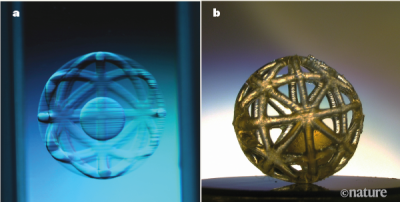
This works, but for more complicated models there’s more effective methods. One type has been covered here before called Xolography, still using intercepting beams, however with differing wavelengths which allows for more finite control. This is effective, but the resin is complex, requiring two-wavelength-photon-sensitive photoinitiators. Introduce the current standard in VAM printing, computed axial lithography (CAL). This method finds itself using existing methods found in traditional tomography, such as CT scanners. CAL methods are basically reverse tomography, where a model is used to create projections to be projected in printing. These projections allow dose control in each “voxel” of resin from changing the projection as the volume of resin is rotated. When ideal, this means that the entire model is printed at once. No layers needed for printing, and printing in minutes rather than hours.
Open-Sourced
Cool, but why should you care about this tech? Because you could start using it now! Just like the RepRap project before it, VAM has OpenCAL. OpenCAL was started by the same lab that originally created the axial version of the technology. UC Berkeley released the first OpenCAL around 2019 which was… well a start.
Functionally practical for only big budget research, it was far too expensive and complicated for any hobbyist with a 9-5 to realistically touch. Last year saw a new model presented at Open Sauce which used a consumer projector and common hobbyist electronics. While this was an improvement, there are three barriers to VAM printing; the hardware, software, and chemical resins make it a challenge for any individual alone. A newer version of the hardware was quickly put together for this summer. This helps with the hardware element, but there’s two new aspects being released alongside OpenCAL V2 for other unsolved problems.
Software: Tomo
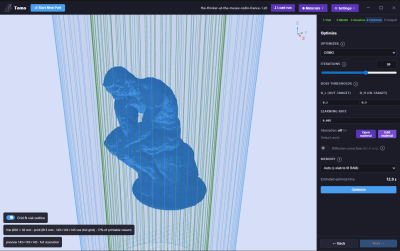
For a little while now there have been various software packages available for allowing easier use of whatever VAM printer you might have, however these had various problems. From being undocumented to being complicated for anyone without comfort in command line , something different would be needed. A standalone application would certainly work, and low and behold that’s exactly what’s being tried here, called Tomo. Tomo allows you to use an OpenCAL printer with little thought or expertise, or ideally any other type of VAM printer.
Chemistry: Formlabs Resin
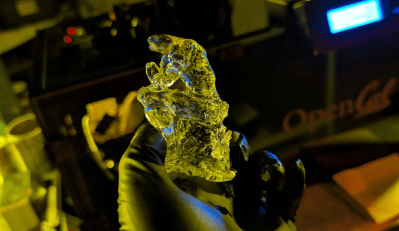
Material science is always a particular challenge for the open source community. Unlike software, you can’t distribute unlimited copies of your perfect mix of photosensitive resin without special chemical clearances and certainly not for free. Some of the first 3D printers from RepRap would use a nylon weed wacker line in place of the standard PLA of today. Unfortunately there’s less flexibility in the fine tuned resin found in VAM. This resin has to have a nonlinear photo-reaction for selective curing, be fairly transparent to the reactive wavelength, and be very viscous to prevent resin movement during printing. Formlabs, which makes resin printers and resins, has gotten into the act. Through talks between the OpenCAL team and Formlabs, an agreement for production of this special resin is being worked out, allowing for far cheaper material.
Hardware: OpenCAL
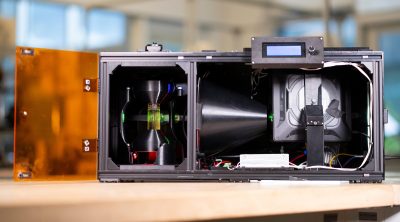
Of course this leaves the printer itself. OpenCAL is designed for a variety of different sized printing volumes, projectors, or anything else you might have in mind. Expect printing anything from this printer to finish in the span of minutes. While it can do the same small prints found in the older model of OpenCAL, experiments involving larger form factors have been attempted. But if you want more details make sure to check out the documentation here or join their Discord channel!
Future of VAM Printing
So how far can this technology really go? Could it pass traditional methods of 3D printing? Well, it’s certainly faster than traditional printing, however, there’s still plenty of trouble when trying it out. How do you remove partially cured resin off your print? How do you actually tell when the print is done? These are problems that are being fixed right now by the community, and maybe you can be the one to fix something holding it back. It’s fair to say that the community that has propped this technology up to where it currently stands is who is going to decide where it goes.












No
It is way too volumetrically restricted. It only works with very small builds.
It is now the time for hobbyists to focus on 3d printing with inkjet technology.
The UV DTF systems that have been based on the epson printheads/engines are starting to evolve into 3d printers. First they started adding “testured printing” but now every few months another company goes full 3d.
In april we had https://shorturl.at/yA821 @~$8k
Last week fabaloo had a post about HeyGears upcoming kickstarter presale of their system
Heygears resin 3d printing based on epson printheads offering 420x330x130mm build area,1440 × 2400 DPI xy resolution, 10–30 μm Z layer thickness, 10M+ Colors, and Water-Soluble Supports
MSRP $5,499
$50 deposit now locks in $300 savings when kickstarter launches putting the price at $3,299
https://store.heygears.com/products/heygears-g1-direct?srsltid=AfmBOooXm2NdfWdMik8Od9qBq3H8inQzfTyFoaIgYMgcFmeiBvCjnmt3
People have been hacking together epson based DTG printers for over a decade and have been making the UV DTF conversions with aliexpress parts for a few years now. 3d is just an extra axis, the right resins and most importantly someone filling in the software gap with a full color+support slicer that outputs in a format an epson can eat away.
That would actually make a useful high resolution medium sized 3d object, unlike volumetric printing which only makes meh quality tiny translucent objects.
I can see the appeal of that for someone who makes small batches of colored art. It does very little for people who do functional prints or rapid prototyping. There is room for both machines in the world.
I.E. I recently printed dozens of custom brackets to hold solar panels on my roof. I went though multiple iterations of print, test, adjust, and print again. If those iterations took 10 minutes instead of 45, I could have finished in an hour instead of a day.
The high resolution and reliable supports make for better more accurate parts for prototypes, but the material selection is more limited.
Unless by “prototype” you mean just printing stuff directly for use, instead of actually manufacturing them by better means once you’ve tested that they fit the purpose? I wouldn’t trust my solar panels on a bunch of 3D printed brackets, but you do you…
The material selection is limited because there hasnt been wide market adoption of the epson based systems yet. 3dSystems uses a (former) Xerox printhead that uses an entirely different chemistry than can be used with the epson head due to its elevated print temperatures. They have a number of specialized resins for their systems. 3dresins in Spain produces a wide variety of resins that work in 3ds Projet machines and will custom formulate most anything youre willing to pay for.
Depends on how overengineered they are and the material choice
You wont get custom brackets from volumetric printing unless they fit in around two to three inches in diameter at most.
You can print single color objects from inkjet printers that are of equal strength to those you get from mSLA. You can print as many iterations as you can fit on the printbed. AND Unlike mSLA you wont be left with a part in need of extensive cleanup as the support washes away and leaves no witness.
There is a reason 3dsystems has spent 30 years selling TONS of inkjet based systems for 5-6 figures a machine to a wide variety of industries. The technology produces superior print speed, and resolution than most other methods while allowing a very decent size printbed. Their recent models can print 0.31 vertical inches per hour regardless of how full the 11.75 × 7.2 (298 × 185 ) bed is in the hd (32 microns layer). mode.
Sounds like you’re confusing the process with this one specific machine performing the process.
By that reasoning, the first inkjet head in the 50’s was fixed and could only print a single line down a reel of 2″ paper using a single color.
Suggesting volumetric printing will never improve past the lab requires believing ink jet never improved either, which sort of negates your claims of what it could do, as well as counters reality.
Im familiar with every volumetric printing system that has been commercially marketed and every experimental system that has a patent or published research paper attached. Its not just this machine that is limited.
Do you understand the physics involved in volumetric printing? Light loses intensity at an exponential rate while passing through resin due to absorption and scattering. This inherently limits the potential of these systems. You can only boost the intensity of the light so much before you over expose the outermost portion of the resin activating its photoinitator instantly. Will this process improve, sure. Will it ever reach 6. 8, 12 inches in diameter, NOT A CHANCE.
Even if it did scale up, you’d need a gargantuan amount of resin to fill it.
12″ x 12″ cylinder holds 22 liters. If you’re paying $30 per liter for resin, that’s $660 worth of resin you have to change every time you want to switch materials.
@Dude
$30/L is some crappy mSLA resin
Commercial volumetric 3D printing resins generally cost between $200 and $400 per kilogram (or liter.
In any case, the issue you describe isnt new. Thats why top down SLA isnt ever pursued by penny pinching hobbyists and is pretty much strictly an industrial technology. The first 3d printer I used was the 3dSystems SLA250 which had a vat that required 32.2 liters of photopolymer. If I recall correctly it cost us just under $7K to fill up in 1991.
Doesnt matter in regards to volumetric printing. Unless someone comes up with some completely different way to perform the exposure its never going to scale beyond a few inches in vat diameter. Its a matter of exponential intensity loss over distance. You cant raise the intensity too high or you will cure the initial intersection zone. The depth will always be very limited.
That was the point. Even if it was some cheap bulk resin, you’d still have to pay serious money to fill the print volume.
If the volume is higher, then so is the surface area. Why can’t you just add more lasers, so that for the very center of the volume it takes a dozen to cure, even though fewer would be enough near the surface. The square-cube law will hit eventually, but I think you can get beyond a few inches.
“The earliest methods of VAM used intercepting lasers which allowed selective curing only where these beams were intercepted. One singular spot at a time would be able to overcome the threshold required for printing, allowing you to build up most geometries.”
So basically, yeah you could do that. But you wouldnt get the layerfree advantages of the part solidifying all at once as you do with the tomography based systems. The rotating projection method relies on the ability for resin to absorb SOME light without triggering its cure, to allow uncured regions to be underexposed, NOT curing, while the desired part accumulates enough energy from successive exposures from different angles to trigger curing. Because light intensity drops off exponentially with depth, there is a limit to what this technique can do. To reach the center without curing the periphery is a balancing act that only works to a few inches.
Thats just the reality of the situation. Feel free to go build something completely different, develop an entirely new photopolymer chemistry that defies the state of chemistry and physics limiting todays systems. Write your paper and publish, or patent it and build a company around your innovation. No university, corporation, or internet dwelling denizen has managed in the nine years since the first paper on volumetric printing to pull it off. Good Luck!
yow! come back in a decade and tell us how well those brackets are lasting on your roof :)
i mean i get it…my friend is a solar installer and when you add up all of the different pieces of aluminum extrusions and brackets, you come to a significant fraction of the cost of the panels themselves. but i wouldn’t do it any other way, myself
Light-colored PETG last a pretty long time in temperate climates. And I don’t mind if I have to print a few replacements over the years. My previous post said “roof” but it’s really just rooftop balcony solar. I can inspect and replace them without even putting my shoes on.
What I DO regret are the cheap aliexpress microinverters. They’re so noisy that they will trip ACFI breakers.
I’m not certain exactly what you were iterating but, in many cases, I just cut out the dimensionally critical part from the model for iteration. I also use a bright orange filament for quickly printed test pieces if it could be mistaken as a final component because faster print speeds diminish the mechanical performance, especially layer adhesion.
Hot dang that’s a heavy website. It hits 100% GPU video decode on Firefox.
I can’t shake the feeling that we need fewer inkjet printers in the world, not more… or at least, someone needs to invent an open-source 2D printer.
why?
what do you have against inkjet technology?
You are kind of getting your wish. Fewer and fewer people are buying printers for their homes. People print less and less as everythings just pixels and bytes now.
Unfortunately homebrewing inkjet printers isnt really possible beyond single nozzle systems. An xp1440 printhead has 1440 nozzles, separated into 8 rows/channels with 180 nozzles per inch.
Its really not the sort of thing you can just make yourself.
But if you want to homebrew your own Solidscape style, single nozzle build, single nozzle support, printer, thats really not too big of an ask. Good Luck!
sure sounds interesting, but i think it will be some time before it roles out to the DIY folk.
Holograms are the natural evolution wherein an entire 3d object gets cured simultaneously. Complications like transmissivity changes between the substrate and the cured regions would complicate the process, but the idea of treating a 3d space based on a 2d image is already there.
yeah thats whats being discussed in this article. Volumetric printing.
The entire 3d object solidifies all at once.
The first company to market a commercial version of this technology Xolo refers to the process as Xolography.
These systems project into a vat of uncured resin and rotate the vat while changing the projection so that only the portion of the vat that is to be solidified recieves enough cumulative energy to trigger polymerization, Once it hits the required total energy input the part just materializes in the vat. Its pretty impressive but due to the physics its very limited in the depth of projection/potential build area.
The impression I had was that tomographic is 2d slicing, so sort of 2.5d, vs fully 3d. So perhaps a 1d “hologram” projecting a 2d slice into space, then shifting to the next slice.
But perhaps I’m wrong.
Your understanding is correct. It is 2d slicing but the object solidifies all at once with no layers.
Projecting an actual hologram into 3d space is science fiction at this point so its not really worth considering.
Just in
https://techxplore.com/news/2026-07-holographic-printer-3d-shot.html
“To demonstrate the printer, the researchers made a variety of complex microstructures, with dimensional ratios as high as 120:1. Menon describes these prints as “extended 2D” rather than true 3D—while they have length, width and height, the researchers can control only the shape of the former two dimensions.”
“The researchers are now working to achieve true 3D prints using their new technique.”
Not 3d, Not holographic. The 3d version will end up being a laser based volumetric printer that operates the same way as these volumetric printers do.
This was meant in response to Jeff Wrights posted link titled “holographic-printer”
ok but what other materials can you print Besides Goo?
“or join their Discord channel!”
I really hope that’s for idle chat and not troubleshooting or documentation explanation. Discord is where free and open information goes to disappear from the internet. Plus they want your government issued ID just to talk these days.
Nope.