
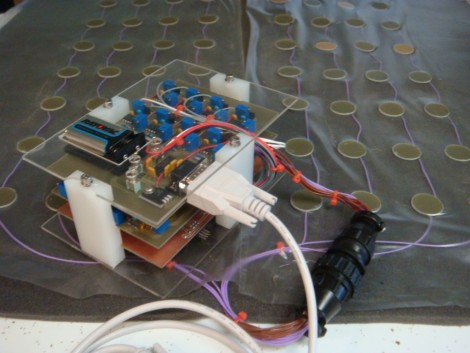
[imsolidstate] built his own pressure sensitive mat. It utilizes two discs of copper clad board with a piece of foam in between for each of 64 sensors. As the foam gets compressed, the capacitance between the two pieces of copper changes, a measurement that is fairly easy to make with an analog to digital converter. The mat is being used to measure how well a horse saddle fits the animal. Data is read in through a serial port and then mapped using Excel. This prototype proves that the concept works but [imsolidstate] mentions that there’s room to improve the sensitivity and that there could be more noise filtering incorporated into the design.












good to know, but where is the site link?
http://www.imsolidstate.com/archives/758#more-758
Nice! The horses will thank you for it.
I’m guessing each “load cell” would need to be
calibrated, each with its own look up table (pressure v. resistance) to compensate for variations between cells.
very cool practical application of the idea. I love it and can imagine this being useful for a lot of other things.
This is pretty useless without a clear idea what sort of foam is being used here. “I think the foam is polyurethane open-cell foam but I’m not sure.” is not very informative.
packrat: experiment with everything you got
http://www.imsolidstate.com/archives/758#more-758
is giving me a 404!
@packrat — its any foam, its not resistive, its capacitve sensing the distance between, not anything special about the foam. Any closed cell foam will do.
Nice concept – not sure the results are any where near accurate – nor will they remain consistent over time using foam as a spacer – nor will they hold calibration (even if you could calibrate them).
A bit easier than making the horse lay on it’s back to make a mold.
This sounds like a Forrest Mims idea out of this book;
http://www.amazon.com/Mims-Circuit-Scrapbook-V-II-v/dp/1878707493/ref=sr_1_3?ie=UTF8&s=books&qid=1283242150&sr=8-3
(excellent book BTW- brilliant pre-uc circuit ideas and brilliant adaption of components to do “interesting” things ;) )
In that book mims recommends anti-static foam (the stuff DIPS and through hole transistors sometimes ships in).
B*gger, Mims used the anti static foam to make a pressure sensitive resistor whereas this project senses capacitance.
Who’s up for a game of twister!
When I saw the picture that’s what came to mind…
This has very important medical applications too! a device such as this, used in orthopedic applications, goes for nearly $10k !
see here – http://www.apostherapy.co.uk/
these guys use a similar device to analyze your posture and adjust special shoes accordingly. it works well, but costs a fortune.
about time this was open source :(
I use a mat like this to trigger a vibrating coffen I built for halloween.
I have been looking for something like this for a couple of years now. Thanks for publishing this project.
I wonder if you could use magnets in guide tubes to get a more predictable capacitance curve. Might make the mat too thick though.
Is this still live? If so, have you done anything with this prototype? taosbill at gmail dot com thanks