
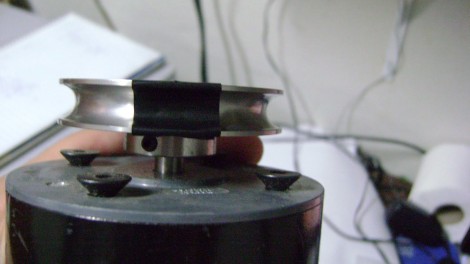
[Arao] wanted to measure the RPM of a spinning wheel using parts that he could scavenge from his junk box. A bit of thought led him to build a reflective sensor which can measure the spinning of a wheel (translated).
He got his hands on an infrared phototransistor which had been used as part of the remote control for some consumer electronics. Snooping around with his multimeter helped him establish the pin out of the device. By positioning an IR LED inside of a shroud, yet adjacent to the phototransistor, he can measure the intensity of the LED’s light as it is reflected off of nearby surfaces. The pulley seen above has a piece of electrical tape on it. When this passes by the LED, less of the infrared light is reflected and the drop in intensity is picked up by the phototransistor. [Arao] made the system rock-solid by rolling an LM358 op-amp into the circuit. He’s posted the schematic as well as some screen shots from an oscilloscope during testing.











In this implementation of an old idea one will need a scope to display the information you need to calculate RPM? An upgrade would be an addition circuitry, so the scale on a stock milliamp meter could display RM directly That other circuitry to hack a Dwell/Tach meter to function as an optical input tach as well.
“A bit of thought led him to build…”
I love a good pun :)
I applaud the effort….definitely a hack
For those of us who just want RPM and not a project though, NONContact Laser Photo Tachometers can be had for a reasonable price….
http://www.amazon.com/gp/product/B001N4QY66
to keep the hack spirit of the thread though…a different approach..stroboscopic..with a pretty decent build…
http://www.freemansgarage.com/tach.html
That’s the way centrifuges are validated in a lab setting. Most centrifuges have a clear window on top for just this purpose.
You could even use the LED as a photodiode and cut out the phototransistor, but I’d imagine that would require a more complicated circuit
This is a great idea. However, in a vehicular setting it will be foiled by brake dust.
how you monitor the output and do you use a LabView