posted Jul 8th 2008 8:55pm by
Juan Aguilar
filed under:
news

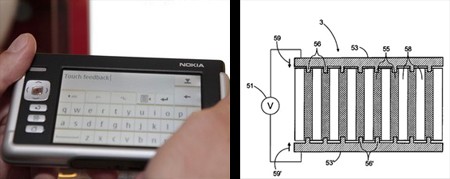
We’ve been waiting for more information on the Nokia Haptikos, the haptic feedback touchscreen announced last October and largely forgotten until now. We knew that it would be a device that could raise sections
of its touchscreen to simulate the feel of buttons or keys, we just weren’t sure how Nokia would pull that off.
Now we have a better idea, as Nokia’s recent patent filing for the Haptikos gives away some juicy details.
The secret behind the device’s feedback is a “plurality of closely spaced voltage controllable protuberances,” or in other words, several small fluid filled compartments just under the screen’s surface. Under them are several piezoelectric members that can be controlled independently; when they extend upward, they apply pressure to the fluid compartments, raising the surface of the screen in that area.
Nokia has yet to work out all the kinks, but you can see the parts that do work by downloading the Haptikos patent application (PDF file).
[via Engadget]
posted Jun 13th 2008 8:30pm by
Juan Aguilar
filed under:
misc hacks

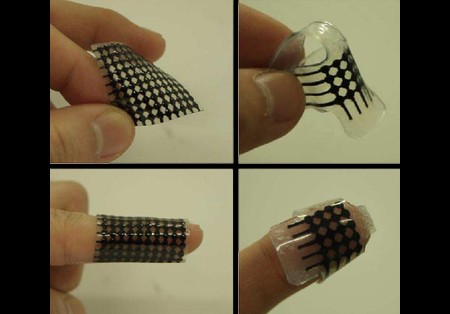
Engadget recently posted a story about a flexible tactile display that can be wrapped around any part of the body and give haptic feedback to the user. The research team from Korea’s Sungkyunkwan University that developed the device are focusing on applications like Braille for the visually impaired or transmitting tactile data to a remote user, but this is just the beginning; the applications for wearable haptic feedback are wide open.
Read the rest of this entry »
posted May 23rd 2008 9:40pm by
Sean Percival
filed under:
peripherals hacks
Haptic feedback (sometimes referred to as tactile or force feedback) offers what some might call a
brave new world of interaction and immersion. The 1932 book of the same name was probably the first introduction many people got to the idea of computer generated touch sensations. In the book, movies are replaced with what are called “feelies”; patrons sit in chairs that provide feedback throughout the screening.
While we don’t see this coming to your local megaplex any time soon, we are starting to see the technology creep into our lives. After the break lets take a look at some examples, talk about projects we’ve covered before, and how you can get started developing your own.
Read the rest of this entry »