
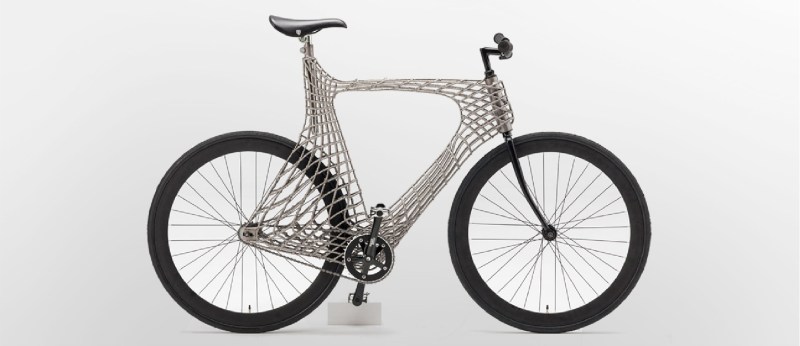
You wouldn’t 3D print a car, would you? That’d simply be impractical. However, if you’re a team of students attending the Delft University of Technology (TU Delft) in the Netherlands, you might be inclined to 3D print a stainless steel bicycle instead.
The TU Delft team collaborated with MX3D, a company that uses an articulated industrial robot arm with a welder for an effector, welding and building the Arc Bicycle, glob by molten glob. Printed in chunks, this process allows the practical construction of larger objects that are able to withstand the stresses and forces of everyday use. Weighing around 20kg, you might not want to spend much time carrying it up to an apartment anytime soon, so stick to the cobblestone streets — the Arc Bicycle can take it.
The TU Delft team believes Arc Bicycle to be the world’s first 3D Printed bicycle — even though it’s technically only the frame. If this story has you wishing you could flee the winter and hop on your bike, a DIY indoor bike trainer might cure that ailment, if you can resist turning the wheel into a bow.
[Thanks for the tip, Itay!]












You wouldn’t pirate a car, would you?
https://www.youtube.com/watch?v=HmZm8vNHBSU
I remember reading somewhere that the ad used pirated music. Such irony
http://www.abc.net.au/science/articles/2013/01/29/3678851.htm?site=galileo/newsanalysis&
Lol I read the first phrase in that exact same tone.
https://www.youtube.com/watch?v=ALZZx1xmAzg
I absolutely would download a car. Hell yes 99% of the population would do it in a second.
The first thing I 3D printed was a car, because I TOTALLY WOULD DOWNLOAD A CAR
You would not shoot a police officer, steal his helmet, have a shit in his helmet and leave the helmet at the door of his grieving widow…
What does this bullshit here? If somebody steals a car, a TV or any other physical object, the former owner does not have it anymore, can not use it any more. If I download a movie, I just create another copy, I do not remove the source from the server.
I suspect the TU Delft method was probably cheaper, but they aren’t the first to 3D print a bike frame:
http://www.gizmodo.co.uk/2014/02/you-could-download-and-print-this-titanium-bike-frame/
http://www.renishaw.com/en/first-metal-3d-printed-bicycle-frame-manufactured-by-renishaw-for-empire-cycles–24154
I’d often thought of trying to mount my mug welder to a beefed up 3D printer and do something similar.
I’d love to see a writeup on your mug welder – I broke my favorite coffee mug! 8-}
Me too! Does it weld ceramic, [Saabman]?
So many good places for a crack to propagate.
No kidding! And cracks there will be, this process has no control over the grain and crystal structures of the deposited material, furthermore these will change unpredictably over time as it ages. I also do not see any mention of controlling hydrogen uptake, or stress relief steps, although one would assume that these were addressed at a minimum.
True but using many little tubes instead of single tubes like a normal frame perhaps it can survive a crack long enough for the rider to notice and stop riding.
Only a year out of date. This was announced this time last year. See https://3dprint.com/118086/dutch-students-3d-printed-bike/
It was wrong then also. http://www.pinkbike.com/news/Worlds-first-3D-printed-bike-2014.html
That back wheel’s location: is that the style over there, or is it to compensate for weakness? ..or to not he pessimistic, does it have advantages?
That appears to be some sort of stylistic choice (and a lot of dead weight). It looks like the webbing in the center of the triangle formed by the seat post, wheel, and pedals doesn’t carry very much load.
missing brakes!
Back pedal brake
Not even. It’s a fixed wheel.
The dutch don’t use hand brakes, they also don’t use derailleurs. Most bikes here a back pedal break and if they are geared, they are hub geared. Many (most?) also have front hub dynamos for the headlight.
That makes me not-Dutch?
My bike has hand-brakes and a derailleur.
(I live in Delft, by the way…)
Yes we do.. what utter drivel.
It’s a fixie. There is no freewheel. If the wheels are turning the crank is turning so you slow your pedaling and the back wheel slows down till you stop.
What a waste of energy! Your body needs energy also to produce braking force. I can not understand this hype around fixie bikes. We could discuss about single speed, if you really want to go minimalistic, but freewheel and brakes are in my opinion as optional as using pneumatic tires instead of wood or stone discs.
FYI
http://www.renishaw.com/en/first-metal-3d-printed-bicycle-frame-manufactured-by-renishaw-for-empire-cycles–24154
just an idea: the welding torch melts a metal rod to make another metal rod, couldn’t this process just take a bigger metal rod as input, bend it to shape, and just melt it at the joints?
Sure, that would be practical, but OMG 3D PRINTING!!!!
It would also be more neat is they had a robot grab a bar and bend it then have it hand it to another robot who added it to the puzzle.
And of course you could always put the second robot a few kilometers away and have a drone fly the bar to it, to maintain the ‘cool & modern’ angle.
Or in a design & control tour de force, have two wire benders that feed in parallel with a third arm swinging around tacking joints together.
I like it!
That sounds actually nice. A model is split in a trellis like structure: a cutter just cut it to length, without bending it; a robot grabs it and add it to the model in the right position, melting the end of it with a high current. I must put it on my “I will never have time to make it” list.
missing subject is a rod of metal
yes, but “Bender” (the bending robot) will drink all our beer and pickpocket our wallets.
On the plus side: He’ll also deliver our packages.
No, of course not, this would make a too nice surface finish. :-)
The wire used for welding is a lot higher grade (at least for mild steel) than the material it is intended to weld. So this should be good metal, but possibly brittle.
Dutch and yet they can’t design a more sensible model.
They could print a Flevo style bike. Less material than diamond frame. On a cobblestone street I would rather have a full suspension frame though.
The first 3d printed bike (that I know of) was made around 2011.
https://youtu.be/hmxjLpu2BvY?t=7m16s
[youtube https://www.youtube.com/watch?v=hmxjLpu2BvY&w=560&h=315%5D
“Weighing around 20kg, you might not want to spend much time carrying it up to an apartment anytime soon, so stick to the cobblestone streets — the Arc Bicycle can take it.”
If it’s so sturdy, why not make it lighter ?
3D printed? I can see a TIG welder but no 3D printers …
MX3D is also the company that wants to 3D print a bridge across a canal in Amsterdam: http://mx3d.com/projects/bridge/