
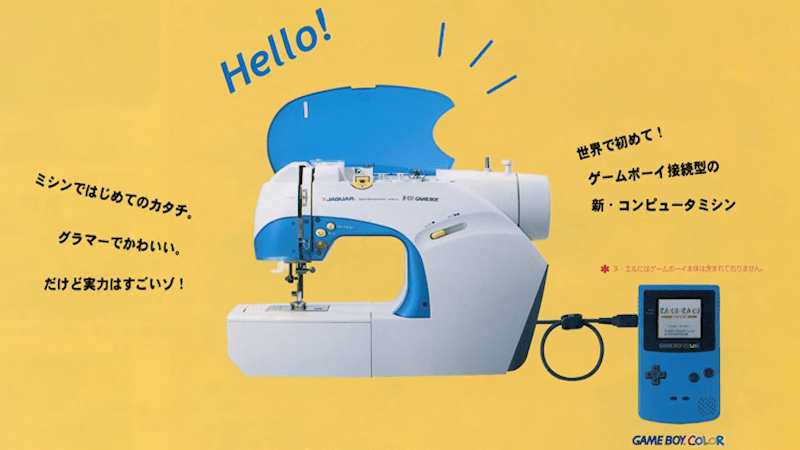
These days, high-quality displays and powerful microcontrollers are cheap and plentiful. That wasn’t the case a couple of decades ago, and so engineers sometimes had to get creative. The result of this is products like the Jaguar nu.yell sewing machine, as covered by [Kelsey Lewin].
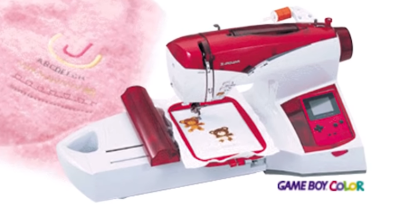
The Japanese market product eschewed the typical mechanical controls of the era, to instead interface with a Nintendo Game Boy. The sewing machine would hook up to the handheld console via the Link Port, while the user ran a special cartridge containing the control software. This would allow the user to select different stitch types, or embroider letters. Very much a product of its time, the nu yell mimics the then-cutting edge industrial design of the first-generation Apple iMac. The technology was later licensed to Singer, who brought it to the US under the name IZEK. Sales were poor, and the later Jaguar nuotto didn’t get a similar rebranding stateside.
Back in the late 90s, the Game Boy was likely an attractive package to engineers. Packing a Z80 processor, buttons, and a screen, it could act as a simple human interface in lieu of designing one from the ground up. Aprilia even used them to diagnose motorbike ECUs, and we’ve seen Game Boy parts used in medical hardware from the era, too. Video after the break.










Let’s not forget the XBOX controllers used as “periscope” controllers in recent US Navy submarines. (BTW, They’re not really traditional periscopes.)
Or this…
https://arcadeblogger.com/2016/10/28/bradley-trainer-ataris-top-secret-military-project/
The OceanGate submersible that imploded in summer of 2023 was using a PlayStation controller as a peripheral to navigate and control the entire craft.
As a young boy around here, the Aprilia SR50 DiTECH moped was very cool because it could allegedly be “Gameboy Tuned”.
Which referenced the official Aprilia interface for changing enegine management parameters: https://www.youtube.com/watch?v=qlZyU5esCGY
Wow, learn to read the whole article, Martin…
They are mostly gone now, but I have seen a lot of low volume products (security system controllers at Lowes home centers, for one) that clearly used a Palm III for a screen.
COTS strikes again. ;-)
I’ve seen an IZEK singer machine in the flesh, and it certainly worked as advertised. Basically like a label printer that did embroidery instead of sticky labels.
I inherited a Singer embroidering machine from my mother. Looks real familiar…
I have one of these. It works pretty well considering the time it came from.
What’s more surprising is that now you can get a WiFi enabled dual core chip for peanuts, but almost all sewing machines sold in Europe use mechanical cams.
Is it lack of vision, protecting higher price-point machines, or a reliability issue?
Although there are other sewing machines available too from famous brands like Singer, Brother, Janome, and Juki etc but I still like the quality of Jaguar sewing machine.
Before this machine, there was the Singer 6268, that had stitch patterns on cartridges to supplement the originally programmed stitches that inserted into the top port of the machine called “SewWare.”. The cartridges came in a box with an overlay that inserted into the stitch display panel to show the new stitch patterns. I have the machine and a few of the software packs—” Alphabet,” “Monogram” and “Animals.”. The Alphabet pack was basic capital letters, the Monogram was a script font and the Animals were cute and cartoonish. There was also an embroidery unit that plugged into the panel under the front fold-down extension for the free-arm and extended the flatbed and used the machine for the power, pattern transfer and held the fabric with its own embroidery hoop. I never got the embroidery unit, but the machine works just fine without it. Now, if only they made blank cartridges to add the fonts I downloaded to my Samsung Z Fold 5! Or there was a way to hack the old cartridges…