
Should you spend some time around the less scientifically informed parts of the internet, it’s easy to find “Free power” stories. Usually they’re some form of perpetual motion machine flying in the face of the laws of conservation of energy, but that’s not to say that there is no free power.
The power just has to come from somewhere, and if you’re not paying for it there’s the bonus. [joekutz] has just such a project, lighting up LEDs with no power source or other active electronics.
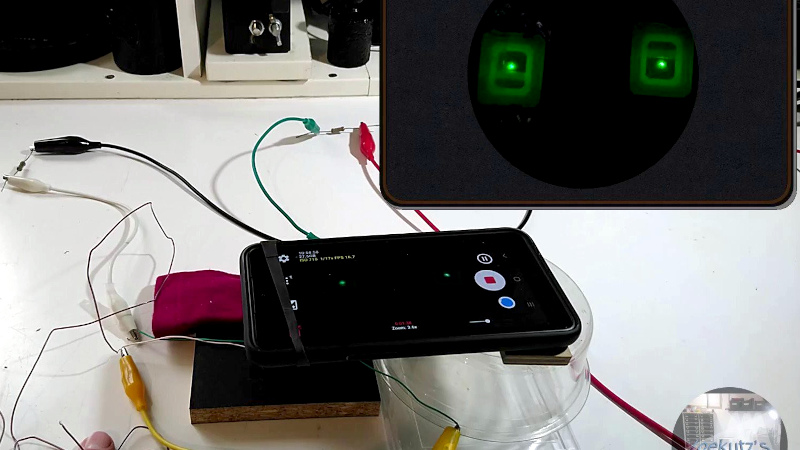
Of course, he’s not discovered perpetual motion. Rather, while an LED normally requires a bit of current to light up properly, it seems many will produce a tiny amount of light on almost nothing. Ambient electromagnetic fields are enough, and it’s this effect that’s under investigation. Using a phone camera and a magnifier as a light detector he’s able to observe the feeble glow as the device is exposed to ambient fields.
In effect this is using the LED as the very simplest form of radio receiver, a crystal set with no headphone and only the leads, some wires, and high value resistors as an antenna. The LED is after all a diode, and it can thus perform as a rectifier. We like the demonstration even if we can’t quite see an application for it.
While we’re no longer taking new entries for the 2025 Component Abuse Challenge, we’ve still got plenty of creative hacks from the competition to show off. We’re currently tabulating the votes, and will announce the winners of this particularly lively challenge soon.












There are Christmass LED lights above my bed. I noticed that when I shake my blanket up, they light up a little when not powered. Probably because of blanket’s electric field.
Is it an electric blanket?
I see this from what I assumed to be static energy. Lights wrapped around my daughters bunk bed stairs. If I carry a blanket down the stairs, I’ll sometimes see this. I believe static because it happens more when it’s dry inside home. It blew my mind when I first saw it happen!
Joekutz here :)
OK that is hilarious to imagine, and clearly the same effect that I saw in my experiment.
In fact, my Idea with the LEDs came because once I was wondering whether I can just tape an LED in front of my adjusted-to-complete-darkness eye with a long wire attached to each leg and see flicker. I didn’t do that experiment (probably works :) ) , but the experiment is still from that idea.
I recall seeing a build where someone bent an LED-s legs parallel, bridges them with a diode in the opposite direction, and tuned the legs by trimming them, I think to 2.4GHz. It could light the LED to a level visible to the naked eye when close to a wifi router or similar.
I tried this hundreds of times and could only get it to work with a microwave
They’re amazing little devices, there was a long running thread about an LED pack from a balloon that, when viewed in a dark room, was still producing visible light years after the cells had discharged to a point where a digital multimeter showed only a couple of millivolts
Anyone remember the LED stickers for old cellphones?
I do! :D
I actually mention them in my video and also link an old video of bigclive where he explains how they worked.
They are a good visualization of how much energy 2000’s cell phones produced!
i remember my dad had a toric fluorescent bulb, and one day when it was dry, we took turns dragging a blanket over our heads with the bulb held just above, like a halo. it would light up from the static electricity.
The leakage from flyback transformers in CRT based monitors used to be a useful source of localized magnetic field energy. For many years I kept a simple device – an LED wired across the ends of a small Radio Shack spool of #28 wire on the top of the monitor in my office. Besides being a conversation piece for visitors it was a useful tool on the occasions I was asked to do a show and tell about the EM fields produced by computer systems. Placed on the top of a monitor above the flyback the LED glowed quite nicely but moved out of the near field by about 1/2 inch in any direction and the glow vanished. A useful tool for giving non-technical people a feel for how EM field energy falls off with distance from the source.