
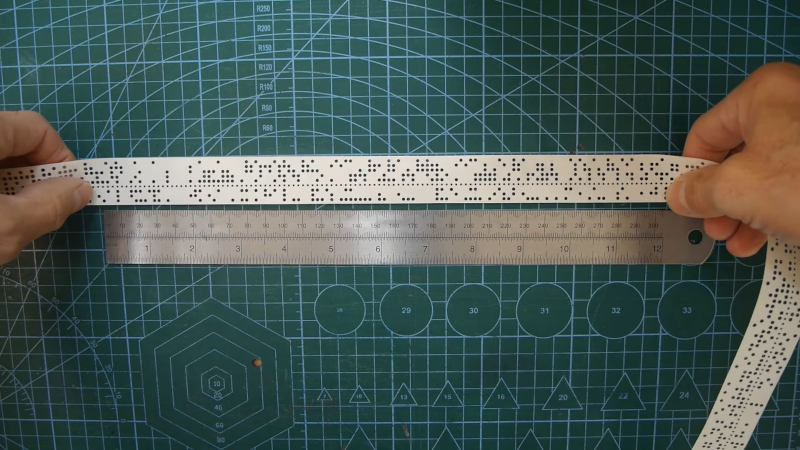
Since the dawn of computers, we’ve tried different ways to store data. These days, you grab data over the network, but you probably remember using optical disks, floppies, or, more recently, flash drives to load something into your computer. Old computers had to use a variety of methods, such as magnetic tape. But many early computers used some technology that existed from the pre-computer era, like punched cards or, as [Anthony Francis-Jones] shows us, paper tape.
Paper tape was common in TeleType machines and some industrial applications. In fact, as early as 1725, looms could use paper tape, which would eventually lead to punched cards. For computers, there were two common variations that differed in how many holes were punched across the tape: 5 or 8. There was also a small sprocket hole that allowed a gear to move the tape forward through a reader.
Typically, brushes or optical sensors would read the holes into the computer. Some paper tape used regular paper, but others used oily paper. You could also get tapes made out of mylar, which was very durable.
The other big difference in tapes was in how they were punched. A conventional tape had the entire hole punched out, leaving confetti-like “chad.” There were also chadless tapes where the chad was left slightly connected to the paper.
One common feature of paper tape was that it would skip any section where every hole had been punched. This allowed you to erase parts of the tape by punching over it. Then, with scissors and tape, you could splice sections by lining up the fully punched areas between two sections of tape. You could also make endless loops of tape.
Paper tape was used as a crude word processor back in the day. They were even used to send wire photos.












Merci Basile BOACHON !
At 18:11 the video says “I’m well known for making mistakes, so you might wanna check my math), I was surprised to see 11 bytes/inch? That value feels odd, so looking back at the video it really looks like a perfect 10 bytes/inch (according to the image at 16:40 in the video).
Standard 0.1 inch spacing in all directions in the tape I loaded for my first job, but a column wasn’t an 8 bit byte it was a character. That character might be expressed in 5 or 6 row encoding to keep the width (and thus cost and weight I had to lift) down.
I am sure somewhere someone thought of using 8 bits as a bootstrap (we used cards for that), but for us, at least, mostly only textual data was being loaded. So thinking back to my University days, even with 8 column tape, it was usually 7 bits per character and a parity bit. But that 7 rows was overkill when you were only working with text, a few special chearacters and encoding let you use less.
I recall well we a whole floor of (noisy) Keypunch machines staffed by a lovely group of ladies with incredible (and accurate) typing skills. There were no screens, they worked blind transcribing insurance claim data from form onto 6 row tape.
Thank you for taking time to share!
And the holes and not holes didn’t represent ones and zeroes but marks and spaces.
Few of bits :-) of trivia from a former TTY repair person:
– the tape is oiled because every hole punched lubricates the punch mechanism
– the model 33 reader uses neither brushes nor optics, it uses tiny sense pins that either pass through the holes or are blocked by the tape. They are more reliable than brushes
– the tape punch on the model 33 is connected mechanically to the codebars you can see when you lift the lid. The bits that set up the typewheel also determine the hole pattern in the tape. A KSR machine can easily be converted to an ASR machine, the most difficult part is running the wiring for the tape reader.
I’ve got a Model 19 Teletype in my basement. I switched it on about six months ago and it still seems to work after having sat there for about 30 years. It was used in the Bell System and it was a 72 WPM gear set instead of the more common 60 WPM gearing. It is on a big metal desk with magnetic feedback power supply using coffee saucer size disk copper/selenium rectifiers. There is also a transmitter-distributor unit. The TTY is set up for KSR operation, echoing anything typed locally.
The magnetic feedback power supply is pretty neat. There are no vacuum tubes needed for the voltage regulation. It uses an E core transformer with a coil on each of the legs of the E. The middle coil has DC from the output of the rectifier applied and is used to control the magnetic saturation of the core. If the output voltage increases, the core saturation also increases thus reducing the coupling between the input and output windings thus reducing the output voltage. The opposite happens when output voltage drops.
“Chad”?!?! Where do you think the term “bit bucket” comes from? Those are “bits” punched out of the tape. The container they fall into is the “bit bucket”. ;-)
You can call it a bit bucket all day long, 3.42857 or whatever the kids are calling 24/7 these days but what it contains are chads. It’s absurd to call things that aren’t there to be read “bits”.
https://dictionary.cambridge.org/us/dictionary/english/chad
It dates back to the 1930s. My first experience with computers (HP2000E) back in the 1970s relied on teletypes and paper tape so this was article was a fun read. Thanks!
Yeah, ‘chad’ has been always the little bits of paper that is usually punched out of punches whether for three ring binders, punched cards, punched tape, etc.
I didn’t know the origin of bit bucket, but it is/was a common term in the office when you delete files and such. ‘Throw it in the bit bucket’ . The waste basket is the the ’round file’. Funny the terms we come up with.
The lab where I worked in the late 1970s had an initiation trick – when the new guy/gal – usually a guy due to the messy nature of the prank – gets up for a break, squirt some liquid nitrogen into a plastic Kodak 35 mm film canister and throw in a bunch of TTY chad, snap on the lid and tape it under the victim’s chair. The victim comes back and a few minutes later the film can lid pops off and chad goes all over the place. Timing was fairly critical so that the gag didn’t trigger too soon. It requires using a look-out to spot the victim on the way back and then quickly loading and placing the film can.
Actually it was more like 30 seconds later, the lid would pop off the film container.
Either way, illegal and I ain’t cleaning that up.
Dry ice also works if you need a longer delay.
The player piano rolls were the weirdest.
Many implementations didn’t use electrical systems at all, instead they dragged the paper across a vacuum manifold that had a long row of ports for each key, with an individual hose going to that key’s actuator.
As the paper was pulled across the manifold bar it would block or unblock each port, modulating the pressure in the actuator line for the key.
They used vacuum instead of positive pressure because it kept the paper stuck tightly on the manifold for a good seal.
That’s brilliant, parallel port data read : – ]
Recording a pianist playing in real-time was even more amazing. The paper has to advance stop then punch advance again etc. fast enough to not mess with rhythm. It made a lot of noise and was in the next room from the piano. 90 or so hoses to do it then the magic happens where the artist could punch out and in mistakes decades before audio tape and razor blades. Tunes could also be
transcribed from sheet music to roll. Non linear editing, computer aided design.
In the 80’s we still had punch cards from university surplus that made good note paper and label stuff with a stout card instead of wispy paper. One day I picked up some cards and held one to the tracker bar on a player and “computer” music issued as I moved it both ways while I pumped the sounds out.
Some grad’s studious work turned in to sounds. Pump hard, Fortran forte!
Here’s a video I made of loading paper tape BASIC on my HP 2108A minicomputer, with a 2748B tape reader (500cps):
https://www.youtube.com/watch?v=dOh76qzUq7o
Yeah. Back in 1969 I worked for a company called National Computer Systems. (Anyone remember the Scantron?) The forms scanners were huge, complicated, and noisy. Our main computers were CDC 160a and 160g systems, and our main programming input was paper tape. At that time, the mechanical tape reader was replaced with a light sensor arrangement that zipped the tape through pretty quickly. This was a big improvement over the mechanical systems which were limited to teletype speeds of about 60wpm {about 720 characters per minute). Patches were entered by manually flipping switches to enter BCD code. Those were the days! {I’m glad they’re gone!)
Punch cards were much better – Fortran code printed across the top, and a great size to doodle on as a kid!
back in 80’s worked for company that made thermal printers. they designed a printer and scanner that used a kinda bar code to backup data. not sure what happened to it, that part was sold off.
IMHO, isn’t it amazing that now one can simply cut/paste these onto some kind of large (doesn’t have to be A4 sized) surface, take photo with a cell phone, and read it in one pass?
Tickler Tape was The Beginning, and look how far it has came ever since (I think QR code is the last simplest kind that can be easily reproduced by the average cheap printer/scanner/camera).
Does anyone here know how fast the codebreakers at Bletchley Park moved their paper tapes? I remember reading a book whcih said that that capability was the second-best-kept secret of World War II.
I was a Teletype coop student summer 1970. I tested model 33’s. One of my colleagues, Bud, loved to smoke big cigars at work. One day, Bud left a cigar on the workbench. Someone picked it up and rolled the end Bud had in his mouth in an ASR bit bucket. Bud found his cigar covered with little yellow dots. Yup, he was pissed. One day, I got a 50 cycle machine to test. Slightly different connections than the 60, no big deal. I’m plugging the machine in, and one by one my colleagues walked by and mentioned these were prone to smoke if you connected them wrong. I said yeah I got this. Turned the machine on and started the tests and almost immediately it smoked. I tried it again, another puff of smoke. I look in the machine and I see a Tygon tube. Followed it and found Hector, smoking a cigarette blowing smoke into the tube, the whole department standing with him laughing at me. That’s what work was like in 1970.
Part of my brain recognizes that 8-hole tape was used all over the place.
…
Another part that remembers being a Security Manager goes into a momentary fight-or-flight panic when seeing a photo of a ‘crypto tape’ posted to the internet.