
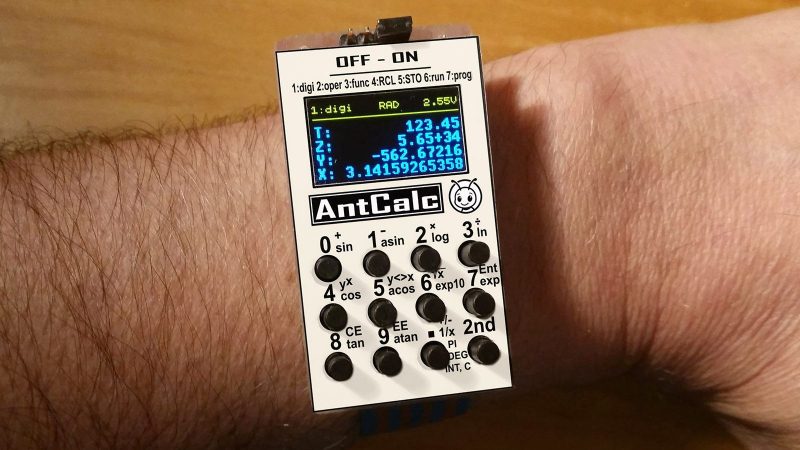
Once upon a time, owning a calculator watch was the epitome of cool. Well, for a very specific subset of the population with our own definition of “cool” anyway. The only thing cooler than wearing a calculator watch? Making a calculator watch, of course! If you do it as part of developing your own SDK for a popular RISC V microcontroller, all the better. That’s what [Miroslav Nemecek] did with his Antcalc watch, which is one of the demo projects for the CH32Lib SDK, which is currently under development at version 0.35 as this is written.
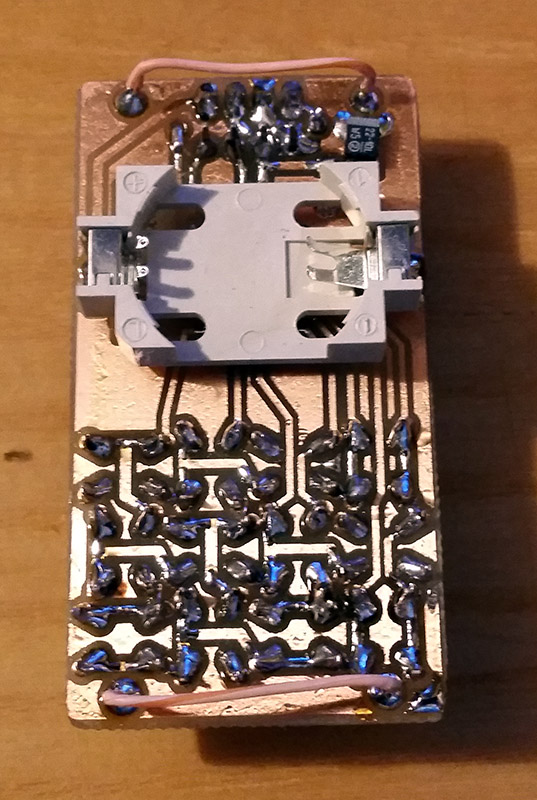
As you might guess, CH32LibSDK is targeting the super-cheap CH32 series of RISC V microcontrollers. Perhaps because the SDK is so early in development, there’s not much documentation outside of the example projects. The examples are all worth looking at, but our tipster wanted us to cover the Antcalc calculator watch specifically.
The Antcalc watch uses the SOP16-packaged CH32V002A4M6 to drive a small OLED display while taking input in Reverse Polish Notation from a dozen small buttons. We’re not sure how the cool kids feel about RPN these days, but that’s got to be worth extra nerd cred. Using a RISC V chip doesn’t hurt in that department, either.
For something so small– 30 mm x 55 mm–it’s looks like a decent little calculator, with 10 registers holding a mantissa of 21 digits and exponents up-to +/-99 in binary coded decimal. Seven layers on the dozen-key input pad mean most of the scientific functions you could ask for are available, along with the ability to record and replay upto 10 macros. There are also ten memory slots, all of which go into the chip’s onboard flash so are non-volatile during a battery swap. (Of which many will be necessary, since this appears to run on a single coin cell.)
If you get bored of wrist-mounted calculating, you could always repurpose this microcontroller to play MOD files on your wrist. Some people couldn’t imagine ever getting bored by a wrist-mounted calculator, and just for them we have this teardown of a beautiful 1975 model and a this article on the history of the calculator watch.
Thanks to [James Bowman] for the tip.












rpn is damn fine cred
hp gx48 accompanied me to a bsme and eit.
Cool. And RPN is just fine. Nice touch!
I had a Casio calculator watch back in high school days. College used HP-11, HP-15 and HP-16 and on into the working world.
Oh?
AI Overview
The GCC C and C++ compiler does not
build a Reverse Polish Notation (RPN),
or Forth-like, stack on the target
machine for each statement ending
in a semicolon. Instead, it uses an
Abstract Syntax Tree (AST) as its
primary intermediate representation
(IR) during the initial parsing and
analysis phases.
Here’s a breakdown of the GCC
process:
…
RPN is an expression notation that
can be efficiently evaluated using
a stack, but it is not the internal
data structure used by modern,
optimizing compilers like GCC
for processing the entire program logic.
If there was ever a perfect example of useless AI slop it’s that.
What you copy pasted without understanding has no relevence to using RPN as an entry system to a calculator. Which is the system used on some of the earlier scientific calculators, and still in use today.
https://www.instructables.com/How-to-Use-Reverse-Polish-Notation-on-a-Calculator/
seriously rad
RPN or GTFO
But uses decimal arithmetic or binary arithmetic ? RPN is the way to go and Decimal or BCD is a necessity too :). And rounded corners ! I want one anyways with BCD, RPN and rounded corners.
Uses BCD arithmetic – calculates with 21 BCD digits of mantissa.
convert this calculator to https://hackaday.com/2025/07/31/hands-on-the-hacker-pager/ hacker pager
, still 12-16 keys, big screeen and …. radio communication. (meybe 18650 power)
Och wondefull idea
i’m both excited by and sad about the fact that my first thought is yet again “this would have been better as a smartphone app” or maybe “smart watch app.” :) we’ve just got no call for using bespoke hardware to solve specific problems that are fundamentally software problems, sigh
I disagree. Having something ‘physical’ to work with is ‘much’ better/fun than a so-called ‘smart’ watch/phone. Buttons, lights, switches, knobs, and a simple display is more … satisfying. I try to stay away from my cell phone as much as possible in this day and age, but I see people ‘addicted’ to it every day. Walk into a restaurant and there is someone dinking with their phone, or even ordering with it, instead of simply walking up to the counter… sigh … Strange world :) .
haha i hate scanning a QR code to view the menu on a phone…give me a piece of paper! and i can definitely feel myself on the slippery slope of like reaching to the phone whenever i’m bored. but when i need to like do a little exponential arithmetic or unit conversions that are too much to do in my head, i don’t mind reaching for my phone…it’s better than my old calculator ever was because i (hopefully) always know where it is. even though i loved my hp48sx sigh
There is a definite tipping point where a do-all phone with an app becomes annoying and physical single purpose hardware becomes superior.
Physical calculator- during my lab years I had to do a lot of low level number crunching and it was way easier, less error prone and generally pre efficient to use and old school calculator, and HP actually. Way easier than messing with computer spreadsheet even.
Probably an oscilloscope is the same
Or like working on a car- you could probably get by with an adjustable wrench but single purpose box wrench is better pretty quickly.