
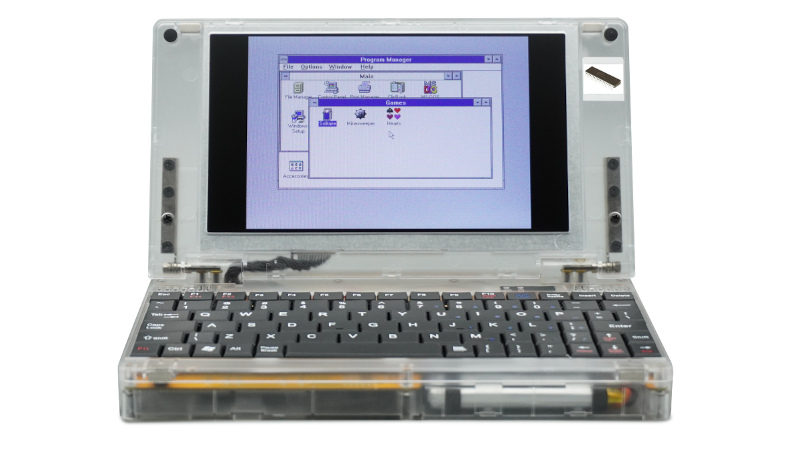
An interesting trend over the last year or two has been the emergence of modern retrocomputer PCs, recreations of classic PC hardware from back in the day taking advantage of modern parts alongside the venerable processors. These machines are usually very well specified for a PC from the 1980s, and represent a credible way to run your DOS or early Windows software on something close to the original. [CNX Software] has news of a couple of new ones from the same manufacturer in China, one sporting a 386sx and the other claiming it can take either an 8088 or an 8086.
Both machines use the same see-through plastic case, screen, and keyboard, and there are plenty of pictures to examine the motherboard. There are even downloadable design files, which is an interesting development. They come with a removable though proprietary looking VGA card bearing a Tseng Labs ET4000, a CF card interface, a USB port which claims to support disk drives, a sound card, the usual array of ports, and an ISA expansion for which a dock is sold separately. The battery appears to be a LiPo pouch cell of some kind.
If you would like one they can be found through the usual channels for a not-outrageous price compared to similar machines. We can see the attraction, though maybe we’ll stick with an emulator for now. If you’d like to check out alternatives we’ve reported in the past on similar 8088 and 386sx computers.












I’m not impressed with how this manufacturer has been pirating modern BIOSs from Sergey of Sergey’s XT
I am. Intellectual property is a fairy tale and people should stop respecting it.
What a disapointing, short-sighted viewpoint.
Fail to respect somebody’s licence (even an open source developer’s GPL licence) and pretty soon you’ll find that nobody writes new software anymore. I’m amazed sergey hasn’t thrown in the towel yet.
I agree, if we don’t respect IP and copyright nobody ever, Ever, will develop new software, companies like Microsoft, Apple, Oracle etc will founder and the world will burn for the lack of AI.
/Sarc
This isn’t some big megacorp we’re talking about here. Sergey is one dude working on this reto stuff for fun.
But sure, go ahead and bite the hand that feeds you.
Nah, people will still write software if they need it. They won’t do it for popularity or money though, which is a good thing. The tech industry has ruined the past 20 years on earth, I’ll be happy if they go broke.
You’re right. They won’t write it for popularity or money. They’ll write it for themselves and/or the company they work for, and they won’t share it. Which means every company will be on proprietary software with little to no interoperability.
That’s what we call a major step backwards.
Let me give you an example. Ever fought with an insurance company over a claim? No imagine that fight, but not after first fighting them to get the information from your doctor in the first place.
Your socialist ideal is actually hell on Earth.
this is why ms is putting ads in their operating system, why android is already an ad hellscape, and so on. just because a few people are too cheap to buy software or pay for services. code quality sucks when all your devs are homeless. i wonder how many linux developers collect welfare.
that said tech companies have gone way too far. pay, or be the product is one thing, but they want both now. if i pay for software i expect to be able to use it anonymously, on an airgapped machine if i want. but nobody does that and all commercial software is ass now. meanwhile people are still bitching about x11/wayland instead of capitalizing on the windows 11 flop.
Yeah it’s absolutely fine for people to go to work 40-80 hours a week creating things so the idea they are creating can be owned by a corporation and the actual creator is given the barest minimum salary they can get away with.
IP laws hurt the little guy more than they help absolutely anyone. They allow people’s creations to be co-opted for profit by people who do not contribute.
When is the last time you heard about a new videogame where half the studio was not fired at release? When was the last time you saw someone file a patent for something they made for a company, and then get dividends for that patent from the company? In the 50s and 60s, millions of inventors held patents that were then licensed from their parent company. Often the inventor could retire comfortably or build wealth by creating more while they made passive income on their past inventions. This is no longer the case and there is no incentive to make things better. The company owns your work and you own nothing.
So maybe the little guy getting hoses on the side is just an indication of the bigger issue. That IP law sucks.
Indeed, some things cost hundreds of thousands of dollars, and years of time to develop. Unlikely ever to see public support, production, and or disclosure…. Simply because revenue would not offset what global key patent defense would cost.
While FOSS is great in many ways, one should expect zero community support for passion projects. Some folks did figure out a balance, and positively impacted technology. “Discussing Circuit Simulators with Mike Engelhardt”
https://www.youtube.com/watch?v=Rc0swh7lpW0
you still need to pay for coders though. companies are getting creative as to how to do that. apple jacks you on hardware, google and now ms are becoming ad funded, even linux and open source depends on a flow of donations to keep programmers from being homeless. red hat provides support services (ms also does this). i think generational product launches, and the e-waste they create, are more to fund software development than actual hardware manufacturing. we have told 3 generations to learn to code, but didnt tell them how to make money doing it.
“When is the last time you heard about a new videogame where half the studio was not fired at release?”
Fun fact: After the historic Prague astronomical clock was built, the clockmaker who built it was reportedly blinded by the local government so he couldn’t make another one elsewhere. A simaler legend surrounds the iconic Saint Basil’s cathedral in Moscow, Russia (some reports/rumors indicate beheadings).
Hopefully it won’t go that far in the game dev. business but we seem to already be stepping on that road. 🫤
There’s a lot of arguments on all sides of this issue — ethical, social, practical. And i am not going to address most of them. But this particular one is easy to refute so i will.
An easy parallel is places where physical theft is more common. You would think, why would anyone work to have something nice when they know it might get stolen? And the answer is, if you can buy the nice thing, you are way ahead of someone who can’t. Even if you can’t hang onto it indefinitely, you are still way ahead of someone who can’t.
My friend moved to a country with a lot of poverty and shortly after he allowed a cable installer into his house, someone broke into his house and stole his laptop. He assumed that the installer essentially cased his house. And yet, he went and bought a new laptop, and all the years since, he has used the heck out of laptops…the theft was inconvenient and demoralizing but in the long run it didn’t deny him the advantages of his relative affluence, or the use value of laptops.
And i see the same in my own life. I bike for transport and i’ve had bikes stolen in a number of ways. And sometimes it has really upset me but i look at the big picture and i’m getting a bike stolen about once every 5 years. I noticed it doesn’t matter if i lock my bikes — i don’t generally lock my bikes and i still keep them for 5 years! It’s barely a blip in my finances (of course i’m always riding some cheap old used beater bike) and not really any more inconvenient than the inescapable need for maintenance.
And that’s examples where theft deprives me of the use of the zero-sum item!
In software, a willingness to write, maintain, and configure it always puts you ahead of where you would be if you didn’t have that willingness. Piracy doesn’t destroy the incentive to build. It has marginal effects, important effects. There are consequences. But within a single individual, building is more rewarding than not building.
Thank you. Yes, and Unix is the prime case of this. Ken Thompson and Dennis Ritchie had no pretensions of writing an OS except for their own, perhaps their MIT dept.’s The FOSS status of Linux was to correct the use and abuse of Unix copyright; a return to the old ways, not something unknown or novel.
and that’s why things have gotten so bad
No, it’s the opposite actually. Everyone pays for software, music, and movies now, and they’ve all never been worse. Money is the worst possible motivator for quality.
Spoken like a man who has never had any Intellectual Property he created himself ….. Just another leech on society
The Linux Community built the entirety of the software that runs the entire Internet for free on volunteer hours. Yes, I have contributed to that. No, I have not been compensated for my contributions. I wanted the Internet to work and be free and open, so I helped try to make it that way. Guess what happened? Giant corporations came in and made everything I tried to build very very bad in the name of making profit for people who did not contribute in any way, shape, or form.
So yes, I have created something and shared it of my own free will for others to use. My contributions run on a large portion of the Internet. Money is the worst reason to create something. Money has been making everything good about society worse since its invention.
Unix itself was a passion project. Even the name was a joke on Multics and Eunuchs; not a corporate nomenclature! It was because Bell Labs couldn’t copyright it without attracting attention of the DOJ for anti-trust law. And it was a long, long time before Ken and Dennis got any monetary gain from it. They made it because they wanted to do it for themselves. You’re in good company!
I think what would bother me is if a company took something I created, and abused the hell out of it and used it to make people’s lives miserable for their own enrichment. Much more so than if a couple people downloaded it as “warez” for their personal use.
I’ve shared plenty of original research, unlicensed and for free; but you’re right, I’ve never had any “Intellectual Property” because it isn’t real. Why would I try to hoard knowledge to make a quick buck? Seems immoral to me.
What Anonymous say is true. “Intellectual property” is vapor. It’s less than vapor, since it costs almost nothing to duplicate in quantity. And the mass of a bit is immeasurably small. If it weren’t for the FOSS community, computing would never progress, because every software company would just sell products without sharing the innovations in it, and everybody, including software companies, would be worse off. And they would have a heck of a time finding qualified people to work for them, because ALL innovation is self-taught. The whole concept of a patent was that you could get exclusive rights to use your invention for a period of time, in exchange for divulging the details that make it work. But today, many patents rely on trade secrets, so the essential details remain secret. I’m talking about things like closed “binary blobs” that many chips won’t work without.
Universities are the biggest waste of money in our society; they live on the notion that the “add value” to the information that for the most part they are just repackaging and selling at extreme profit. Remember USB? It came out in the late 90s, and that shut out a whole generation of hobbyists who USED to be able to hook up their self-designed and self-built peripherals to their computers through the serial and parallel ports. Why? Because the “USB Implementers Forum” owned all of the IP and charged exorbitant fees to break into the field. But once a few companies challenged that and did things like sharing their vendor ID with buyers of their microcontrollers (strictly verboten by USB-IF, who very definitely did not encourage the entry of non-coporate entities into their garden, and weren’t shy about saying so), there was a break in the wall. The USB “dark ages” served nobody, because it relied on intellectual property and its enforcement. Now, due to open-source libraries on github (and elsewhere), USB is no longer a scary place where nobody will talk to you unless you know the secret handshake.
Knowledge is free. Sure, it costs time and therefore money to create it, but NOBODY owns it. Look at the scientific publishing parasites. They CHARGE scientists to publish their articles, and then charge them again to read them. Because they can. The good news? Scientists are going to nonprofit publishers that have popped up to challenge this injustice, and it’s about time.
Oh: and I have both produced and consumed a great deal of “intellectual property” in my life, much of it for hire. But I don’t charge people to tell them how something I wrote or built works.
@BrightBlueJim
Not on DOS platform. It remained laregely unaffected and unimpressed by the introduction of USB. :)
Here, on good ol’ DOS, the world was still alright and peaceful.
Joshua: the exception that proves the rule. Anybody who stuck with DOS after Windows95 came out basically dropped out of the PC world, so they don’t count anyway.
Coincidentally though, I worked as a test engineer at a chip manufacturer for a while in the early 2000s, and the test systems we used were based on desktop PCs with instrument boards (stimulus and measurement instruments) plugged into the ISA bus. So I was stuck in DOS for a while, at least at work. It seemed funny, using an antiquated PC, plugged into and controlling a ~$million wafer test and laser trim machine, over a serial port. Like a really, really poor man’s version of GPIB.
IP us indeed a scourge that needs to disappear
You are a jackass
I come for the articles, stay for the uninformed, silly takes in the comments. This site honestly has some of the wildest alternate reality takes and it’s beautiful.
I like you Anon. You’re funny.
what the f**k are you talking about, the source for the BIOS is on the website, I guess like many of your kind, expecting reading comprehension is just a pipe dream
How do think it got there? The company had to be reminded of their obligation.
You’ll note it’s also still notably absent for the 386 machine.
Sergey got in touch and gave his blessing. They really only needed to put his name on the firmware and they do that now.
As soon as a 486DX version with ISA appears I will pounce.
Would be perfect for setting up to calibrate Tektronix TDS500, 600, and 700 series oscilloscopes that need the specific National Instruments ISA GPIB card…
Hi, but why? The 386SX has 24/16-Bit i/o (adress bus/data bus) just like ISA.
A 486DX would not improve ISA performance, thus.
Like a 386DX it is using 32/32-Bit i/o (or optionally 24/16-Bit i/o in an 386SX “mode”).
The only advantage a 486DX has is a small L1 cache and an FPU, bitness is same to 386DX.
An Cyrix/Ti 486SLC, 486SXL or 486SRx² would be the next logical upgade for an 386SX system, provided the chips are available still.
https://en.wikipedia.org/wiki/Cyrix_Cx486SLC
The Tektronix calibration software makes use of floating point arithmetic, it is strongly recommended in the service manual to use a CPU with a math coprocessor.
The 486DX is faster and has the coprocessor, and will also play Doom better than a 386SX.
But any CPU with coprocessor and a decent clock rate would be ok I guess, be it Intel, Cyrix, etc.
You can use a co-processor emulator on DOS if the application was optimized for an x87 FPU.
I recommend trying out Franke.387, it’s very quick.
http://icfs.de/english/franke387.html
You are not gonna like what I am about to say.
Since it is retro-making, WHY can’t we make this in the US? Older chips, larger than 180 nm, technology is well-known, etc etc. Actually, I do NOT understand why we cannot restart making older and well-known chips for things like cars and light industrial stuffs, must EVERYTHING be made in either Taiwan or China?
No skill, plus we’re broke. We just can’t. Same reason you don’t see chips made in Uganda.
Hi – as a foreigner I do think a little bit more positive about that, I guess.
In principle, you guys could due to your financial power alone.
But it would need a different mindset, something that’s more solidary/social torwards the own industry/workers.
And that’s sort of a dilemma, because everything is so focused on making high profits these days and because production in China simply is so much cheaper.
Not on the long run, though, maybe. That also has its price.
Once China has become the sole market leader, it can rise the price tag as it wishs.
Unfortunately, that’s not on the mind of the people who move production from the US or Europe over to China, I’m afraid.
They’re being busy thinking about their own profits,
rather than the well-being of the industry of their own country.
As a US citizen, I honestly doubt our “financial power” is real. Supposedly we’re a bunch of rich guys, but if that’s the case, why don’t we do rich guy stuff? Where’s our golden palaces with fountains of wine? The best we can do is a plastic car and a cardboard house, even for the top 1% (theirs are just bigger and shinier). Our billionaires couldn’t even spend their money if they tried! It’s not stored as assets or cash, but as the “value” of their companies, which is just the collective fantasy of their investors. American wealth is fictional.
I understand. Over here in Germany it’s not that different in principle, either.
The country is rich, but most of the people living inside it are not.
Sure, there’s the supposed middle-class, but in daily life most people don’t have much money to spend, either.
In additon, energy prices are very high, too.
And notable parts of our infrastructure is over-aged, too.
The difference is that we have a safety net, like most other countries have, that helps us get up again from time to time..
So we have a bit of time to recover if we loose a job or are sick.
That being said, once you’re in, getting completely out of that safety net isn’t always easy, either.
Because it needs a profession that pays off, too.
But that’s another story, perhaps. What I meant to say is: don’t despair.
Like us you guys have a wonderful (but big) country with all sorts of nature and wonders that could be restored to former prosperity. The question just is how to make that happen, how to react to China’s dominance.
You are correct…the “disposable” wealth (i.e. what is left over after mere survival) in the US is mainly concentrated into the hands of a few individuals. The economy is supposed to be SME based…middle class…mom-and-pop shops…the independent grocer in the corner shop…the lone engineer who designs out of his house and does small-scale manufacturing from his garage. A thousand SME’s can fail in one day, and the economy won’t bat an eye-lid. A single large corporate that fails is felt everywhere.
The good news is that the conditions to return this to the US is busy falling in place. Your president’s actions are not arbitrary. As Americans you just need to grab what is being given to you now, and run with it. The unavoidable multi-polar world we are entering now requires it for survival…you do not want someone else to operate the vice that holds your nuts.
Skills?…was never a problem. The willingness to work blue-collar is…you cannot have a whole society of managers, and no workers. The education dynamic needs to change away fron university.
Because you guys nolonger have the competence and the skilled workers needed, my friend.
It’s same here in Germany, I think. We used to have x86 CPUs made by Siemens and VEB Robotron (GDR).
Back in the early-mid 1990s, we were big in telecommunications.
Siemens built digital ISDN technology and related things.
But something during the 1990s went wrong and we nolonger have our own national manufacturers of telephones, cell phones or computers.
It all went into the foreign countries, globalization happened. Our know-how went vanished.
In the 80s, we still had monitors and PCs made by companies such as Siemens-Nixdorf, Triumph-Adler, Müller GmbH (CTM), Olympia, Schneider Rundfunkwerke AG and Robotron (GDR).
In the 90s/early 2000s, we still had some monitors/LCDs and PCs made by Fujitsu-Siemens .
What’s left is engineering, steel industry, cars and export.
We also have scientists and researchers, of course. But they’re looking for jobs elsewhere.
Business wanks is why.
“We can’t be using OLD chips in our WIFI enabled, bluetooth connected, GPS tracked, luxury SUV!”
Same goes for industrial, I run into so much equipment that could be controlled by a dozen relays and a timer but it comes packed with a top of the line Siemens PLC because that’s what the “professionals” are using.
Dump the MBAs, kneecap the marketing departments and let technological decisions be made by people who don’t need an LLM to read their e-mail.
To our defense, Siemens nolonger is what it used to be.
In the past century, it used to be a German company that supported our country and had German values.
Something along the lines of Bosch, Bauknecht or AKG.
Nowadays companies of the kind of SAP or Siemens are international, multi billion heavy companies that don’t care about the former home country. AFAIK.
Perhaps I’m telling the obvious here, I just meant to say that these companies aren’t really “us” in the common sense.
They’re beyond our control, rather.
Siemens became what it is via choices. They exited telecoms (sold their share of Nokia Siemens Networks to Nokia) and chips (Infineon), but they do own Hackaday.
So interesting choices.
I often feel confused by comments like yours. Back then we had higher interest rates, so people really had to save up to buy a car or a house. Then we had higher tariffs, so we had to buy local, and it was way more expensive. Other countries were less developed so they were not able to export to us so we didn’t have to compete. We could decide to make the iPhone a 2000 euro purchase, basically what Trump was trying to do all year long in the USA. Because surely Siemens would setup a phone factory in Germany if they could sell a phone for that much money. Also we could reduce employment benefits and we could increase work hours to 44 so we can compete with the rest of the world, who are just as smart as us, but they work harder. The vacation days alone make me think that in Europe we perhaps live in delusion. Do we want to live like the Americans or the Chinese? I don’t think so.
Look at https://www.youtube.com/watch?v=leFuF-zoVzA or even https://www.youtube.com/watch?v=utfbE3_uAMA
Factory towns in china and elsewhere are factories that make factories. Everything you need to start a manufacturing business, readily available in one place. All such places are gone from the western world and have been for decades, making it a Sisyphean task with a huge up-front pricetag to start a hardware business.
As for why they’re there and not here? “look how much money we can save moving somewhere with cheaper labour and laxer regulations” with zero consideration to the strategic importance of what was being given up.
In dead, it’s a syphil.. err, sisyphean task. But maybe it’s worth a try. Giving up is no real alternative, either.
Maybe by focusing on production of less sophisticated things first.
Or by trying to resurrect abandoned factories, not sure.
Matching China’s high-tech semiconductor industry is very hard.
Even Korea and Japan are under high pressure remaining somehow relevant in the business.
Etching high-quality PCBs inside Europe or US is still possible, though.
Same goes for production of chassis and other things. Not everything is lost yet.
These are all small factories. This guy doesnt care and just films who will pay him 10k usd (about 3 year salaries for a average 996 worker in China). Anyway, places like Guiyu (and HK) prolly have millions of ewaste 386/486 chips stocked for the infinite future.
It’s counterintuitive but the older, larger processes, I believe, require different equipment which is mostly junked, are only in the hands of specialist fabs or companies in developing markets.
Plus, for a whole device, it has to be CHEAP so it’s way harder than it might appear to manufacture and make a profit, especially for a niche product like this which might struggle to sell a few thousand.
Don’t believe me?
Try it, develop the schematic, grab yourself a handful of old chips, then design and find a local contractor to make the PCBs, do the software integration and dev work, design the moulded enclosure, keyboard etc, again find a local contractor, do the full work up, don’t forget to get prices for 1K, 10K, 100K quantities, include your time and see how many you have to sell to make minimum wage.
So we could do it in the ’80s, but we can’t now? And supposedly we’ve never been wealthier or more productive than we are today? Something’s not adding up.
Sure, and we could rebuild a Saturn V rocket too. But the suppliers are out of business, the engineers are retired, and the specialized equipment was scrapped for more profitable uses. Turns out ‘wealthy and productive’ means we stopped doing obsolete things on purpose.
“Something doesn’t add up.”
It adds up fine: we got rich by not making 40-year-old chips.
We also used to be able to pour concrete for nuclear power plants that met the specifications, but lost that ability. And the ability to build the components for those plants. That is gone. So, the proposed “nuclear renaissance” has a VERY steep hill to re-climb, or else we will have to import thousands of Chinese workers to build them.
I think we did that once befoe, for the railroads…..
Well, there’s also shipping costs, import taxes and delivery time.
That’s one of the reasons some of my German fellow citizens do order PCBs from within Germany rather than China.
The quality of the etching is about same, with the German PCBs a little bit better overall.
Things like deburred edges and so on.
On the chemical side, the Chinese PCBs might be more poisonous due to laxer regelations for environmental protection, not sure.
A lot of products from China are rightous toxic, after all.
RE: older chips making in the US – coincidence has it, my childhood dream was to become an IC engineer. I went as far as the basics (we are talking mid-1980s) and planned to pivot into quantum physics to further my knowledge (early 1990s). I can design simple ICs myself, just never had a chance to actually work in the industry and gain usable experience. If I’d find a place that hires someone like me, I am willing to pick up where I left 25 years ago, and move forward. I am also very, VERY sure there are (forced) retired IC engineers that can mentor people like me. All we need is proper/strategic planning, and NOT the USSR 5-year plans of extracting the maximum profit at any cost.
The question of “not having enough experienced people” is moot – most engineers who designed and build older processors/ICs are still around, just no longer can find a reliable job. I personally REGULARLY run into these (even rural Delaware has them – RURAL DELAWARE, the middle of nowhere, relly). Northern NJ used to have R&D centers (some buildings are still there, too, btw), IBM, etc. If I’d be investing in things I’d start by hiring THOSE people as mentors, and moving forward. Local hire, again, US citizens, because that’s the only way that works, keeping everything 100% local, and building momentum.
The other question of “not enough finances” is moot, too – Wall St regularly trashes billions in pointless ponzi schemas, and those are now FDIC-backed (1990s “banking re-regulation”, we are now backing these casinos with our hard-earned money), so it is a matter of re-pointing moneys and investing into local enterprises.
As a side note, and correct me if I am wrong, wasn’t “factories making other factories” the US invention?. If I remember right, it was Ford who started doing that, btw, early 20 century; USSR bought entire ready-made Ford factories in the 1930s, because they were that efficient – and they hired Ford engineers to speed up things and train their own – so-called Stalin’s “industrial plan” of the 1930s was mostly based on these things, and it is very, very well documented. Point being, isn’t it good time to repeat the same now, 100 years later, plan it so that we are building factories that build other factories?
You can’t make this in the US, because it’s a very small niche market, and the machines for making such old ICs have been sold to China 30 years ago.
The cost of making new ones wouldn’t be much lower than that of making news ones for < 5nm.
So why invest money to make cold war era chips, when you can make and sell GPUs for AI instead?
Doesn’t make sense, except for a Chinese backyard business, that runs on old machines and lets family members do the work.
As a German/European, I would answer: independence, self-reliance.
The whole current situation came to exactly be because of economic reasons, rather than being reasonable.
Making profits only makes sense as long as the other side can’t drag you into dependency.
And that’s what China was doing.
It used the western capitalism model as an instrument to lure everyone into dependency.
Western companies thought they were smart by exploiting cheap human labor in a foreign country,
not realizing that this would make them dependant because it would ruin the own, national industry same time.
Here in Europe we did same thing, but to a lesser extent, maybe.
We still have some of our old industry around, but it’s more supplemental and not a substitute for products from China.
So we’re all basically in same boat, unfortunately.
Or in other words, the US citizens must learn to be willing to buy national products that cost a litte bit more.
In order to support their own region, their own country.
Over here in Europe, we do that sometimes. We pay a bit more to support local companies and shops.
We buy groceries from local production, for example. To support regional farmers etc.
The reward is quality and self-reliance, though.
Real, healthy, natural strawberries from a regional farmer vs. those poisonous ones imported from China.
The problem is every one has a different idea of “a bit more”. In reality it would be significantly more. Most consumers won’t buy a laptop that costs twice as much just because it was fully built in the USA.
Please share with us, precisely and exactly, which [the use of the singular case here is ABSOLUTELY INTENTIONAL] laptop is now “fully built” in the USA.
“US citizens must learn to be willing to buy national products that cost a litte bit more”
And US manufacturers must learn to be willing to earn a little bit less.
The question is how long that business model would last, though.
China has “just” revealed DeepSeek and advances quickly.
It may dominate the field of A.I. soon without needing western technology anymore.
From my point of view, the only thing the US still has to offer here are software companies (and banks/credit cards).
You know, the usual big US tech companies that interfere with western societies on a daily basis.
Those that we Europeans are so dependent of and subconsciously know
that we have to try to get rid of but don’t know how to do so far.
Maybe China has an answer to that, too. ;)
Because there is no real money in it …… You could try to do it but you’d likely never sell enough units to get your development costs back
Again, the money argument.. You guys are walking in a circle here.
In reality, ICs produced in your own country could be used for national products.
Products that your goverment would use, products that are being given to city administrations, schools, the whole public sector.
It doesn’t have to be 1:1 competitive with China tech, just be functional enough.
Because, there has to be a start. You can’t become competitive out of nowhere.
You have to begin and then improve over time. A positive side effect is, that there’s no spyware inside. Well, at least not foreign one. ;)
But if you have big profits in mind, there will never be a start in first place.
The Chinese knew that, that’s why they’re now where they are!
Yep, and I second that – local chips made for local products.
Japan had nifty law set in place in the 1980s – local chips/products CANNOT be exported until they reach certain age, and if I remember right, it was 5 years for the electronics. Only 5-year-old electronics can be sold outside Japan. I am quite sure US can pass something similar and boost local investmet pretty much overnight.
I’ve already stated the obvious – find any Nintendo manual and read the names on the back of the manual. They are pretty much all japanese names because they value their own citizens over foreign workers – and there is a law guarding local expertise – imported contractors CANNOT be paid less than twice the rate of local hire. Obviously, companies pick local graduates and train them, because that’s cheaper. (and retaining local talent is even cheaper – it also means that the expertise is passed to other locals, and not shipped overseas).
There’s a whole bunch of required surrounding infrastructure that was torn down when companies outsourced.
It’s not just the chips, it’s the whole silicon fab, the testing equipment and software, the supplier of pure amorphous silicon, the companies that provided small but essential services, they are all gone and you would have to lift them up before you get to the actual chips.
Depending on how we look at it, can’t this bad situation be “good” too?
I mean, rebuilding the whole thing requires workplaces, jobs.
It’s an opportunity to hire local companies and provide jobs.
Which in the process might attract investors, engineers and whatnot.
except it’s rarely local companies, in fact usually distant foreign countries and jobs. But it’s how Silicon Valley out-competed northeastern companies like DEC, Wang, Data General, and all the companies that directly came out of MIT. It “can” be good, but it’s by far not good. Taiwan and Korea might argue with my point, but there it is.
Because in the United States, if it doesn’t make a bajillion trillion kerplillion dollars, it is “not worth the time”. I see gaming studios shuttered because their profits aren’t enough. They are profitable, solvent companies that are able to stand on their own legs and even make lots of money for the actual* contributors* but instead it “only” made $5 million, so that wasn’t worth the time shut it down.
The way the US runs its businesses on massive profit margins for every single step of a process… Is deranged and is the entire reason we don’t have manufacturing anymore. The expectations and the numbers we put on people’s work are absolutely insane.
Maybe time to reinvent coops : – ]
i just scrolled down until i found someone that already wrote the right answer, and here it is :)
It’s a special case of the tendency for the rate of profit to fall as commodity production matures. Which is such an important aspect of market production because it’s exactly opposite to the investor demands. Returns on financial investment have overall only gone up in the US in recent decades, even as the returns from production have cratered. As a result, financiers aren’t interested in chasing returns from production. They’re far more interested in the question of how to corner the profit from foreign production than they are in developing or sustaining production directly.
I suspect that the biggest issue for something like this would be the parts that aren’t the chips.
If you require the absolute bleeding edge of logic fab, then Intel currently has some bad news for you; TSMC is currently the better bet; though either(or even GlobalFoundries) are something like 20-25 years in the future depending on exactly how late a 386 we are talking.
TI, NXP, Diodes Incorporated(and some of the others that snagged bits of ON Semi) also continue to churn out various microcontroller, analog, and mixed signal parts; and there are a whole lot of more specialty outfits.
China certainly isn’t a bad spot to get old chips that have been scavenged out of things and either labelled honestly or ‘upcycled’ into ‘new old stock’; so if you want authenticity rather than an FPGA or more modern processor with some older interfaces carefully bodged in(which remained viable without too much low-level witchcraft for a surprisingly long time with LPC to ISA conversion; with low-level witchcraft you can probably have an ISA device bolted onto PCIe talking to DOS in an x86 emulator under a hypervisor on RISC-V if you are feeling really committed to keeping it perverse).
Where your options are probably considerably less good is things like “I want an injection-molded plastic case in not terribly large quantity”. Technically doable; but the unit cost would likely be fairly alarming if you want it done domestically. Depending on how many you are planning on selling it might literally be cheaper to do a metal one; since outfits that do machining to spec wouldn’t hit you with the mold cost. Then you’d get hit again when you want ‘a laptop keyboard, it’s OK if it’s mediocre’; and ‘some kind of Li-ion pouch’, and ‘TFT that would have really impressed a 386 user’.
The obstacles to manufacturing an entire product are quite real; but a lot of them are the ‘doable; but bean counters have been offshoring this stuff for 30 years or more, so doing it locally is going to sting’ bits; rather than the really high end tech where the costs involved are so high and the requirements are specialized enough that there’s not that much incentive to move.
All excellent points made, and I appreciate the time taken writing the replies.
Close to me there is chip-making factory. It does military chip making, so it is closed/proprietary, but what little bits I do know that it is NOT the only one around (cheap University of Delaware graduates, of course – in particular Quantum Physics major, materials science, and not only). It gets even more interesting, they procure their stuffs globally, but from what I’ve heard mostly from Netherlands (China, too, and Taiwan, but not only – South Korea and Japan as well). Why we can’t just learn from Netherlands and build similar factory in Delaware?
Point being we DO have working profit-making business model, even though it is Pentigon-paid. I see no reasons for SOME of their stuffs forked off as a separate company making de-classified chips (obviously, AFTER being scaled down to non-proprietary and removing anything that has to do with the national security) and made into small chip making factory. I am also very sure there ARE steps taken in the past that made it into proprietary stuff making that can be repeated by other makers, thus, making it non-proprietary – civil chip making for things that do NOT need advanced/latest/greatest.
Also, outsourcing is a well-known thing. At some point the costs of outsourcing WILL outweigh any benefits won in the short-term. Any economics major will tell you that. Nothing new there, once the place has the expertise, it will jack up the price, because it became de-facto monopoly. THis is were we are now, most of the Western Europe and the US (Canada, too, but partially – they’ve managed to keep at least SOME of their manufacturing local) is facing increasing costs, and it has chosen to go with the high costs, and it does suck for the average Sam.
Maybe I should just look into pooling together few of my firends’ finances (one is a millionaire, btw) and open a factory. I am pretty sure I can find more than few willing UoD graduates and I am also quite sure I can find retired/disgruntled IC engineers. Never thought about it, but who knows.
Fixing this – “…I am also very sure there ARE steps taken in the past that made it into proprietary stuff making that can be repeated …” supposed to be “…I am also very sure there ARE steps taken in the past that made it into proprietary stuff making that can be REVERSED…”
I should dig out my 486ish DOS+GEOS phone and find how to make it boot into command.com again. sigh!
It might be a nice PDA with DOS and TinyCC..
Picture is windows 2 , not dos , dos was ASCII char only
haha, I guess you didn’t work with PCs in those times. Windows 2 was simply a GUI for DOS. Arguably Windows 3.x as well, although it was sold as a new OS. Before Win95, all MS Windows ran ON DOS. nice try at correcting, though
Hi, Windows 2.x also had the ability to multitask DOS applications and provide Expanded Memory.
The normal Windows 2.x and Windows/286 could multitask DOS text-mode applications, if configured via PIF Editor.
Windows/386 went a bit further and included something like EMM386 (or CEMM) and could multitask graphical DOS applications, too.
Such as CGA applications (windowed) on an EGA/VGA graphics card.
Windows/386 was the first real Windows as we know it,
since it introduced virtual drivers and EMS emulation via 386 MMU.
The EMS could he used by both DOS and Windows 2.x applications.
That’s why Windows/386 was a real rival to OS/2 at the time.
It provided a lot for DOS applications, but little for native applications (Windows applications).
16-Bit OS/2 was the reverse, it had single penalty box for DOS but had offered a lot to native applications (OS/2 and PM applications).
There also was the Family API, which allowed OS/2 programs to have an OS/2 runtime built-in.
That way, these OS/2 programs ran on DOS on an PC/XT, too.
The downside was that they were fatter than ordinary DOS programs.
What’s cool about Windows 2.x is that it can run on any PC.
The plain version, Windows 2.x (often 2.03) is the basic version.
Windows/286 can (but doesn’t have to) use the 64 KB of extra memory on a 286 PC that’s beyond 1MB (the HMA).
Windows/386 has a virtual machine monitor (that EMM386 counterpart).
It will also run on any pre-386 PC by running it via WIN86.COM.
That’s right, the Windows part is separate and can be run standalone.
Without the memory managment feature, it’s basically same as the old Windows 2.03.
It even could let applications use existing physical EMS, if the PC had an EMS board installed or EMS via chipset.
That’s what ordinary Windows 2.x and Windows/286 had to get along with, after all, because they didn’t have an LIMulator shipped.
Using CEMM/EMM386 with Windows 2.x is still possible, by the way.
On MS-DOS 6.x, for example, merely SETVER must be loaded and then must be MemMaker started.
It will optimize EMM386 in a way it can be seen properly by Windows 2.x (and 3.0 in Real-Mode).
Having EMS helps greatly with large Windows applications such as Page Maker 3, Excel or WinWord..
That’s just a summary, though. I described it as best as I could.
Strictly speaking, Windows 3.0 was sold as a “graphical environment”. It’s even on the box.
And Window for Workgroups 3.11 was as much as an OS (or not) as Windows 95 was.
Both run on DOS first, then try to transfer DOS into an VM.
DOS is then running on top of Windows, basically.
(The heart of Windows 95 is the VMM, the virtual machine monitor or manager.)
To make that happen, though, WfW 3.11 must have 32-Bit File Access (HDD cache) and 32-Bit Drive Access (FastDisk, native HDD driver) enabled.
The swap file (if any used) should be set to “permanent” (fixed block of sectors).
If the conditions are met, it then will filter both int13h (BIOS HDD routines) and int21h (MS-DOS API) and handle it all alone.
Without using DOS!
Btw, Windows 95 sometimes would still fall back using DOS for HDD access.
That’s when the system was in “16-Bit compatibility mode” for whatever reason.
There’s a warning/info in Control Panel->System–>Performance, I vaguely remember.
It says that the filesystem access is using MS-DOS as a workaround basically.
Not only that, but by no means was MS-DOS “ASCII char only.” We had CGA and VGA boards well before Windows, and applications were written to drive these with graphics directly, before Windows came along. You would start the application from the command line, then the application would switch the CGA or VGA board to the mode that it needed, and returned you to an 80×25 character mode when the application exited.
There also was the GSX graphics runtime and the GEM Desktop..
And OS/2 1.1 from 1988, which had a Presentation Manager that looked like Windows 2.
That being said, Norton Commander and XTree Gold were popular, too.
They’ve used text-mode, but were in color.
TopView and DESQView were around, too.
They had allowed for multitasking in the “dark ages”. ;)
Oh, and paint programs shipped with computer mice, often!
You had those graphical programs in ca. 1986 already – on PC, I mean.
Then there were other system such as Xenix, of course.
The higher end versions shipped with X11 like graphics systems.
In the mid-late 1980s, I mean. Only a few were familiar with that, though, of course.
Right, but I’m just talking about how you did graphics IN MS-DOS. Just because you see Windows on the screen doesn’t mean it’s not running under DOS.
The article incorrectly claims there’s an ET4000 on board. As the provided links show, this is incorrect, the products sport a TVGA9000.
These systems seem like updates to the ones that were released not so long ago.
It would be nice if they had normal serial and parallel ports instead of pin headers.
OTOH that seems authentic in a way :) i definitely used to have a pile of adaptors for pin headers to external I/O ports. Like just the steel blank from the end of an ISA card, with D-sub connectors on it with short ribbon cables
But, you have to appreciate Pocket386 hits a sweet spot because all, (nearly all?) 386 of the period had monochrome screens. Otherwise it would be much better and more cost effective to buy an old 386 laptop. That’s also why I’m betting there will never be a Pocket486 or Hand486. I’m surprise I haven’t read an article that points this out. I was trashpicking in the mid-90s, desperate to find a machine that would run linux at the time, I’m still hyper aware of the limitations.
Black and white LC displays were common way into the 486 era, I think.
At home, we had a slim line 486 notebook with a monochrome screen in the mid-90s.
It had 4 MB of RAM, 120 MB HDD, some 25 or 40 MHz i486 low-power notebook CPU (486SXL or similar).
And it ran MS-DOS 6 and Windows 3.1, some Visual Basic and Works 2.
In the Macintosh world, similar, m68k based notebooks with monochrome screen were around in the mid-90s.
My ‘386 machine had VGA and a ViewSonic color monitor (ViewSonic Outside®). Tseng Labs ET4000 with an aftermarket RAMDAC. Remember those?
Haven’t these machines been out a long time now and there’s plenty of reviews on them online?
The thing I wonder is where they are finding a supply of Tsend ET4000s? I’m assuming they’re using some soc for the CPU but recalling the ET4000 from the 1990s I also don’t recall it being integrated into anything (like some Cirrus Logic and Via VGA solutions were.)
From the comments I see that at least some of these have a different VGA chip. They are probably using just about any NOS VGA chips they can find.
For a little while I designed embedded 386 and 486 systems for a company that would guarantee 10 years of support, and did so by doing EOL buys for each chip as soon as EOL was announced. It really wasn’t hard to do – every chip maker provided a reference design for every chip, so you just had to follow the recipe. You DID have to get the BIOS extension for the chips you used though, especially for VGA, but of course we got that when the chips were still supported.
Reminded me I have an old Toshiba Libretto Pentium mini pc somewhere at home. I should dig it out and check it still boots into Win 95 play some Doom.
I got a 1987 ThinkPad on deep freeze, only thing I could find to support the hardware was unix. Win/Linux is a no go. So if you’re looking to install one of these with a 286 or 386 use freebsd…