
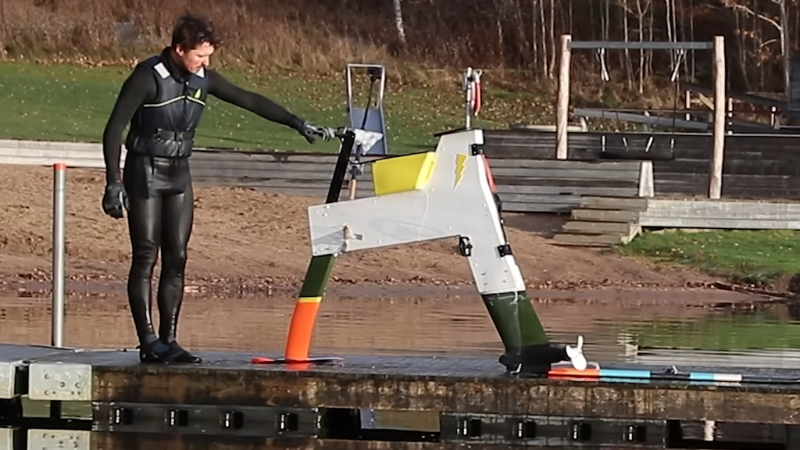
Hydrofoils are perhaps best known for their application on boring ferries and scary boats that go too fast. However, as [RCLifeOn] demonstrates, you can also use them to build fun and quirky personal watercraft. Like a hydrofoil bike! Only, there are some challenges involved.
Hydrofoils work much like airfoils in air. The shape of the foil creates lift, raising the attached vehicle out of the water. This allows the creation of a craft that can travel more quickly because the majority of its body is not subject drag from the water. The key is to design the craft such that the hydrofoils remain at the right angle and depth to keep the craft lifted out of the water while remaining stable.
The hydrofoil bike is created out of a combination of plywood, foam, and 3D printed components. It uses a powerful brushless motor for propulsion, and that’s about it. Sadly, despite the simplicity, it wasn’t an instant success. As you might expect, balancing on the bike is quite difficult, particularly when trying to get it started—as the foils need some speed to actually start generating meaningful lift.
After further research into commercial hydrofoil bikes, [RCLifeOn] realized that the buoyancy of the bike made it too hard to straddle when starting out. Some of the 3D printed foils also proved more than a little fragile. It’s back to the drawing board for now—the power system is likely up to snuff, but the dynamics of the platform need work. It’s perhaps no surprise; we’ve covered the challenges of hydrofoil stability before. If you want to go fast on water, you could go the easier route and just build an electric surfboard. Video after the break.












Lewin, as a fellow australian I can tell you that back in the day the Sydney Harbour hydrofoils were anything but boring! Let’s hope the project to restore and bring the surviving original Curl Curl from Italy back to Sydney one day comes to fruition.
Jeez… he thought of about half of the things he needed to think about. He didn’t even mention the obvious improvement of a lanyard to cut the power when he falls off the thing.
I appreciate trying to make something for yourself, but at least bother to look at the state of the industry before you’re putting pen to paper.
Jokes on you! I haven’t even begun to think about the level of difficulty involved in building your own hydrofoil bike.
Can’t help think that a slight dihedral will also help with stability here, perhaps with some ballast to help with the righting moment. As well as an emergency cut off lanyard, as fitted to most outboards and jet skis.
reminds me of the https://hackaday.com/2013/11/14/human-powered-hydrofoil-the-wingbike/ which though had no buoyancy and needed a supported start, maybe motorize that.
This is like bespoke musical instruments where the challenge of learning how to ride one is sufficient even with a reasonably well-produced one…experimenting with novel ideas at the same time as learning how to ride with the novelty is extremely difficult. Have to invest hours into riding the thing before you can be confident if it’s a skill issue or not.
He needs to add a kill switch that cuts power to the ESC when he falls off. The prop could have cut him open when he fell off and it went out of control. It could injure someone else if it runs away too.