
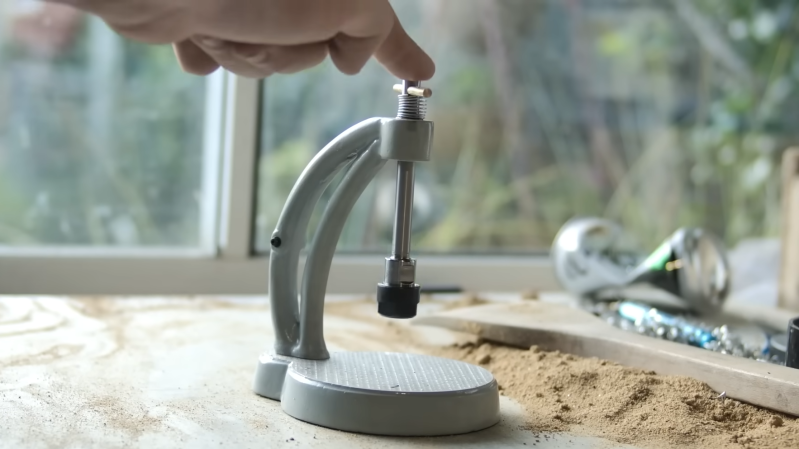
[Chris Borge] has made (and revised) many of his own tools using a combination of 3D printing and common hardware, and recently decided to try metal casting. Having created his own tapping arm, he tries his hand at aluminum casting to create a much more compact version out of metal. His video (embedded below) really shows off the whole process, and [Chris] freely shares his learning experiences in casting his first metal tool.
The result looks great and is considerably smaller in stature than the 3D-printed version. However, the workflow of casting metal parts is very different. The parts are much stronger, but there is a lot of preparation and post-processing involved.
The key to making good castings is mold preparation. [Chris] uses green sand (a mixture of fine sand and bentonite clay – one source of the latter is ground-up kitty litter) packed tightly around 3D printed parts inside a frame. The packed sand holds its shape while still allowing the original forms to be removed and channels to be cut, creating a two-part mold.
His first-time castings have a rough surface texture, but are perfectly serviceable. After some CNC operations to smooth some faces and drill some holes, the surface imperfections are nothing filing, filler, and paint can’t handle.
To cast molten metal, there really isn’t any way around needing a forge. Or is there? We have seen some enterprising hackers repurpose microwave ovens for this purpose. One can also use a low-temperature alloy like Rose’s Metal, or eschew molten liquid altogether and do cold casting, which uses a mixture of resin and metal powder instead.
The design files for [Chris]’s tapping arm are available from links in the video description, and he also helpfully provides links to videos and resources he found useful. Watch it in the video, embedded just below.









There are also metal clays that become solid metal when fired in a kiln.
be aware metal clays shrink when fired. There can be issues of warping and distortion unless the part is very well designed, supported, and fired with specific ramping protocols. So not always great for functional parts.
They tend to be incredibly expensive though
Madness. Did he have to sacrifice that beautiful heatsink?
Not sacrifice, but transform.
Isn’t that every heatsink’s ultimate dream – going out in glorious flames absorbing all the heat?
lol
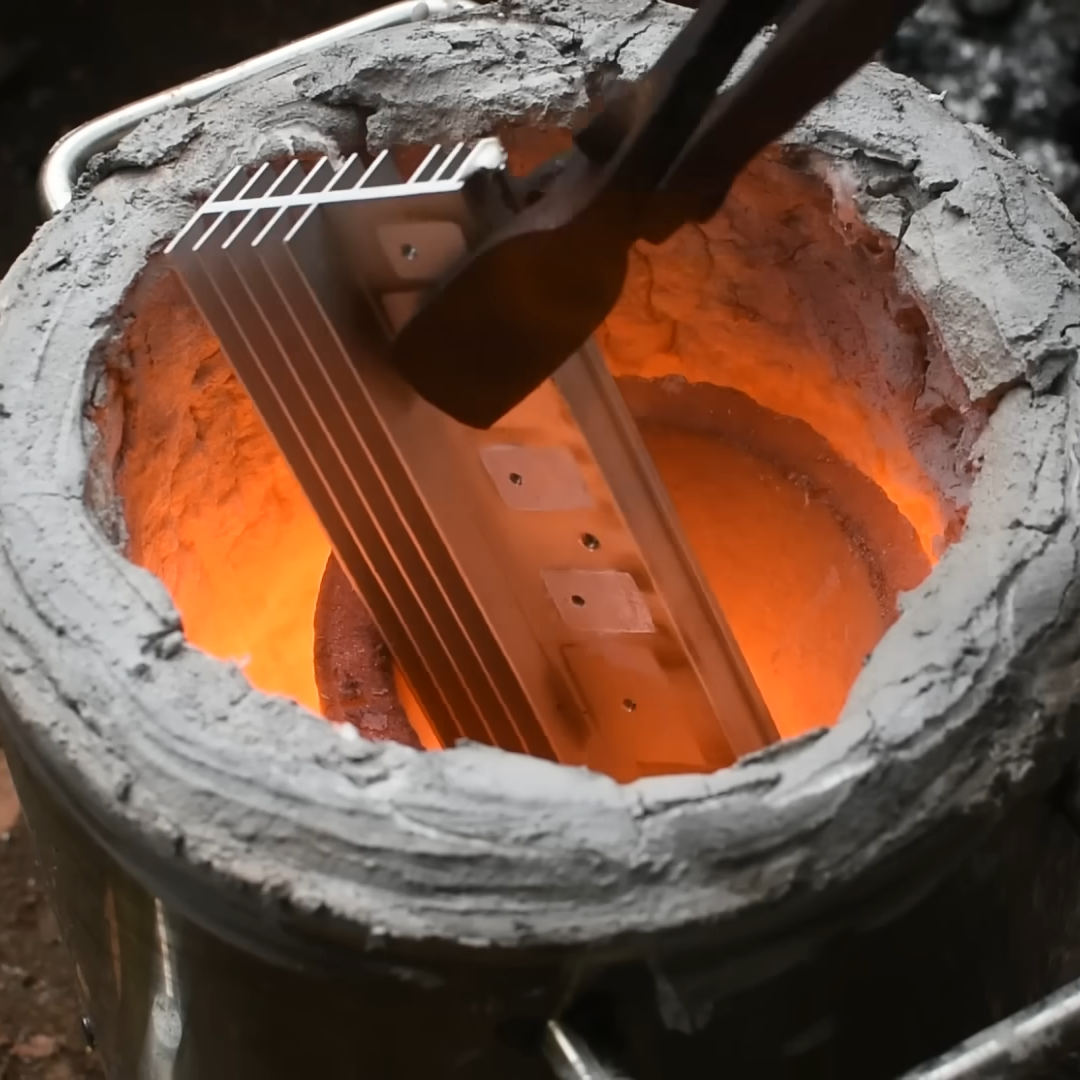
Pic shows him melting a presumably extruded heatsink as a metal source. If any y’all are trying this, I definitely encourage you to choose a starting material that itself was cast. The physical characteristics of different aluminum alloys really affect how the cast comes out. Using pop cans is about the worst, extruded is not so great, high strength zinc/magnesium alloys are so-so, and high silicon casting alloys are amazing. If you have a car junkyard go get yourself some dead engine parts. and melt those. You can certainly cast with extrusions but the results tend to have more porosity and poor detail, and pouring at the right temperature is more important than with an alloy designed for casting.
Excellent advice !
I have found the opposite to be true. Extruded alu is always better it is a higher grade. It has to be to work in the extrudeing process. Also has a higher scrap value . Cast is always some alloy with different melting temps
Greta advice and a single discarded alloy wheel or dead cylinder head contains way more metal than a whole heap of coke cans or heat sinks.
Most garages have a scrap pile / bin that contains stuff like this and they’ll either happily let you take it for free or accept literal scrap value (or perhaps a 6-pack) for anything you pick up.
Pop/Soda cans are plastic bags with a tiny fraction of aluminium added to it. The amount of aluminium in there is so low it’s not worth it to melt down as it’s mostly plastic so you are burning off a ton of plastic in the cans and don’t get much in return.
I’m looking into casting and zamac za12 seems like a good way to start. It’s a pretty cheap metal, low melting temperature and easy to cast. Not the strongest but it’s to start with.
If you already have the aluminum you could always add some silicon.
More important than most hobbyists realize. If I need something functional, i.e. parts that can take stressful use, I reclaim aluminum automotive parts. Transmission and Transfer cases are best.
A rather over ambitious and under-thinking gentleman chose to try to emulate “Forged in Fire” on a windy (30 mph constant and gusts tp 55 mph) day several years ago in the city I live next to. A 50gal barrel full of burning wood and a truck spring didn’t work as a forge, but did great job burning down 3 blocks of the city!
I know the HD readers are smarter than that but it does illustrate the dangers
Look up “Cohoes” and “Forged in Fire” for the mind-boggling story
The irony is the person got charged with Arson and spent a year in jail, for something that was a stupid accident. He was also charged with reckless endangerment, which seem more appropriate for being boneheaded.
Wait….. I was like no shot this is about cohoes guy…..I was born and raised in Troy, recently moved out of state but thats crazy to see this reference.
I do this, but I use a different process. The PLA, or resin print has the sprue already attached. the top of the sprue is flat, so I glue this to a piece of glass, and I use one of those stainless somewhat conical silverware holders with the holes in it. The ones you see at a buffet restaurant. I tape the holes closed, and fill with plaster, mixed on the wet side. I vibrate this with a jigsaw or something to get all the voids out.
I happened to get a kiln from the craigslist free section, I burn out the PLA in there. I also use it to melt the aluminum, and use tongs I made from some rebar.
After burnout, the conical silverware thing fits in the top of an old water pressure tank, with a silicone gasket. I apply a vacuum pump to the tank, this sucks the metal into all the tight corners. I need to be careful here, since the molten metal seals it off, and too much vacuum can blow the mold out the bottom.
I have to limit the size of my castings to the size of the silverware holder, but I get some very good results. I can see the PLA layer lines in the metal castings. I think the only things I actually bought were the crucible and the silverware holder. And some very expensive wax like resin. The vacuum pump was bought years ago for something else.
That sounds like a fascinating process. If would be great to see pictures
A couple of comments,
If you are just going to make one or two if your things in metal you can 3D print all of the metal plumbing on the master, than with no release or fancy mold, tamp green sand down on the bottom, put your piece in, and thoroughly pack around it with sand so the sprew just clears the top, Run that through a vented kiln to vaporize all of the PLA, and then follow with your melted aluminum. Lost wax casting ala PLA.
Also, there are different types of green sand and I would suggest if you want a nice surface finish that you use one of the petroleum based ones. There is no way the water based ones are not going to release some steam and give you that look that is much corcer than the sand itself.
And metal, back when I did this, which was high school, which was a long time ago, one thing that the shop teacher told me that stuck with me is if you can, get aluminum that was serving a similar duty. Virtually none of the aluminum you get is pure, it is all some kind of an alloy, and for your use, a trip to the local auto salvage yard would probably get you some cast parts that are meant to take a beating. There is also one alloy out there but it is commonly made with soda cans and zinc and copper pennies, the recipe calls out for how many of each to make a pound, and it is reputed to be good for casting, and tough but machinable.
The Post Apocalyptic Inventor (YT channel) also went into Alu casting recently. Bench grinder guard https://www.youtube.com/watch?v=cNv-3opP8pk
I will shout out Paul’s Garage for a very no-nonsense and practical guide to casting, he’s been doing great videos on the subject for a long time now:
https://www.youtube.com/watch?v=GGVnrdzlYqg