
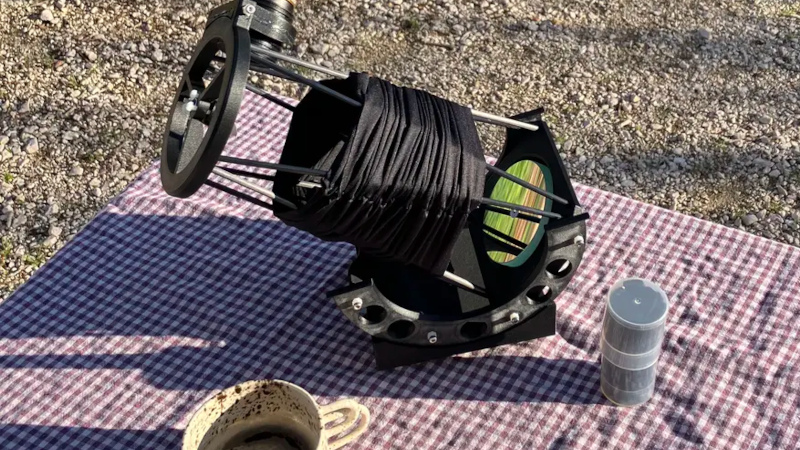
For most of us who are not astronomers, the image that comes to mind when describing a reflecting telescope is of a huge instrument in its own domed-roof building on a mountain top. But a reflecting telescope doesn’t have to be large at all, as shown by the small-but-uncompromising design from [Lucas Sifoni].
Using an off-the-shelf mirror kit with a 76mm diameter and a 300mm focal length, he’s made a pair of 3D-printed frames that are joined by carbon fibre rods. The eyepiece and mirror assembly sit in the front 3D-printed frame, and the eyepiece is threaded so the telescope can be focused. There’s a 3D-printed azimuth-elevation mount, and once assembled, the whole thing is extremely compact.
While a common refracting telescope uses a lens and an eyepiece to magnify your view, a reflector uses a parabolic mirror to focus an image on a smaller diagonal mirror, and that mirror sends the image through the eyepiece. Most larger telescopes use this technique or a variation on it because large first-surface mirrors are easier to make than large lenses. There are also compound telescope types that use different combinations of mirrors and lenses. Which one is “best” depends on what you want to optimize, but reflectors are well known for being fairly simple to build and for having good light-gathering properties.
If you’d like to build your own version of this telescope then the files can all be found on Printables, meanwhile this isn’t the first 3D-printed telescope you might have seen on these pages. If you want to make your own mirror, that’s a classic hacker project, too.












Nice build, makes me want to put my big parabolic mirror to use. The article alludes to lenses being hard to make, and that gives mirrors an advantage. Although that’s true there’s a few other reasons to consider as well. Light passing through a dielectric medium like glass leads to image changes in a way similar to how prisms refract light. By using a front surface mirror you are more or less free of those.
Honestly I’d never seen that explain-like-I’m-five explanation, but it works, and you don’t have to explain (or spell) “aberration” or “dispersion”.
Interestingly, though, a mirror requires 3-4 times better geometric accuracy in its shape than a lens: An angle error in a mirror deflects light twice as much as the error, whereas a lens deflects it around half as much. In that respect a lens is easier to make than a mirror. And you don’t need to coat a lens with a reflective layer and protect said layer.
You should coat at least the first surface of a lens with an AR coating, if contrast is a thing desired. Granted, using a simple lens coupled with a narrow bandwith filter does away with such nonsense.
Thanks I debated using big words then decided this is a place that big words could gate keep someone from understanding.
My line of reasoning around the difficulty was that making a lens or doublet that does suffer from aberrations involve several more surfaces. That said I’ve never ground my own lens or mirror system. So I probably shouldn’t be talking about it.
Not sure what kind of lenses nice telescopes use or if all of them are mirror based.
Yeah, if you’re spending a few hundred hours per surface in manual grinding and figuring, a mirror has its merits.
If you’re planning to use a lens for anything serious, then you’re looking at an apochromat (not achromat). The 80 mm class is kind of the “gateway drug”, at around $1k.
Are we all pretending that there’s no lens involved here?
Classic fallacy argument
I built several dobsonian telescopes in my childhood, but only because my dad’s mate had a custom rig to grind glass blanks to near perfect parabolas (before silvering). Nice simple and easily accessible to many.
It’s wild to me that one can grind their own lenses and mirror blanks with any reasonable accuracy let alone the quarter wavelength or so needed… easily. IIRC. Well easy but laborious. You can also just buy them good-enough for not much money.
We have a big 8″ Dob that is amazing but binoculars or the regular spotting scope (<$100 on sale) still show rings of Saturn or Gallelelo’s moons just fine and are a huge crowd pleaser. Plus, you know, still do bruins as a spotting scope.
i guess that is what an astroscan would look like naked..
Similar to the Celestron FirstScope I’ve got, which sometimes sees more use than the bigger scope simply because it’s simpler to set up (it has a built-in lazy Susan, so you just need a tabletop). Those can be had for under $75 these days, but you lose out on the fun factor of building your own rig.