
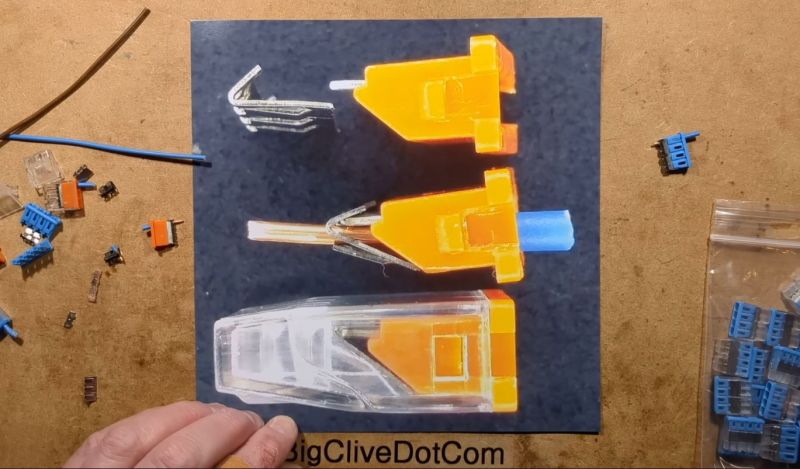
Everyone loves Wago connectors for how versatile and effective they are for quickly and securely connecting conductors, but it can be tempting to buy a bag of the significantly cheaper knock-offs. The reason why this can be a terrible idea is explained by [Big Clive] who tore down a few bags of them to ogle at their internals.
The main problem with some of these knock-offs is the way that they use the plastic molding as part of the structure that holds the conductors in place. Over time this plastic will develop larger tolerances, with heat developed from passing large currents speeding up the process. As the examined type of connector relies on metal clamps that securely push the conductor onto the busbar, having the plastic weaken, and the clamp correspondingly loosen up, is clearly not a desirable scenario.
As [Clive] says in the video, you’re probably okay using these cheapo knock-offs for a quick test on the bench, but you should never put them in a permanent installation. Not just due to potential fiery scenarios, but also for insurance claims should the worst come to pass, and the insurance company finds dodgy connectors everywhere in the electrical wiring. This isn’t the first we’ve heard of knock-off Wago problems.












Until recently, I had no idea what this strange American stuff even is! 😂
Then I learned that WAGO is from Germany! Funny!
So far, I was familiar with ordinary screw terminals, but not these, uh, “things”. 🤣
These “things” are better than screw terminals, and heaps better those crappy wire nuts you yanks love for some inconceivable reason.
Well, not the above ones.
Check AliExpress, once the patent ran out the Chinese went berserk making every possible variant (some that Wago then copied – giving ammo to the “patents stifle innovation” crowd).
Wire nuts when used properly make a very solid connection. The British fear of them comes from how some of their local ones were manufactured poorly(all ceramic instead of metal threads), which led to a few fires.
I know about the vintage model in the image but haven’t used those in two decades.
The screw terminals, only seen them once in my life when I bought the house I currently live in and found out the previous owner used those and almost burned down the house as a result. I knew they existed because of American TV shows but never seen one before I bought this house and hope to never see one again in my life. Still have nightmares.
I only use Wago 221 series. I got several Stanley storage organizers filled up entirely with Wago 221’s in all shapes and sizes. I love them. I adore them.
221’s aren’t just great for doing household electrical stuff, it’s amazing for prototyping. I use it with Arduino stuff, testing circuits, building motorcycle wiring looms, etc. It’s (except for household) always temporary, but it’s so easy and I always have a good connection.
I used to put a few of these solder containing wire connectors in my pocket when riding one of my vintage bikes, these days I throw several 221’s in my pocket.
Just in case, I don’t work for Wago, but I work as a bad electrical engineer and I love that stuff as much as I love Wera. That’s saying something.
“Tolerances” doesn’t mean what you think it does.
Oh GOD!
I NEVER realized such marginal crap was out there in the first place…….
The original idea is even bad from the start.
You won’t be seeing any gas-tight connections with that crap.
Crimp, Solder, weld, or screw it together…..
They should call those Wacko connectors; because you have to be wacko to use them.
Wago connectors are completely safe. They are TUG tested and pass all certification in Europe. The article doesn’t critisize wago but the cheap knock off from chinese copier.
This may be true; in my opinion it doesn’t inspire confidence in a reliable connection, Original or knock off…
Just too “Old School” I guess.
It is not about safety of the connector. It is about the competency of the installer.
It’s not a bad idea. Similar type of Wago terminals are used by the billions in electric and automation industry and they work.
You have no idea what you are talking about.
The actual Wago connector that these are intimating are better then screw terminals. They make a much better connection and the hold strength is better.
The only reason they’re not used everywhere is that they’re more expensive than screw terminals.
Seconded, and 👍to [Jii]’s comment too. Wagos are great for domestic wiring; I have switched over completely. Far better/safer/more durable than the abominations that are wire-nuts (…shudder…)
Not to throw any shade but a property installed wire nut would make a better connection than most other connectors, since all they’re doing is twisting the wires together to make a direct wire-to-wire connection rather than wire to buss bar to wire.
That’s not to say that wago’s are bad, they’re great for tight spaces, and the lever ones are especially good.
Errr no, not a bad idea on the slightest. Wago connectors make excellent electrical contact and are perfectly rated for electrical installations. They are also easier to test, possible to reuse, and have visual indicators to indicate proper connection, abs damage wiring less. They are standard for electrical installations throughout Europe and you often see solder, welded, or screwed connectors replaced with these as electricians touch circuits.
They’re not fake wagos at all. They’re just cheap connectors. It doesn’t say wago on the side in an attempt to deceive. They’re just cheap crap from AliExpress.
So not “Wagos”, but rather “wagos”? Is the term common enough that it is the generic term in some locations?
They’re lever (splice) terminals.
Just watched Clives video, these aren’t even level terminals.
No legitimate company is going to use a genericized trademark in their product description. Trademark protection still applies. Wago is still the name for these the same way that people say Velcro and Styrofoam. A name like hook and loop fastener is something for the lawyers, not real people.
Manufacturers no, but resellers and retailers definitely will.
People are also generally wrong when they say styrofoam too. It’s odd that you should pick up another thing that drives me and anybody with a sense of accuracy. Mad as an example of that which people ordinarily do. Styrofoam is blue and dense. If it isn’t blue, it isn’t styrofoam.
I would say yes, I personally have seen the term Wago become the popularized term for that style of connector, in the same vein as bandaid, Q-tip or kleenex.
Well, you can have all the real and fake ones you want, I am not using that thing in anything I build lol. Jeebus just use Lego mindstorms lol.
They do take a lot of the skill out of making connections ; at the expense of a marginal gas tight connection. That is really my core issue with these types of connectors. Just like Anderson connectors (popular with hams here in the states) I will not use them on anything I build.
Your just connecting two wires together, not building a turboprop racing airplane powered by buring nitrohexane dimethylosulphates fuel. It should take no skill at all. But I suppose good ol’ americans will never understand innovation even if someone spits in they’re face.
Only use old school “Wire Nuts” in my homes electrical, don’t even want to try the WAGO’s or the knock offs…..
Good, don’t.
I find even the cheap imitation lever type connectors to be effective and time efficient to install. I only use them for low voltage, low power applications so have never come close to burning one up.
The inline/end-to-end format ones are handy when the wires are just barely long enough to touch together.🙂
Wago connectors filmed with high speed camera:
https://www.youtube.com/watch?v=LPCRm1oRgQ8
I quite like Wagos & lever nuts, tho tbh I prefer lever nuts. What I’ve found over a few years is there’s little reason to cheap out on these, due of their reusability and durability; a variety pack of 50-100 will last a loooooong time, though they do degrade faster in direct sunlight (I’ve only tossed one because I didn’t like the feel of it, and it was one I had sitting outdoors for a couple years). I do NOT use these for high voltage/current, so can’t speak to that; but for <10A on 48V & less (some are rated much higher, but I don’t like that because they’re sort of a “black box” similar to a wire cap; for those, I want a bolt I can feel and precisely see), these are wonderfully simple and secure, and very cost-effective given it takes so little effort to put them to work somewhere else. Lever nuts in particular are nice because they provide a thick insulation with no reasonable chance of creating an accidental short; I can haphazardly toss a bunch into a box for a solar project without worry, which becomes particularly handy when I need multiple voltage rails for the project (I use sealed buck converters, so both ends of it have wire to slot in).
The “lever nuts” are originally Wagos too.