

It’s a blustery January day outside Lakehurst, New Jersey. The East Coast of North America is experiencing its worst weather in decades, and all civilian aircraft have been grounded the past four days, from Florida to Maine. For the past two days, that order has included military aircraft, including those certified “all weather” – with one notable exception. A few miles offshore, rocking and bucking in the gales, a U.S. Navy airship braves the storm. Sleet pelts the plexiglass windscreen and ice sloughs off the gasbag in great sheets as the storm rages on, and churning airscrews keep the airship on station.
If you know history you might be a bit confused: the rigid airship USS Akron was lost off the coast of New Jersey, but in April, not January. Before jumping into the comments with your corrections, note the story I’ve begun is set not in 1933, but in 1957, a full generation later.
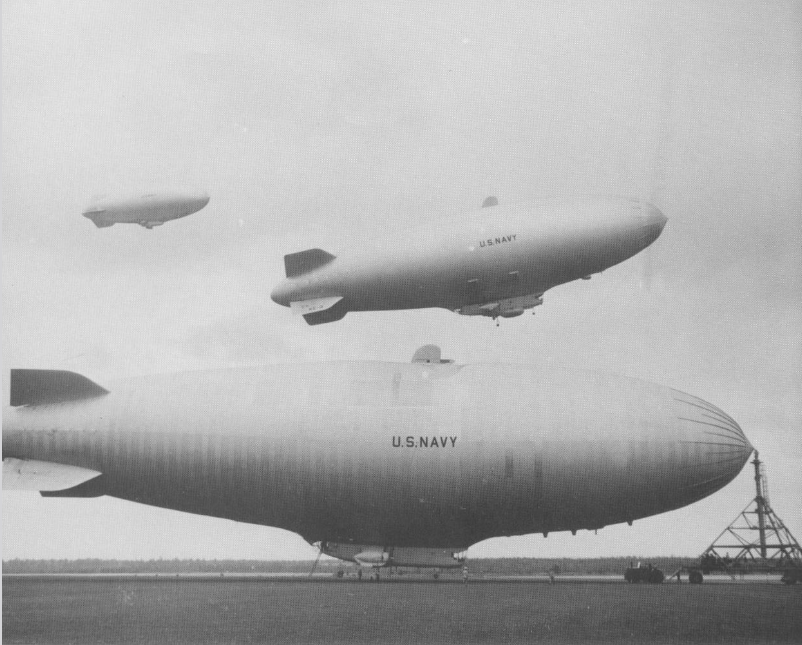
The airship caught in the storm is no experimental Zeppelin, but an N-class blimp, the workhorse of the cold-war fleet. Yes, there was a cold war fleet of airships; we’ll get to why further on. The most important distinction is that unlike the last flight of the Akron, this story doesn’t end in tragedy, but in triumph. Tasked to demonstrate their readiness, five blimps from Lakehurst’s Airship Airborne Early-Warning Squadron 1 remained on station with no gaps in coverage for the ten days from January 15th to 24th. The blimps were able to swap places, watch-on-watch, and provide continuous coverage, in spite of weather conditions that included 60 knot winds and grounded literally every other aircraft in existence at that time.
Rigid? Count (Zeppelin) Me Out
Airships come in multiple types: rigid, non-rigid, and semi-rigid. Most people — my past self included — assume that the rigid type is more advanced. Unlike rigid airships, which are stabilized by an aluminum skeleton (or a wooden one, in the case of the Schütte-Lanz ships of the Great War), a blimp’s shape is maintained by gas pressure alone. Just a balloon with motors, if we’re being uncharitable. This limits the maximum speed, as the aerodynamic pressure of moving through the atmosphere increases with the square of the airspeed, and must always be lower than the internal pressure of the gas bag. You can’t even pressurize the gas bag much to compensate, because then the density of the lift gas gets too high to actually, well, lift.

Put a skeleton in there, and your airship can be much, much larger. It can go much faster. It can become a flying aircraft carrier, like the ill-fated USS Akron, and its ill-fated sister ship, USS Macon. The U.S. Navy has only ever fielded five rigid airships; only one survived long enough to be decommissioned. It is with no disrespect to the brave men and women who served– and lost their lives– aboard those silver giants that we dismiss them from our narrative here. They were a worthy experiment, but a failed one. By contrast, the U.S. Navy fielded 166 blimps in the Second World War, and only a handful were lost, mostly during ground handling, and one to enemy action.
So, how was an N-class blimp, also known as a ZPG-2, in the designation system of the day, or SZ-1A after 1962, able to ride out a storm much worse than the one that sank its rigid-framed predecessors? It’s probably precisely because it lacked that rigid frame. The non-rigid envelope of the blimps could bend, buckle, twist, and alter their shape in response to strains that would break the keel of a Zeppelin. Non-rigid airships can quite literally flex on their rigid cousins when it comes to airworthiness.
The flexing skin of a blimp turns the entire gas-bag into one giant de-icing boot to boot, keeping yet another weather hazard at bay. Icing is a great danger to aircraft: when conditions are just wrong, like during the January storm described above, it’s easy for the weight of ice to build up and bring down any aircraft without an effective de-icing system. De-icing boots are one such system: rubber membranes, typically on the leading edge of the wing and tail surfaces of an airplane, that are inflated to flake off ice. On airplanes, they’re addons, but it’s a built-in bonus to flying a blimp.
Of course another key advantage of non-rigid airships is that they’re just plain cheaper. Being smaller, they require less crew, less ground crew, and smaller hangers, but a small rigid would have the same advantage. More importantly, especially during wartime, is that a Zeppelin requires everything you’d use to build the equivalent blimp, plus all the Duraluminum (or other material) going into its rigid frame. Logistically speaking, blimps were a no-brainer if the US wanted to field a lot of airships, and at one point they certainly did.

Image: US Navy
But Why?
Unlike a certain (in)famous penguin, the US Navy knew exactly what it was doing when it ordered the N-class airships after World War Two. As stated, they had over a hundred blimps in service during that conflict, and racked up more Lighter-Than-Air (LTA) flight time than any other organization has before or since: 550,000 hours split over 55,900 sorties in both the Atlantic and Pacific theaters. While the institutional knowledge is long gone, it’s safe to say that in those days nobody knew airships like the U.S. Navy knew airships.
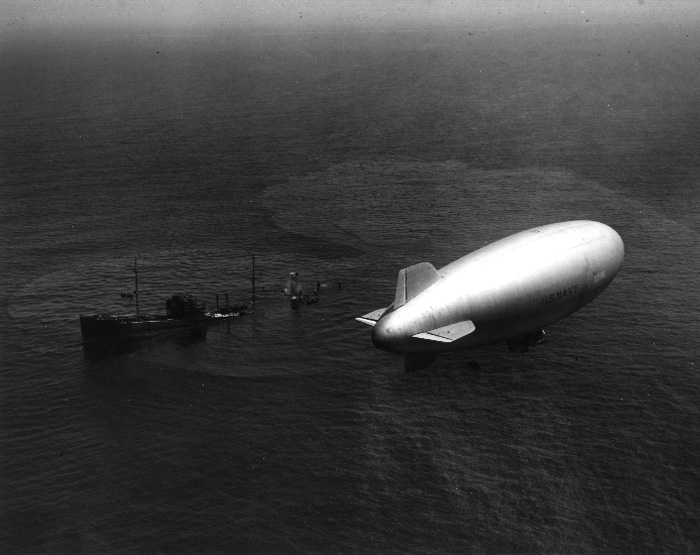
Image: US Navy
The vast majority of the wartime fleet — some 135 examples — were of the K-class. These ships were designed with a specific mission in mind: antisubmarine warfare. Blimps vs subs wasn’t a new idea; the Americans had worked with the Royal Navy’s u-boat hunting blimps in the First World War. Though the Royal Navy gave up on the idea after the conflict, interest remained on the other side of the Atlantic, and history shows the Yanks were right to persist with it. Of roughly 89,000 ships in blimp-escorted convoys, only one, the tanker Persephone, was sunk, ironically off the coast of New Jersey, not terribly far from the Lakehurst home of LTA.
The sub-hunting blimps were perhaps making it up as they went along. On paper, though, the airship is ideal for the role: without needing to burn fuel to stay airborne, it can have absurdly long loiter times. Its low speed is of no issue when shadowing convoys that have to move at the speed of the slowest merchant vessel– even the HX series “fast convoys” didn’t exceed 13 knots (24 km/h). Blimps of the K-class could cruise at 50 kn (92 km/h), and dash at up to 68 kn (125 km/h), which proved more than sufficient to keep up.
When the class was designed in 1937, its ability to cruise low and slow was ideal for hunting submarines with the Mk.I eyeball, but by the time the K-class was fielded in numbers in 1942, they were also equipped with first-generation radar, magnetic detection coils, and even primitive sonoboys after 1943. The class proved flexible and continued to be upgraded with the latest equipment until the last “K-ship” was retired from active duty in 1959.
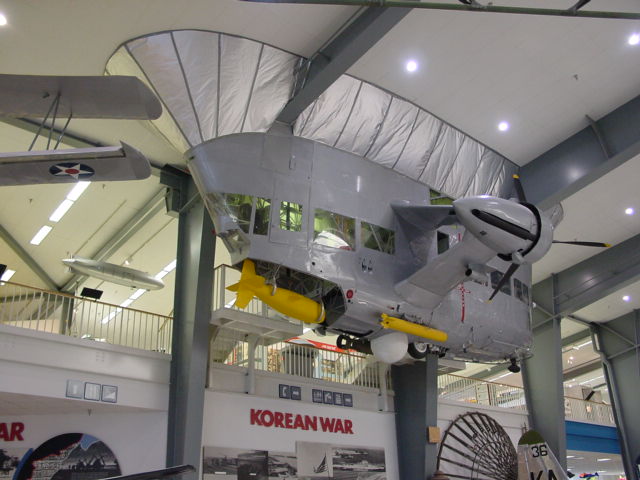
Image: “Blimp” by Pedro Vera, CC-BY-2.0
At 251 ft 8 in (76.73 m) long, with a gas-bag diameter of 57 ft 10 in (17.63 m), the K-ships could lift a crew of 9 in relative comfort, with fuel to feed their twin Pratt & Whitney R-1340 radials for 38 hours of normal operation. Idling the engines and making use of air currents could extend that number by quite a lot compared to cruising steadily, of course. As stated above, in wartime the K-ships carried magnetic detectors, sonobouys and radars for U-boat detection, along with four depth bombs and a .50 cal machine gun for weapons.
If four bombs doesn’t sound like much, well, that’s probably why no U-boats were recorded killed by Navy airships. On the other hand, the main mission of the blimps was to protect convoys, not to sink subs. “Damaged and driven off” was good enough, especially when the blimp could track the wounded u-boat from above and direct other assets like destroyers to make the kill, as often happened. There was a larger M-class designed during the war that was half again the size of the K-ships and could thus carry eight depth charges, but only four were built before the conflict ended.
Post-war, one K-ship by the name Puritan was sold back to Goodyear and equipped with 1,820 incandescent light bulbs to serve as a floating ad ticker, which perhaps shows the versatility of the design. Alas, ad revenues did not cover the cost of keeping the 425,000 ft³ (12,035 m³) envelope filled with precious helium. Civilian blimps since have been of more modest size.
The LTAs that Aren’t

Image: Akron Beacon Journal, via The Lighter than Air Society.
Speaking of precious helium, in order to conserve that lift gas, the Navy actually operated their blimps as Lighter-Than-Air craft as little as they possibly could, both during and after the war. An annoying thing about airships is that they get lighter the longer they fly as they run down their gas tanks. It is possible to run an engine on a hydrocarbon gas with a density similar to air, like the “blau gas” used by the Graf Zeppelin in the 1920s, but this has one major drawback: it’s a major logistical headache to require a special fuel for a relatively small number of units. Though there was one prototype with a blau gas style fuel in the 30s, the US Navy put logistics first. For the war and several years afterwards, everything that the Navy flew would burn AvGas, at least until the jet age made things annoyingly complicated for quartermasters.
Without special fuel, the issue of excess lift can be mitigated by condensing water from the exhaust, but that doesn’t quite balance out, so the problem still remains on long flights. Eventually one must either vent helium to reduce lift, which is wasteful, or take on ballast to make up for lost mass, which can disrupt operations. The alternative the US Navy preferred was to fly “heavy”.
Yeah, it turns out hybrid airships– craft that combine lift gas with aerodynamic lift–aren’t a new idea. You might not think of the teardrop-shaped gas bag of a classic blimp as an airfoil, but with a little airspeed just a modest nose-up attitude– what a pilot would call ‘angle of attack’–the blimp can get considerable dynamic lift. By accepting the tradeoff of requiring a takeoff run, the blimps could get into the air with enough dynamic lift to account for the expected fuel burn, and come back to base with only so much lift capacity that could be cancelled out by trimming the ship downwards.
The Cold War Era

Photo courtesy of National Nuclear Security Administration / Nevada Field Office
After the war, most of the K-ships were crated-up and decommissioned, and their air and ground crews were amongst the first to be demobilized. “Most” does not mean “all”, and once the thrill of peace turned into the uneasy truce of the Cold War, Uncle Sam was glad to have those airships. The Soviets had submarines, too, after all.
Rather than continue with building more of the M-class, the decision was made to update the existing stocks and produce improved K-class ships for the immediate post-war period. The wartime ships that were not decommissioned were updated with better electronics and a 20% larger gas bag, getting the designation ZPK2 and then a further upgrade to ZPK3 standard. Fifteen new K ships were built by Goodyear after the war and delivered starting in 1953 under the designation ZPK-4. The last revision of that design, ZPK-5, was built with an inverted “Y” tail instead of the standard cruciform to allow for greater nose-up attitude during the ‘heavy’ takeoffs mentioned above. Twelve ZPK-5s were built by Goodyear and delivered from 1955.
While the K-class was being modernized with better sensors and weapons, the US Navy’s LTA program recognized that it could not simply coast on legacy wartime engineering.They therefore commissioned Goodyear for a clean-sheet design that would be another 50% larger than even the four M-ships, which were kept in service until 1956. These new airships would become the N-class whose all-weather adventures this article opened with.
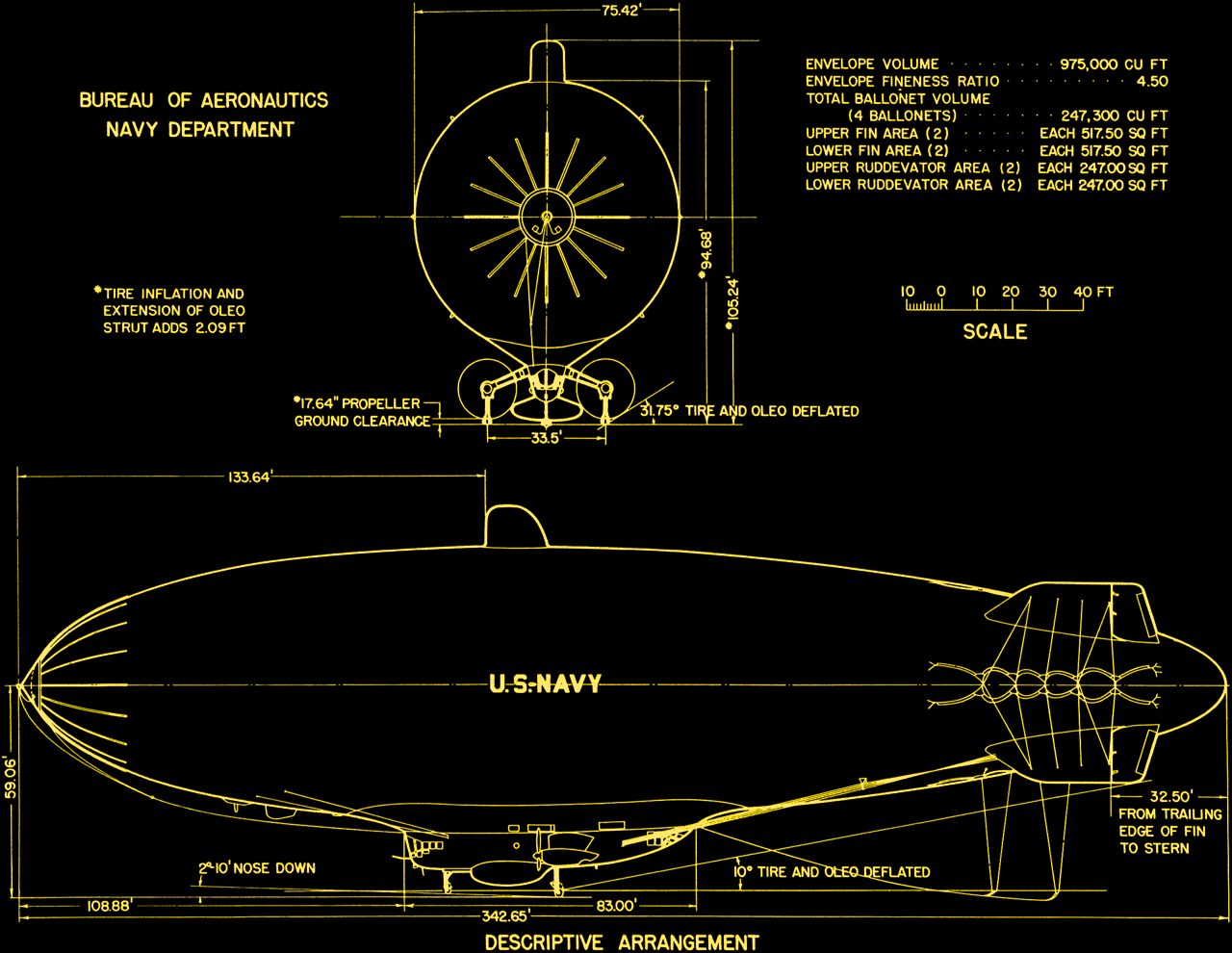
While the ZPG-2W whose triumph we described above were built to serve the airborne early warning role, most– twelve out of seventeen–of the “Nan ships”, as the class was called, were initially designed as bigger, badder sub-killers in case war broke out with the Soviets.
They had better down-looking radars– the AN-20, the best available at the time–much improved sonobouys, more sensitive magnetic anomaly sensors, and homing torpedoes. In war games against US and allied diesel-electric subs, like the GUPPY class, they proved very effective indeed, as did the improved K-ships. Against the new, nuclear-powered USS Nautilus, they were much less successful, but so were fixed-wing and helicopter assets. Doctrine that relied on spotting subs while recharging at snorkel or on surface was ill-suited to deal with a ship that could run submerged for months.
Improving on the control arrangement of the ZPK-5s, the Nan ships were built with an X-shaped tail to allow for even greater pitch angles during takeoff without tailstrikes. The ruddervators on the X-tail could also be controlled by one pilot, compared to earlier blimps which needed separate operators for elevator and rudder. The largest difference in design was perhaps the buried engines: unlike previous Navy blimps, which used radial engines hung from the gondola, the ZPG-2 Nan ships kept their two 800 HP Wright Cyclones indoors. This was supposed to allow for maintenance during flight, and it allowed the engines to be coupled together via a clutch, allowing single-engine cruising. As the air-early-warning blimps proved in 1957, these were all-weather craft.
The Anti-Submarine Warfare (ASW) squadrons gave a similar demonstration in 1960 with “Operation Whole Gale” during which the Nan ships provided 24/7 coverage for two full months, again in the teeth of winter’s worst weather. In spite of their best efforts to make use of wind and storms, no submarine got past the blimps during the operation.
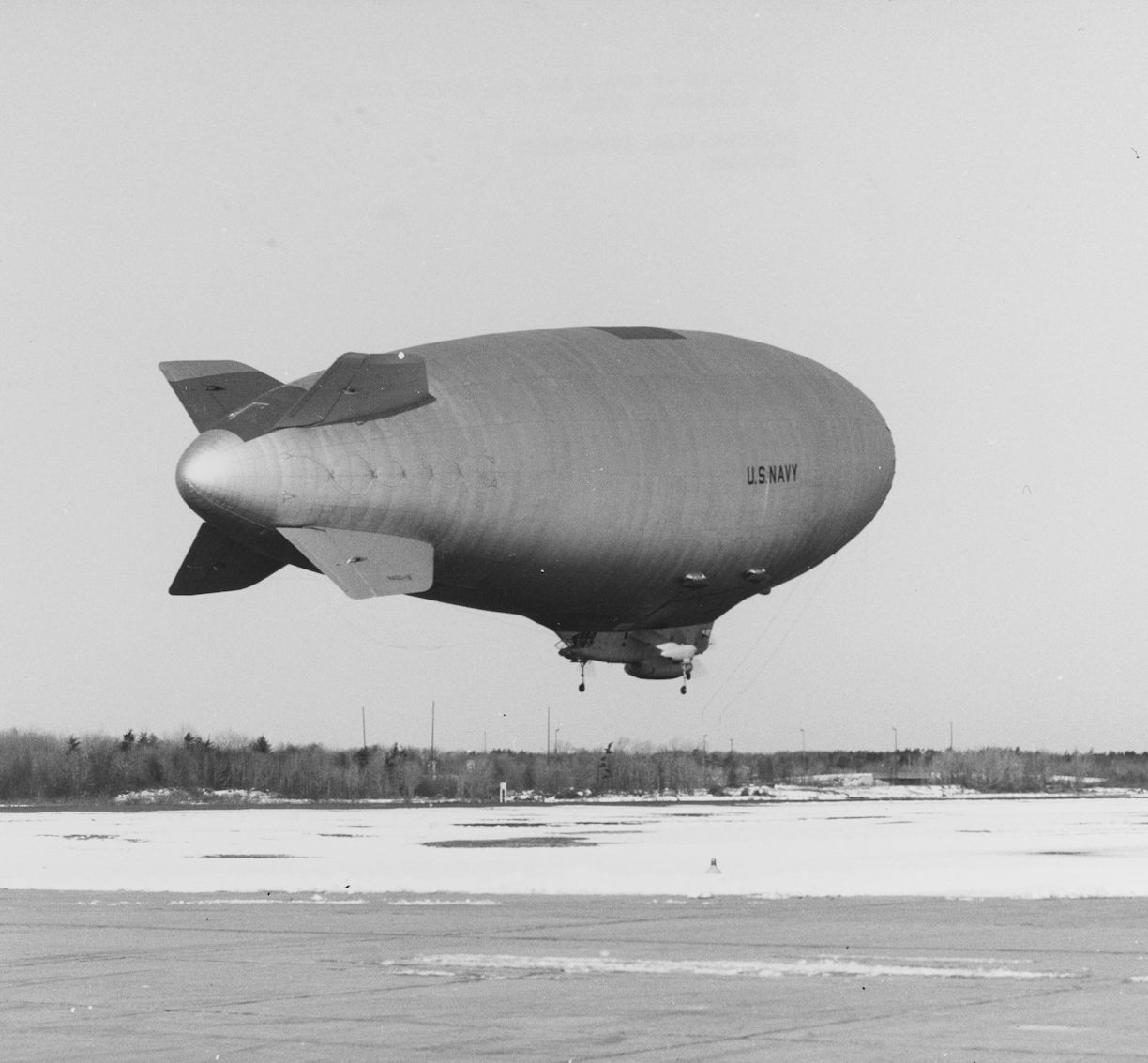
The post-war record of the US Navy’s blimps is full of such impressive moments. The service was very much looking to prove itself, and so jumped at opportunities to demonstrate the blimps’ capabilities. Arctic expeditions? A Nan-ship proved its worth on 24-hour patrols between Churchill, Manitoba and Resolute, Baffin Island– the last airship to cross the Arctic Circle. Another stunt in 1957 set a record for unrefueled flight: a circumnavigation of the Atlantic basin from Massachusetts to Portugual, North Africa, and finally ending in Florida that took 264 hours and spanned 9,448 nautical miles (17,500 km). Guinness will tell you that Graf Zepplin’s 71-hour 6,384.5 km trip from Fedrickshaven to Lakehurst holds the record for airship flight, but that’s seriously out-of-date. For a rigid, sure, that’s the record, but for any LTA? Blimps win. Blimps actually win all the airship records save for speed and size, and none of those records stand from the “golden age” of the 1930s.
Takeways
That’s maybe the lesson here. Blimps win. I consider myself something of an aviation geek, and have multiple books on airships. All of them tell the same story: blimps were a sideshow, Zeppelins were the pinnacle of airship engineering, and it all ended with the Hindenburg. That’s the story everyone knows, just like everyone knows that airships are useless in any kind of bad weather.
What everyone knows is wrong. The problem with the story we all know is that it ends 24 years early, and leaves out more flights than it includes. Add in those 24 extra years of innovation, and the blimps come off looking a lot better in comparison.
The last flight of a US Navy dirigible with a US Navy crew was in August 1961. The ZPG-2 Nan ships were followed by a larger ZPG-3: bigger again, with a larger, more capable AN-70 radar hiding in the gasbag, the ZPG-3 was the largest blimp ever fielded. Its capability didn’t matter– there was no money for blimps. Imagine a line of Admirals standing before the US Congress, hats in hand, and one asks for money for nuclear-powered submarines to smite the enemies of Uncle Sam with Intercontinental Ballistic Missiles wielding atomic fire, and the next man in line wants money for blimps. Airships seemed positively old-fashioned in comparison, and money was tight. The blimps were cut.
Yes, they provided an all-weather ASW and AEW capability nothing else could match… but other assets, ships and airplanes and helicopters, could do 90% of the job without requiring the expensive, dedicated infrastructure the blimps did. Airships were cut from the U.S. Navy the same year as seaplanes and the Regulus cruise missile program. You might say they’re the only things ever destroyed by the Polaris missile subs, but that’s arguably a good thing.
All the hot venture capital money is being sucked up by the AI bubble right now, and even if it wasn’t, the trendy thing in aviation is electric vertical takeoff and landing. That doesn’t mean there isn’t an airship renaissance just around the corner– there is always an airship renaissance just around the corner. That it never results in anything but prototypes is irrelevant. LTA is just too enticing a technology to ever give up. If we ever are to get that renaissance to bear fruit, though, we’re going to have to have better stories.
If you’re focused on the Hindenburg going down in flames, or the Akron and Macon breaking up over water, airships seem like a bad bet. If you remember the Nan ships bouncing and wiggling their way through January snowstorms, manned by Navy “squids” with the one-winged dirigible badge on their breasts, then LTA starts to sound more reasonable.












uss akron, not uss arkon
Yes, getting such a simple thing so consistently wrong casts doubt on the whole thing. Which is a pity since it is seemingly well-researched and written.
same. just stopped reading when they started repeating the typo
You’re not wrong. I’d like to blame autocorrect, but I’m not sure why it happened since I don’t think “Arkon” is any more a normal English word than “Akron”. I’ve fixed it now, for whatever that’s worth.
You still missed the one in paragraph 5.
don’t forget the ‘sonoboys’! teehee.
it was an interesting read regardless of the occasional head-scratcher.
So those should have been sonobouys all the way through? Until the second spelling showed up, I just assumed the spelling was a military thing.
Arkon isn’t any more common than Akron, but it isn’t as though auto-corrupt always pushes toward words that are real or make sense. My guess is that this variant had recently* been fed some fantasy fanfic.
That * is because once I had typed “rece”, my phone suggested I quick-finish the word as “rcently”. I suppose in this particular message, that would at least be funny, and therefore about the least unhelpful that suggestion could ever be.
When there’s no errors, people say it must be AI.
I loved this story (modulo the Arkon glitch), but where were the squids? Unless you are using the slang for the Navy, and the lift generation of the high angle of attack takeoffs?
I think it could use some clarification.
As you surmised, the “squid” in the title is the nickname given to Navy men in the USA; the bit about having one wing is a reference to the now-defunct baloonist&dirigible badge, which unlike the “wings” given to pilots today… only had one wing. So a “one winged squid” was a Navy dirigible pilot.
That was in an earlier version of the draft. A lot got left on the editing room floor, and I didn’t think to change the title. That’s on me.
I’ve squeezed it back in as best I could– in the very last sentence– because you’re absolutely right: it does need clarification.
As a slight correction, my father as a 50s vintage blimp pilot, had to first get fully qualified as a Naval Aviator (including carrier qualification), then get multi-engine qualified, then get blimp qualified. So his wings were normal USN pilot wings. After they decommissioned ZP-1 he switched to seaplanes (P-5M Martin Marlin), until they shutdown seaplanes, and then transitioned to the P-3A Lockheed Orion).
Thanks for sharing.
IIRC the single-wing badge was depreciated post-war. My understanding is that before and during the war they blimps to start airmen on (the L- and G- classes) but those were all decommissioned in ’45. After the war it makes sense they put pilots through the regular training regime and they got the regular badge.
You could have just stuck a picture of the thing in there – talking about it but not showing it never sits right.
Also the caption:
“The one ship escorted by blimp was torpedoed by U-boat. That’s a pretty good record.”
doesn’t make sense, it suggests there was only one ship that was escorted by a blimp, and that that was a 100% kill ratio for the U-boats – the opposite of a good record.
“Unlike a certain (in)famous penguin, the US Navy knew exactly what it was doing when it ordered the N-class airships after World War Two” This led me into a deep dive! as I don’t use a lot of social media. Apparently a viral video of a deranged, suicidal penguin was repurposed into motivational TikToks? There may be no better metaphor(or perhaps meta-metaphor, including the re-purposing) for the latest generation on social media. I was disappointed that it wasn’t referring to a penguin ordering N-class airships. I’m not going to complain too much, because that would make me sound old and grumpy. Lately I’ve been thinking of heading to the mountains myself. lol
Looks like Penguins and Squids are some cover names from US Navy slang. Hab ich keine Ahnung. Anyway nice part of technology. Real hack is how to get enough helium, bwahahaha.
This is one of the best, most informative, and well-written articles I’ve read on Hackaday in a very long time.
Keep it up, Tyler.
Thanks!
My father was a pilot in the last USN blimp Squadron, ZP-1. He mentioned 24 hour plus missions many times. He echoed the comment that the high cost of the ground support infrastructure told heavily against blimps. He did mention that they once did a test take off with a “special weapon” and it was of such high weight that the blimp barely got off the ground after a lengthy takeoff run.
A person I worked with knew the pilot of the one blimp that was shot down by a U-boat in WW2. He violated standing tactical guidance and attacked the U-boat which he caught on the surface. Unfortunately, it was a FLAK-boat mod with many AAA guns. He managed to drop a depth charge directly onto the deck of the U-boat before he was shot down, but it did not detonate and he was then shot down. For his penance they made him the blimp wing tactics officer for the rest of the war…
Rigid airships win regardless via the rule of cool. You will never catch me piloting an oversized football balloon. Bring back hydrogen and keep the US military away from the controls, as they seem compelled to fly the things into storms and crash into the sea. Problem solved.
Can’t argue rule of cool. Count Zeppelin was Aura Farming long before anyone knew what that was.
“The one ship escorted by blimp was torpedoed by U-boat. That’s a pretty good record.”
I think you’re missing a “that” after blimp and before was. This sentence implies that only one was ever escorted and that it was torpedoed.
Good catch. The text should be clear enough about the actual record, but if you’re just skimming it does give very much the wrong idea.
“Let’s eat grandpa.”
“Let’s eat, grandpa.”
Seems like airships would match well with electric motors, since batteries don’t generally get lighter as you use the energy from them. The main issue is just having the energy density needed for the intended missions. Supposing you could add flexible solar cells to the covering, even better (except for night missions).
The author links to a Hackaday article from 2024 about this. Here’s the raw link. https://hackaday.com/2024/01/23/could-solar-powered-airships-offer-cleaner-travel/
Thanks so much for writing this, so glad to get sent on a rabbit hole to find out more about them. Sad to see it might have dropped off the blog feed.
When I was a little kid in Cleveland OH during the war blimps from Akron would fly up to Lake Erie to practice taking on and discharging water ballast. Once a blimp flew really low (I’d guess about 100 yards altitude) and the sailors dropped handfuls of hard candy to us kids on the grass. Fun for us running around picking up the candy and seemingly (from their grins) fun for the sailors too!
don’t give the guys driving white “pedovans” of the sky any ideas!
Fun article .. the bit about rigids was a bit myopic though. Several of the few that were built were destroyed from weather and impatience overriding procedure, and another was overstressed during testing. Waiting for proper maintenance and to avoid known weather at the time of flight would have avoided 2 of the weather 3 losses.
i fully expected this to be an article about how studying squid aquadynamics informed blimp design. it was totally different from that but i learned a lot!
I’ve always thought a hybrid envelope made from an LLDPE liner as a gas barrier and a shell of ripstop nylon with aramid reinforcement would work. Add anchor points to the outside of the nylon shell to distribute the load. Make it a capsule shape (cylinder with hemisphere end caps) and build it at a 3:1 ratio; say 70×210 feet (~20x60m).
Enclose multiple envelopes in a rigid hull made of CFRP panels with Nomex cores. Pressurize the hull with straight N2 at just enough to keep ambient air out and H2 could be utilized as the lifting gas.
For all the Hindenburg enthusiasts, pylon mount the crew/cargo gondola in a separate hull well below the one with the lifting gas. If there’s a fire, jettison the lifting hull and use rocket deployed cargo chutes. The really big ones. For power go with some standard P&W APUs driving electric motors.
All we need is… $9mil for the prototype?
I wonder if any thought was given to pumping water from the sea up a pipe to balance the loss of fuel weight.