
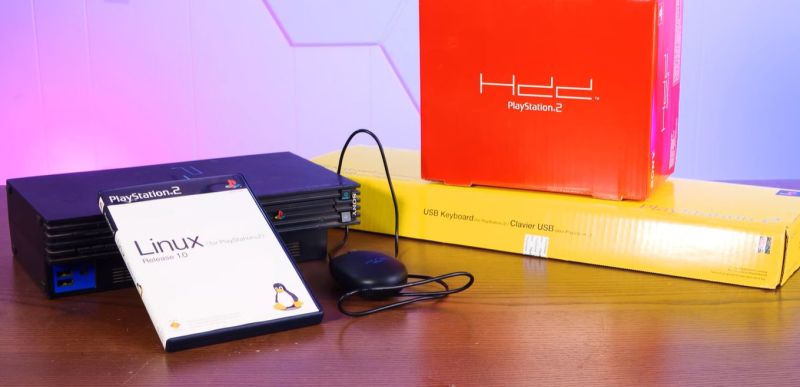
Until the 2000s, game consoles existed primarily to bring a bit of the gaming arcade experience to homes, providing graphical feats that the average home computer would struggle to emulate. By the 2000s this changed, along with the idea of running desktop applications on gaming console for some reason. Hence we got Linux for the PlayStation 2, targeting its MIPS R5900 CPU and custom GPU. Unlike these days where game consoles are reskinned gaming PCs, this required some real effort, as well as a veritable stack of accessories, as demonstrated by [Action Retro] in a recent video.
Linux on the PlayStation 2 was a bit of a rare beast, as it required not only the optional HDD and a compatible ‘fat’ PS2, but also an Ethernet adapter, VGA adapter and a dedicated 8 MB memory card along with a keyboard and mouse. PS2 Linux users were also not free to do what they wanted, with e.g. ripping PS2 game discs disallowed, but you could make your own games. All of which had to fit within the PS2’s meagre 32 MB of RAM.
Of these accessories, the keyboard and mouse are standard USB – sadly not PS/2 – peripherals. The 40 GB HDD is a Sony-branded IDE HDD, while the Ethernet adapter is proprietary and also has the IDE HDD connector. This means that the VGA and Ethernet adapter are the two parts you absolutely need to source alongside a compatible PS2.
Linux is installed from the PS2 Linux DVD much like launching a game, with the memory card used for certain boot files. With it being based on Debian Linux, it should be quite familiar to most Linux users of the era, but there’s no fancy wizard to automagically do things like setting up the partitions. For this there is the paper manual to somewhat hold your hand.
After this you insert Disc 1 to boot from it and the memory card, ultimately finding yourself on the PS2 Linux desktop with Linux Kernel 2.2.1 for MIPS. As for what you can do with this in 2025, not too much. There’s still an active community with more up to date software that keeps the OS somewhat going, but in the end it’s still Linux running on a 32 MB MIPS system.
Despite only supporting PS2 Linux for a little while, the PlayStation 3 would also support installing other OSes like Linux and FreeBSD for a while alongside its native FreeBSD-based OS, but that got dropped as well along with the entire PS2 Emotion Engine chip for full PS2 backward compatibility and a host of other features. By the time the PlayStation 4 rolled around it seems that the idea of running a regular desktop OS on the hardware was no longer on Sony’s mind, making it a curious period in gaming console history.










I wonder whether that was kickstarted by the Xbox being not much more than a miniaturized PC with custom software that was pretty performant yet cheaper than the equivalent PC. However, using a game console as your home computer went all the way back to when game consoles first appeared in the 1970s. Several games consoles back then (like the Odyssey 2 I had) touted their potential to be home computers.
I’ve heard it was just a sort of tax dodge for certain regions. Game consoles would be taxed higher, but a “computer” was at a lower rate.
In Soviet Russia it was the opposite that’s why even in late 1990s it was possible to buy cheap Dendy but even 386 PC was more expensive than a car.
In PAL regions the PS2 originally came with Yabasic bundled on a demo disc for that purpose. But Nintendo released Family Basic for the Famicom (“Family Computer”) all the way back in 1984.
Realistically, it was for developer buy-in. Development for a dedicated game console came with a lot of expensive performance tuning, a lot of “getting into the weeds of assembly”, a lot of console-specific shenaniganry to get games running well on the consoles themselves despite being developed on a PC. By making the XBox more like a PC, you could use existing PC game engines that have already had their code optimized for PC hardware, or more easily run what you just tested on your dev box on the console without a pile of compiler directives or emulation.
This reduced friction and made the XBox the “console-du-jour” for developers because of it. Doesn’t mean it was the most popular for gamers, per-se, that distinction goes to the PS2. But for devs? The XBox was widely considered the easiest, most pleasant to develop for because of its architecture. The fact that it had ethernet and a hard drive also meant save files and patching were much, much easier/more possible to implement as well.
For Microsoft, this “ease for developers” created some pretty tight lock-in later, through the 360 era, matching up to Microsoft’s “Extend, Embrace, Extinguish” methodology from the past. I’m not saying the Microsoft 3-e’s was the end goal here (people closer than I to that can confirm/deny), but it definitely matches the pattern.
It’s a shame the “MIPS” cpu in the PS2 is so broken. Otherwise NetBSD would almost certainly still support it (or have supported it at all). iir there were some GCC patches to work around the problems but they never landed.
Aside from bugs, IIRC it had some customizations that made it less suitable for running a general-purpose OS. E.g. the TLB could only hold something like one or two entries, which wasn’t an issue for games.
A long time back I tried to get gentoo running on mine, got a sort of functional system. The main issue was the custom patches to glibc and the kernel though. I tried running diff’s against the vanilla kernel and glibc to generate patches then forward apply them to later versions but it ended up being too much hassle at the time.
From what I remember the model of MIPS cpu was a sort of in-between version, the model above could run linux the model below could not, so you couldn’t just drop down to a lower MIPS cpu version for the kernel. I think it had custom patches for the instruction set baked in.
I’d imagine the homebrew scene has moved on quite a fair bit since then so I’ve no idea if anyone else has patched later kernels or glibc
Do you think Sony or any Japanese company might one day data dump all their old source code?
At least Microsoft has been known to release code.
But only the irrelvant or obscure stuff, I’d say. And in half-broken form. Sadly.
Makes we wonder if the whole thing is anything more than “show”, to gain positive feedback in the press.
Things like MS-DOS 3.x-6.22, Windows 1.04, 2.03 or Xenix aren’t released, for example.
Same goes for MBASIC (aka BASIC-80, CP/M), BASIC Compiler 86/88, Multiplan, Excel, WinWord, QuickBASIC etc. Historic relevant things in short.
The most notable stuff so far is the leaked stuff (Win2k sources?) that Microsoft didn’t mean to make public.
In my opinion, MS-DOS 2.11 was the most historical relevant thing that Microsoft has released source code for yet.
Besides the GW-BASIC source code (albeit merely the early, obsolete 1983 release virtually no one had used).
In principle, MS-DOS 1.25 was relevant, too, but it barely was more than a CP/M-86 alternative.
Most DOS applications of the 80s required MS-DOS 2 as a minimum requirement.
The practical real-world minimum was MS-DOS 3.1 or 3.2, however.
MS-DOS 2.11 was small, but very limited and had slow i/o.
It had featured some optional Unix compatibility, though, which was removed in later releases of DOS.
If memory serves, the PS2 Linux kit came with all the sources for the open-source software. But since you still needed the bundled magic memory card to boot, you couldn’t build a working PS2 Linux system even if you bought the broadband adapter separately. A mod chip would probably serve the same purpose.
And if the Steam Machine manages to launch despite the memory crisis, we’ll again have Linux on consoles.
We’ve had that for a while if you count handheld game consoles.
PS2 Linux was based on Red Hat not Debian.
Still got mine. Used to run various things in a previous home automation install, but haven’t fired it up for a decade or two.