
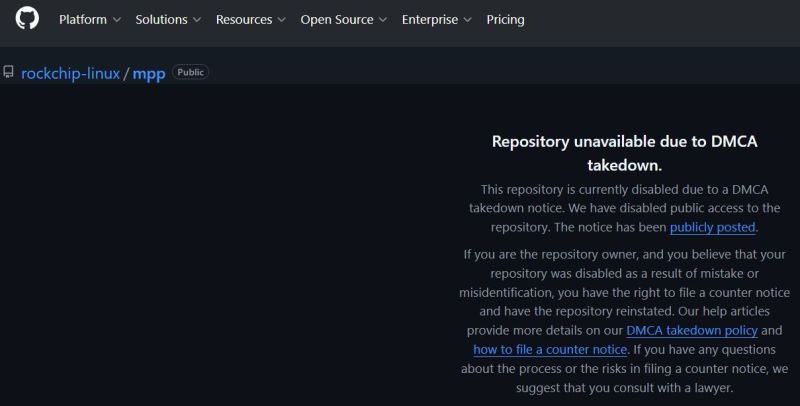
Recently GitHub disabled the Rockchip Linux MPP repository, following a DMCA takedown request from the FFmpeg team. As of writing the affected repository remains unavailable. At the core of this issue is the Rockchip MPP framework, which provides hardware-accelerated video operations on Rockchip SoCs. Much of the code for this was lifted verbatim from FFmpeg, with the allegation being that this occurred with the removal of the original copyright notices and authors. The Rockchip MPP framework was further re-licensed from LGPL 2.1 to the Apache license.
Most egregious of all is perhaps that the FFmpeg team privately contacted Rockchip about this nearly two years ago, with clearly no action taken since. Thus FFmpeg demands that Rockchip either undoes these actions that violate the LGPL, or remove all infringing files.
This news and further context is also covered by [Brodie Robertson] in a video. What’s interesting is that Rockchip in public communications and in GitHub issues are clearly aware of this license issue, but seem to defer dealing with it until some undefined point in the future. Clearly that was the wrong choice by Rockchip, though it remains a major question what will happen next. [Brodie] speculates that Rockchip will keep ignoring the issue, but is hopeful that he’ll be proven wrong.
Unfortunately, these sort of long-standing license violations aren’t uncommon in the open source world.












IP: Imaginary property.
So, do we eliminate all copyrights as well? I just spent over a year writing a book, does everyone get to copy it for free?
That said, there are a lot of thing patented that should have never been granted a patent. But since coding is so damn easy, why don’t Rockchip just write their own code. Many you can volunteer your time & effort to that goal?
nope, but a resonable time limit and easo of use, not as it is used now, corporations using it as a sledgehammer… Lego will survive and also Disney will be fine if it lose Mickey Mouse
Open-source also depends on copyright law.
But this case is weird, as rockchip did license it under a less permissive but still open source license. And the removal of copyright/attribution is just weird.
Then again, I have seen someone do this (from a small company called philips) before, and the reasons where twofold:
* Complete misunderstanding of Open-source licenses
* Static code analysis tools that required copyright blocks of the specific company
This is the most weird explanation I have ever heard. All such tools have tuneable policies (if they do not – they are shit). This is ‘suits’ being idiots and forcing unapplicable policies.
If they did – they have to suffer for their decision.
Wasn’t there a case of a company including a byte to trick a linter into accepting code as GPL when it wasn’t licensed like that? It’s a vague memory and Google brings up not much.
Honestly fixing the issue once flagged seems a reasonable expectation which didn’t happen here.
Fiddling with tooling costs time and money. Once it gets setup, it is often left as it is, almost superstitiously, unless an actual blocking problem comes up that requires changing it. That’s the only reasoning needed for these kinds of things not to get done in a corporate environment.
Calling it “weird” is academic and naive. It happens ALL THE F’N TIME in the real world. You just won’t hear any management type actually admit it. They’d rather fabricate some convoluted excuse(s) than to acknowledge human nature. I suppose that’s part of their job though.
Today, they received a real blocking reason. Watch them fix it now.
Yes, but the issue is that the license is permissive. The the ffmpeg contributers said by the LGPL that people can use and modify the software, but need to give back changes under the same license. No company is allowed to say take ffmpeg, modify it a bit and license it under a proprietary license. But now if MPP takes the code from ffmpeg, but it relicenses it as Apache license (rather than LGPL as they are required to) a company can just take the ffmpeg code from MPP and build a proprietary software on it. So ffmpeg has to protect their copyright here.
Ideally, yes. But we don’t have another way for you to be compensated or a way to ensure that you have a roof over your head and food on the table.
As long as capitalism is the economic system we use. Then the mental gymnastics of Intellectual Property seem to be a necessary hack in order for the current system to function.
It’s not. You just have to accept that you can’t make money out of copies, so you have to ask for the money on the actual labor you’re doing, which is writing the book. There are ways to obtain public and private patronage if you prove your worth to the people by the work you do.
Copyright was not invented in the first place to protect authors, but to enable publishers to buy up copyrights, so they could be turned into monopolies. That’s because an author could not effectively self-publish, so the only way they could make money is by selling their rights to a publisher at the promise of some petty sum of cash or a tiny share of the sales, and the publisher could then take all the rest.
“Pay for the labor, not the copies” ignores that creative demand is non-linear and often unknowable at creation time. Copyright exists less to price copies than to pool and defer demand risk. If you remove that mechanism, you need a replacement that absorbs uncertainty, otherwise you’re just telling creators to self-insure against markets that don’t behave like markets.
Patronage alone doesn’t eliminate gatekeepers, it turns volatility, visibility, and audience mood into the gate.
No, it merely accepts it as a fact of life. Being a creator is a choice, not something that automatically entitles you to income.
That’s nonsense. Just because it behaves differently doesn’t make it a non-market.
Those apply in the present system as well. I don’t know how copyright would help here.
By spreading the cost of producing art over the copies, into what is effectively “micropayments” that are hidden into everything, copyright enables and sustains a lot of trivial bunk “art” and creations made to milk royalties and targeting the lowest common denominator. The public who pays has no idea what they’re paying for, how much, or to whom, or the fact that they’re paying copyright royalties at all. This system if anything is actually a non-market as it lacks any negotiation between the actual producer and the consumer. They just shovel the shit out there and expect you to pay for it all.
All this makes it too easy to make money out of copyrights and simultaneously too hard to make money from actual art and creative labor in competition with all the schlock people push out there. What everybody does for money, including the creators themselves because they have to, is farming the copyright portfolio instead of actually creating stuff. It’s not a problem of only big corporations – everyone is raking in money for bullshit. You’re rewarding the wrong thing under false premises: we “support the creators” regardless of what they actually do for the money, if anything at all.
The problem here is that people take the “creators” as the value. Not the work that they do but the people, arguing that we should preserve their status quo. Of course that’s impossible, and the whole thing is a circular argument. You want the copyright-less system to sustain all the people who are currently collecting unearned and unjustified income through the copyright system, and reject the idea because it can’t.
That’s also nonsense.
That’s true. What’s more, you cannot value the book itself, because it has no intrinsic value. The value comes from the person receiving the information and what they do with it. The author of the book is not entitled to the value others derive of it, otherwise we would literally owe the entire world economy to the descendants of the cavemen who invented fire.
The book should be priced according to the cost to print it and put it on the bookstore shelf. The book’s author should be paid according to the amount they need for writing the book – however many hours it takes. These are two separate deals that actually have nothing to do with one another.
A lot of the ideas around copyright are backwards thinking. I don’t automatically have any obligation to pay you simply because you chose to create something. That’s your choice, not mine. If on the other hand, you say “Pay me money and I’ll play you a song”, then we’re talking business. If you offer me something which couldn’t be obtained from anywhere else, then you have a point for payment.
That is what makes your creative labor valuable, insofar that it’s actually valued by people, but the copies of your work not – because the copies do not depend on you any longer. They demand no output from you, so why should I pay you?
If people keep paying you for copies, over and over, then they will end up paying an arbitrary amount of money that has nothing to do with what creative labor you did, or what efforts you spent. That’s not a fair deal – that’s a stupid deal. It’s going to screw everybody over by tricking them to pay far more than we would have paid if we were negotiating for the actual price of your actual work. The trick works because a single copy seems so cheap that we don’t really care. Somebody steals ten cents off of you, you won’t press charges even if you did notice.
The tragedy is that because you are making money by a trick, the actual art becomes irrelevant. Making money becomes about visibility, needing publishers, marketing etc. which all demand you to give up your copyrights and hand the profits over. You write the book or play the song, sign the contract, and they make the money.
Better question: did you just spend a year writing a book without first securing sponsorship or any payment of any sort?
Writing is the part that is valuable and in short supply, copying is not. Making your money out of the copying rather than the writing is backwards. It’s rent seeking which has nothing to do with any idea of “fair compensation” or “fruits of your labor”, whatever you want to call it.
The major psychological hangup with copyrights is that people mistake the opportunity to make money for an entitlement to make money. Even if the way you would be making the money was nonsense, made up and morally false, effectively legalized abuse, the fact that you’re able to do it makes people argue that it’s an inalienable right.
Which is like thinking that since the gas station’s cashier left the till open, you’re entitled to reach in a grab the cash. Finder’s keepers! Should have been more careful!
Concerning books… IMHO it’s handled completely ridiculous for a long time now. I’ve got a paperback copy of “The Nano Flower”, on it’s back printed: GPB 8.99. It now costs EUR 14.46. Of that money around 10% goes to the author, and the rest is lost in the gravy train between the publisher, retail, shipping and other “expenses”.
And the music business has been very similar. The artists are at the far end of the feeding train and get next to nothing for the music they make.
I’m all for giving those “content creators” a decent compensation for their artwork, but when I realized the division of the money streams some 30 years ago, I lost interest in contributing to that mechanism.
Also, have a look at movies. A bunch of years “pirating” movies was very popular (and downloading was even legal here in the Netherlands). Popularity of downloading took a big nosedive when Netflix became popular. People were willing to pay for netflix because it was a good service for a low price. And now after enshitification you have to pay though the nose (and need a bunch of different streaming services) and get advertisements shoved in your face. As a result pirating movies is on the up again.
And for Rockchip. Removing licensing notes is “not done”, ESPECIALLY for FOSS software. (I stopped caring about other software long ago).
It’s not like the LGPL is a particularly restrictive software license. This is Free Open Source Software, as it should be
We just have to play nice with each other (say I, writing much more restricted code for a day job).
What if germany was using Linux to manage death camps where theyir boil people into soap? Would it still be the #1 OS for all pruposes?
At least, they have a spell checker.
IBM, Kodak, and General Motors all seemed to do very well even immediately after the War. So under your hypothetical scenario, I don’t think such involved would have been much of a consideration in the adoption of Linux. It has everything to do with our culture’s willingness to forgive and forget if there is enough money on the line.
Not even soap. Death camp owners desperately wanted to use human fats for making diesel to fuel Tiger and Panther tanks because Russia cut off their oil supplies from muslim countries.
Rockchip customers have ssh access to a git server hosted under a Rockchip domain. The repositories on Github are just mirrors and not always up to date.
Plus many people have recent clones.
I see how this is a problem for someone to relicense ffmpeg’s code in a more permissive license. I also see how the loss of attribution might motivate them but imo that’s a stupid thing to act on. But i put my finger on why this seems wrong to me.
The difference between the LGPL and the Apache license is specifically that the LGPL requires that they release the source to derivative works. That github repository is how rockchip (roughly) satisfies that requirement. So what they’re doing is forcing non-compliance on a company that was previously substantively complying. The details do matter but the most substantive issue matters too.
The tactically easy thing to do — enforcement through github — was the wrong way to remedy this problem. They need a different enforcement mechanism and, lacking that, they should not compound the problem in this way. Sometimes you have a good claim but the wrong tool.
But when they won’t comply for apparently years after having their bad behaviour mentioned you really must use the tools you have…
Pain as it is I don’t see a better choice as complete failure to react to the breaching of licencing terms is in the end worse, this really amounts to little more than calling out Rockchip a bit more publicly – some bad PR but not much else.
No, you aren’t obligated to use the tools you have if they produce the wrong result. Evidence of wrong-doing and a clear need to take action are actually the opposite of reasons to use the wrong tool to achieve the wrong result.
Once you have used the playing nicely ‘correct’ tool and got nothing its time to break out the flat bladed screwdriver to pry the case open and hope that acts shakes out at fixing more than it breaks. Leaving something broken forever because it is not the most awful situation you can imagine is not a solution.
Plus this really isn’t a tool producing any predicable result – it really does work out to being just a slightly more public naming and shaming really. Some bad PR for Rockchip so they might just pay attention and actually do the really really simply fix…
LGPL requires modifications released under LGPL. Rockchip was not satisfying that licensing requirement at all using Apache.
I’m sorry, but if you get to say the licence is wrong, and should be more permissive, despite the creators choice, than I get to say that copyright is the wrong licence for the violaters yo use, and should be more permissive.
You are trying to define the problem out of existence by claiming the problem doesn’t exist.
LGPL was created for very specific reasons.
No, I’m not, I’m very much not saying the problem doesn’t exist. Please read my first sentence, “I see how this is a problem.”
I’m saying, the remedy directly causes a substantial decrease in compliance. Rockchip was creating one problem, and now because of ffmpeg’s action, they are creating two problems. If the first problem was solved, we could debate whether the tradeoff of creating a second problem was worthwhile. But all we’ve done is create one more problem. Now Rockchip is still effectively licensing it under a BSD-style license, and also not contributing their source code on github.
I don’t usually ask why in cases like this, but I do wonder what Rockchip has to gain by re-licensing under a more restrictive license.
Others have mentioned “China doing China things” But what does that really mean? It’s just a “random” act? That’s a little too dismissive for my tastes… And dangerous.
why do you say the apache license is more restrictive?
Isn’t it the other way round, it was Apache and went to LGPL?
I need these hackaday posts however. It’s not always practical to watch a video and I appreciate the background and additional sources the authors provide.
Honestly hackaday could make money writing these for big AI companies. These posts are far more valuable than random subreddits
I have in my possession a circuit board from a Shahed drone that was shot down in Ukraine, and for some reason it turned out to contain a processor from Rockchip. This is yet another dark spot in this matter. The drone was flying to kill people who want to live peacefully.
Which uses ARM components; a lot of companies have their fingers in this pie.
Every military on earth does this, they just have better PR.
Soldiers are thugs and politicians are pimps.
None of them deserve any respect.
I didn’t realize that open source licenses were legally enforceable. I thought only proprietary software had that privilege.
You missed a /s off the end (I hope).
It’s hecka unclear what you’re saying.
He’s trying to explain, “You didn’t mark your comment as being sarcasm, which I hope it was.”
It’s perfectly clear what he was trying to say if you understand that “/s” at the end of a comment is how you identify your comment as being sarcastic.
Not necessarily. It’s just the way a DMCA takedown request works.
The host has to take it down on receiving the takedown request, and keep the content offline for a minimum of 10-14 days, during which time the claimant must file a court order. At this point the “infringing party” also has the option to prove themselves innocent, though it won’t re-establish the content any sooner.
If the host does not comply with the DMCA takedown request, they may be held liable for the content, and any other content they’re hosting, and dragged into court instead.
All this has nothing to do with whether the material is actually infringing on anyone’s copyright, or whether copyright is even enforceable on the case. It’s a tool for arbitrarily taking down stuff and holding it in a legal limbo for two weeks, to disrupt websites and services you don’t like.
I get it why ffpmeg guys are upset – but does this really help? Companies like Rockchip, Allwinner and others have reputation of publishing exactly nothing. Yes, GPL forces them to do so but they don’t care. Here they published at least something – they did it wrong, but at least something. After this they will most likely go back to their usual “nothing”.
“does this really help?”
That has yet to be seen but it also doesn’t hurt.
If this “After this they will most likely go back to their usual “nothing”.” than yes, it may hurt.
You know what’s funny? That there are companies selling SBCs to hobbyists with these SoCs – with janky outdated hacked kernel with binary blobs and missing userspace. Sometimes not even that – “Only thing that supports all the peripherals is this special binary image of Android 4”
Why is Raspberry PI so popular? Because the foundation got into agreement with broadcom, signed the NDAs and than released (although only in binary form – because of the NDAs) all the bits and pieces to fully use the hardware with modern Linux.
https://github.com/HermanChen/mpp/commit/fff87da91706d92913ba0254cee8c27eb093ae16 seems to indicate that there is hope Rockchip will actually restore the license and copyright info on the files “inspired” by ffmpeg, and therefore resolving the issue. I assume that the repo can be put back online afterwards.
I question in this case what final goal will be achieved without costing an innocent party something.
Was my comment about the wisdom of this tactic moderated? Why?
We got a huge comment-reporting on this thread, and a bunch went into the mod queue for a while. Some of the comments were racist/jingoistic, and got deleted, and the responses to deleted posts don’t show up anymore.
Hope it’s resolved, but if not, I encourage you to comment again.
Good excuse to placate the crowd, but this isn’t what happened.
So I want to buy a few SBC’s. What should I buy?
I don’t want to buy raspi’s because of their broadcom blobs.
I don’t want to buy allwinner or rockchip because of their GPL violations.
I don’t want to buy RISCV because I expect too many problems (Try getting LinuxCNC to run on it)
I don’t want to buy Intel because they are a generally shitty company for 40+ years.
I don’t want to buy Sitara (Already have 3 BBB’s) but they’re too slow /old.
I would like to buy AMD industrial SBC’s but they’re hard to find and/or extremely expensive for hobbyists. (Like EUR 500 for a “slowish” PC and companies not willing to sell to a private person in the first place.)
That mostly leaves Amlogic and Samsung. Maybe some others too.
At some day’s, I’m considering to give in and buy some N100 boards (I.e. Intel). LinuxCNC apparently runs quite good on those while even all ARM boards (except maybe RP 4) are considered a bit fussy to get going properly.
Sounds like you’re looking for decommissioned thin clients.
Actually pretty popular for DIY OPNsense router or NAS / cluster builds, since some of them are almost midrange computer tier in terms of performance.
seconded. just stay away from Igel boxes as they’re super locked down firmware-wise, which makes running anything other than Igel Workspace tough/impossible.
The Dell thin clients seem to be popular with LinuxCNC, but I’d like to buy something new. But I guess that buying second hand intel is better then new intel. But I’ll have to do some more research before buying anything in that direction.
There are some of those 1L desktop (tinyminimicro) machines with AMD cpus.
Allwinner is not that bad because thanks to community effort, almost all is now upstream and therefore 100% open source. End their stuff is cheap. Yes, the company sucks, but the mainline support is actually very good now.
All this is likely to achieve is Rockchip moving further into RKMPI and rockit and simply dropping MPP. In other words becoming less open.
Seems to me like the FFmpeg people would gained more by asking for some cash and granting a license exception than issuing a take down notice. This was not a case of making the licensing more restrictive, Rockchip had made it less restrictive. The take down is just symbolic since the repo has been forked hundreds of times.
could they make a license exception? afaiu that would require permission from everyone who’s contributed code, so that might not be realistic
Wow the comments here just got wiped. That’s nuts.
Gotta support a specific narrative…or else
Tons of comments got reported, moved to the moderation queue, and they’re now restored. This happens sometimes.
No “specific narrative”.
Except for 90% of my posts, lol.
You’re not fooling anyone, we know what’s going on here.