
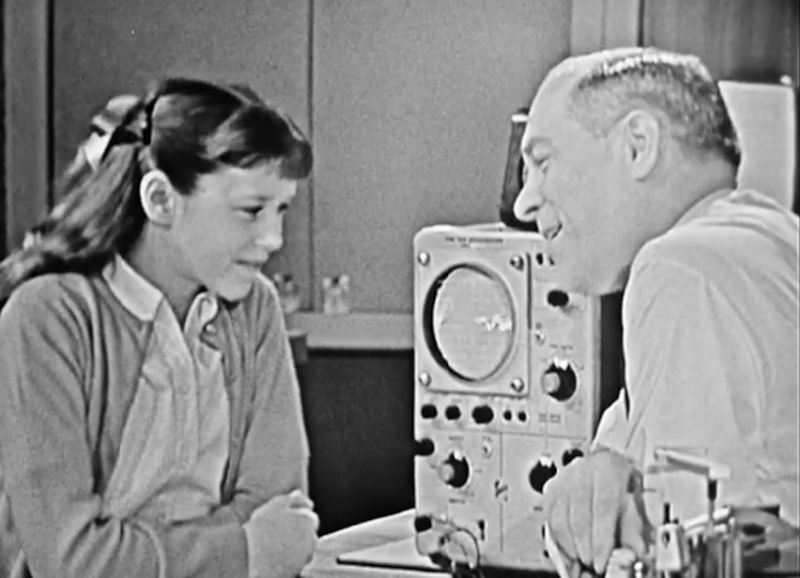
You may not remember [Mr. Wizard], but he was a staple of nerd kids over a few decades, teaching science to kids via the magic of television. The Computer History Archives Project has a partially restored film of [Mr. Wizard] showing off sounds and noise on a state-of-the-art (for 1963) Tektronix 504 oscilloscope. He talks about noise and also shows the famous IBM mainframe rendition of the song “Daisy Bell.” You can see the video along with some extras below.
You might recall that the movie “2001: A Space Odyssey” paid homage to the IBM computer’s singing debut by having HAL 9000 sing the same song as it is being deactivated. The idea that HAL was IBM “minus one” has been repeatedly denied, but we still remain convinced.
Can you imagine a TV show these days that would teach kids about signal-to-noise ratio or even show them an actual oscilloscope? We suppose that’s what YouTube is for.
At about the 17-minute mark, you can see some enormous walkie-talkies. A far cry from today’s cell phones. At the 27-minute mark, another film shows how engineers at Bell created the song using a mainframe.
We wish there were a modern version of [Mr. Wizard]. Then again, there’s no reason you can’t fill in. You might not be on TV, but you can always drop in on a few classrooms.












I loved Mr. Wizard! And how often experiments did not go quite right was a great lesson as well. HAL is definitely IBM shifted. What more do you need than the Daisy bit?
HAL was not IBM’s “minus 1.” It was IBM’s “ROT 25.”
That’s a bit misleading comparison or conclusion, I think.
It makes technology more dated than it really was!
These walkie talkies likely had used 11m Citizen band at 27 MHz and had to have “long” antennas in order to be still usable at that frequency.
We’re talking about 11 metre long radio waves, after all!
Then there’s the size of the radios, the chassis.
A lot of it is because of the battery department.
These 0.5 or 1W AM radios had a couple of AA batreries (8x) or something similar.
That power was needed to compensate for the poor antenna efficiency.:
A 5m long dipole antenna would been the right antenna for a low-power radio operating at 27 MHz.
If these walkie talkies had operated on 2m amateur band at 145 MHz,
then an very good antenna would have been about merely 47 cm long.
The power source would have been a single 9v battery, providing 0,150 W.
Size of the radios would have been a half or a third the size of the radiosin the video.
Remember: The 145 MHz ham band is not very far from FM broadcast band.
And spy bugs of the 1960s using that FM band did fit in a small matchbox already!
Adding receiver functionality was no big deal and turned it into a radio transceiver.
By using earphones it was no bigger than a cigarette box.
Cell phones.. They’re low-power, low range transceivers, because there’s a cell phone tower is at every corner. Literally!
What comparing a vintage walkie-talkie with a cell phone really means is that the outdated technology outperformed the cell phone manifold.
Such 27 MHz AM walkie talkies with “long” antenna could communicate over a distance of over about 3 km (on flat terrain, through some buildings; otherwise more).
A classic 2G cell phone at 900 MHz could barely make it a few hundred metres.
I don’t think they used AA batteries at that stage Joshua, they more likely used those big block batteries at 7 or 9 or something volts.
And of course in the old days it was all discrete through-hole components and lots of them on PCB with large tracks, so yeah the electronics were much larger.
I recall this episode, learning about noise. Lots of music my parents listened to sounded like noise to me, so that lesson was memorable. Also about that time me and my buddie built a pair of Knight Kit walkie talkies — 11 meter — and yep those long antannae were clumsy. And yep they were noisy. Not sure but think the used 9v batteries. Good times.
That was a great post
inurl:”nist.gov” filetype:PDF best practice
I in used to watch Mr Wizard, Don Herbert. He was a real science teacher not at Azz Clown like Bill Nye the non Science guy
Bill Nye is an engineer (applied scientist). The real clown was Beakman
How dare you slander Beakman
I may have seen this very episode when I was a kid – probably a little too young to really appreciate it back in the mid 1960’s. I do however remember another episode where Mr. Wizard put one of the early integrated circuits under a microscope that was connected to a television camera and talked about the parts contained on it. I think he also mentioned that this was going to really change things in the future as they became more refined. I was always amazed by what appeared to me the expensive equipment – like that scope, digital counters, microscopes among other things that he used during the show – stuff that I had no way of seeing used other than this show – but hey it was network television in it’s heyday and I think it was the only national television show about science for kids that was on the air.
“You may not remember [Mr. Wizard]…”
Strange way to start an article on HaD. Who here wouldn’t remember Mr. wizard?? It’d be like saying, “You’ve probably never heard of a blue box, but…”
not everyone who reads Hackaday lives in the US
Not true, all countries belong to America therefore all users are American
What’s a blue box? I’ve never heard of it. Or Mr Wizard.
Clearly a Brit with that handle. Not had I (Irish)
srsly “blue box”??? Like the tardis on Dr Who? The first result I found in websearch is a manga: aka アオのハコ, aka Ao no Hako. There’s a film (documentary?) Jewish National Fund had successful fund raising campaign to support the purchase of land in Palestine.
I think you are referring to the old phreaking hardware to illegally make long distance phone calls. As I’m getting older, I think I’m also little offended of this reminder of my age, maybe you, too?
First result when I search: https://en.wikipedia.org/wiki/Blue_box
I guess they don’t like wikipedia in your parts.
Note the image with it that says “Blue box designed and built by Steve Wozniak and sold by Steve Jobs before they founded Apple. ”
Cute detail.
I think you are a it overselling the simpleness.
If you want an audio file you’d first have to load it in memory and have some code to stream it out at the right wavelength and connect an audio out method
If you want to generate it it gets even more complex.
And I think kindergarten kids would need a lot of guidance either way.
That was a reply to Sammie Gee.
Incidentally I saw someone say ‘the reply is broken’ and Williams saying ‘we know, we created a ticket’
After how many years? Now they find out.
Maybe in another decade or three we’ll have AGI, as well as a working reply system on HaD. (And nuclear fusion of course).
Considering he died before I was born, I don’t remember Mr Wizard. I only saw some of his work when I was an adult.
Not everyone was born in 1950s America.
Dating back to the late neotechnic era when engineers were more widespread than CEOs, and some were paid better than CEOs.
No wonder they nuked the field with floods of scab labor, can’t have that kind of prosperity happening
One of my favorites. I love the generic warning at the start. Don’t mess with ping pong balls on mouse traps! You’ll put your eye out, kid!
What Are Chain Reactions? (Mr. Wizard)
Official Mr.Wizard’s World Channel
https://www.youtube.com/watch?v=bjEnrB18AL0
Thank you for this one. One I recall watching. Also recall wishing I could see it again, but TV did not provide that feature:) Around that time there was also Science Fiction Theater from the borderlands of science — easy to find on youtube. That show got me reading Scientific American.
I also find it amazing that for “the computer” to “sing the Daisy Bell” all one has to do is tweak some CircuitPython/MicroPython commands inside, say, rp2040 or Xiao ESP32-SAMD21 (both have about the same computing power, one has two cores, one – only one).
Meaning, simplicity of such task is now at the level of kindergarten kids who can type commands into laptop (or cell phone).
Look carefully at the television. The undistorted reflection off the front shows that it is from the days before toughened CRTs, so a plate of glass was placed in front of the CRT to protect people from an implosion.
Definitely was a Mr. Wizard kid. Got parts for my projects at Mr. Wizard’s Science Center. Still have a ruler from there. And later I had a Tektronix scope just like the one shown. Long live the nerds!