
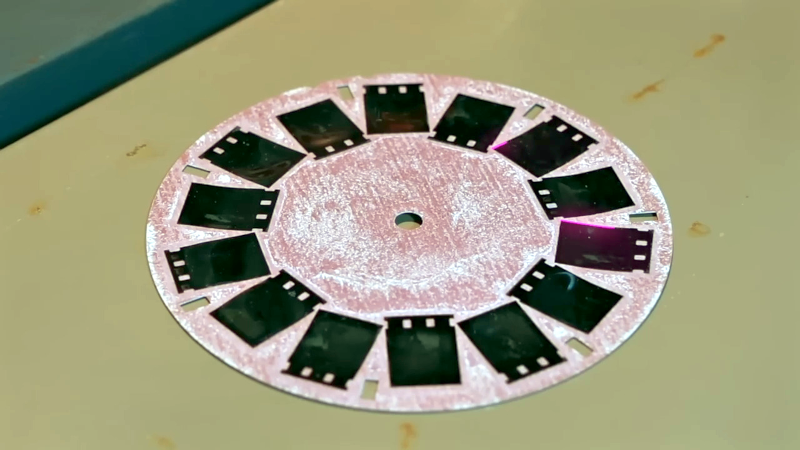
We are going to bet that as a kid, you had a View-Master. This toy has been around for decades and is, more or less, a handheld stereoscope. We never thought much about the device’s invention until we saw a recent video from [View Master Travels and Peter Dibble]. It turns out that the principle of the whole thing was created by the well-known [Charles Wheatstone]. However, it was piano repairman [William Gruber] who invented what we think of as the View-Master.
[Gruber] didn’t just work on normal pianos, but complex player pianos and, in particular, the pianos used to record player piano rolls. He was also, as you might expect, a stereo photography enthusiast. Many of the ideas used in automating pianos would show up in the View-Master and the machines that made the reels, too. In the 1930s, stereoscopes were not particularly popular and were cumbersome to use. Color film was also a new technology.
[Gruber] realized that a disk-like format would be easy to use and, more importantly, easy to mass produce. The reels had a few features to simplify their use. For example, if you show each image in sequence, you’d eventually see pictures upside down. [Gruber’s] solution? Use an odd number of pairs and advance the reel two positions for each jump forward. That way, you never show an image to the wrong eye.
The model “A” didn’t look much like the View-Master you probably remember. By 1940, the toy was a hit. But initially, it wasn’t really a toy so much as a way for adults to view distant sites. Of course, World War II could have stopped the enterprise dead, but instead, they shifted to producing training aids for the military. The War Department would buy 100,000 viewers and about 6 million reels to help train soldiers to identify aircraft and ships, as well as to estimate range.
Training was always a key use of the View-Master technology, but the company eventually bought a competitor with rights to Disney films and exploded into a must-have toy. When the company was bought by GAF, the focus on the toy market grew. Despite some efforts to keep the company relevant in an era with virtual reality and other 3D technologies, View-Master is, sadly, a bit of nostalgia now, even though you can still buy them. But it is impressive that despite many changes to the viewer and the production methods, the View-Master reel remained virtually unchanged despite the production of about 1.5 billion of them. Sure, there were fancy viewers that had audio tracks, too, but the basic idea of an odd number of film frames mounted in a circle in a notched disk remained the same.
These days, a phone can be your View-Master, at least, if you can cross your eyes. Want to preserve your View-Master reels for posterity? So did [W. Jason Altice].












Viewmaster with ET film snapshots… very cool. Long since disappeared…….. :-(
https://www.image3d.com/
I bought one of these as a Christmas present to my wife along with a few credits for custom reels. It was pretty good but the images were a little grainy. I wonder if that was due to the unavailability of really good slide film these days.
I have the View-Master projector and the Space1999 reels when I was a kid.
I found a reel of Star Trek bridge shots, the original series.
I remember ages ago half clicking and releasing the lever and looking at the inverted and inside out pictures.
It’s an odd number of pairs of frames.
I am the proud keeper (by inheritance) of a full set of gear to make the reels. Mid-level cameras, cutting and mounting gear, desktop viewer, and a bunch of other gear.
Hella fun to use. The camera (not the top line pro, but the commercial level) shoots the same format as the consumer– interleaved, at half height/half width frames obn 35mm film. A 63 shot roll gets 72 pairs, 36 unreeling, shift, and 36 reeling back in. It’s first owner was doing internal photography for a manufacturer of industrial parts and machines used for internal training. WWII era into the 1950’s.
Get a lot of interested looks using it. Back when I inherited the gear in the 1980’s, I retimed the camera and made an X-sync module and bracket for a modern flash.
It doesn’t get a lot of use these days, but still, once in a while….
I hope you pass it on to someone who will take as good care of it.
Do you have any videos posted of the process or just of you using the equipment?
Still have one here. When the grand kids visit, it sometimes it pulled out. They like it too. Still relevant.
There appears to be surprisingly little ViewMaster porn. Fascinating, Captain.
Kind of hard to hold it steady while looking at porn and pleasuring.
Challenge accepted.
So the video mentions the slides are made with 16 mm film, and shows shots of film with two rows of perforations (double perf). The images in the viewmaster are consistent with the aspect ratio of standard (double-perf) 16 mm film.
But the photo above shows single-perf film pieces, got either from single-perf Super 16 film (with a different aspect ratio) or by slicing 35 mm film in half (like commenter [cliff claven] above says).
I didn’t get it in the video — Did they change the manufacturing method at some point?
There’s little hints of AI generated content all over the video, from the illustrations to the weird cadence of the narrator’s voice. I wouldn’t be surprised if half the information is just made up.
For instance, if you search for the patent W. B. Gruber 2,511,334 you don’t get the colored illustrations you can see in the video. Those drawings never existed – they’re AI recreations.
I colored that patent diagram by hand. (I made the video). All the AI usage is in the description. And my voice is my own.
Right… so “he” says…
And how do we know for sure you’re not AI, Mr. Machin?
Or should I say “Mr. Machine”?
:-)
FYI – I also manually cut out the reel from the patent image and “inserted” it into the viewer, where the patent image shows the reel above the viewer. I picked this image because the view was recognizable – although the video’s talking about the model A viewer. This was all done in Apple Motion and Affinity and took like an hour to do.
There were a number of methods, AFAIK. The commercial reels were done using a production reducer. I don’t know if the films were positive or negative, but the resolution was excellent as the master was larger format than the reel images, and slower film could be used for the reels, controlling grain size.
The consumer cameras used 35mm, as does the setup I have, and the image plane size is the same as the reel image. Positive film was directly cut or could be reproduced before cutting with a filmstrip duplicator (or other ways). Negative film needed to be reproduced and color corrected. This is all I know from the documentation I have, which is decidedly incomplete.
I have a few modern reels (second sourced– one is from a museum exhibit in the early 2000’s and has EXCELLENT quality) that were reproed on large format film so the cardboard carrier has a single film in it that looks like a daisy. I can’t imagine the volume needed to pay for the cutting dies for this.
It’s sad that we have to doubt the pictures presented in the source to verify our assumptions because there’s not a clear disclaimer that AI was not use to create the images shown, and the fact that we can clearly show by the patent images that AI was used to create the visual contents of the video without distinction to what part is real and what part isn’t.
In other words, what photos it does show are dubious or coincidental at best. The film format or any other information from this video, a simple guess. To say, do not trust the information in the least.
Thanks cliff. Good to know.
There’s lots of colourization and animation in that video. Perhaps some of it was machine-assisted. Perhaps the author made minor errors in producing it, but I don’t see grounds to condemn the work as AI slop.
There’s a moment in the video at 10:20 where I’m showing double-perf 16mm on the left (which is film from a movie I made) – and a reel on the right. You can see that the view-master images are slightly larger than the 16mm movie frames. The reels used single perf 16mm so that the images on them could be a little larger. If you were making a motion picture this would be super-16 – Sawyers took advantage of the extra space and made their images a little larger. This also meant that there were fewer images per 400 foot reel than you would traditionally get in terms of frames of motion-picture per 400 foot reel.
The films were positive Kodachrome (at least up until somewhere in the 70s when they changed sources). Sawyers was the second-leading consumer of Kodachrome 16mm film behind “Hollywood” (whatever that means specifically). The original photography was done in various formats – but settled on 35mm color transparencies – and they used a machine to print those onto the 16mm film. There’s a seller on eBay occasionally selling the “outtake” images from Charley Van Pelt’s collection – which are regular 35mm color transparencies like you’d mount in a slide.
Thanks!
Training, I never thought of that but it seems obvious now you mention in. And since the viewmaster body looks pretty simple I suppose you could 3D print one, put in a Pi and a couple of small screens and lenses and boom, digital viewmaster.
YT channel “Our Own Devices” (recentrly resurected after hack and ban) has several videos regarding this type of, well, device.
Things are so much better these days just by having digital photography alone.
It was so limiting when people had to pay tons of money and had to go through a whole process to get the images from a camera.
Reminds me of rotary dials on phones, the ridiculous effort and time it took just to dial a number, man oh man.
A decade+ or so ago, i was working for a certain director trying to get a certain REALLY ambitious movie greenlit at a certain movie studio. We had tried once before with a different director, but they didn’t bite. So for round 2, I pulled out all the stops. I had a compositor friend adapt the concept art to be 3D, I made most of the pre-vis in 3D, and when the time for the pitch rolled around, I gave all the execs glasses to watch the pre-vis, and at the end we passed out viewmasters with custom-made discs featuring the 3D concept art. It was like giving candy to kids, they lapped it right up and we got the green light. Sadly, a certain vendor who we hired to do the full-length pre-vis of the film doubled their estimate for the real version of the film, and the studio axed it.
To this day, though, there are execs at that studio who still keep their viewmasters in their offices- I only made 25 or so, so they were quite the hot item. They were an incredible pain in the butt to make- there’s a company in Seattle or Portland that sells the viewers and empty discs. Two years before I made those things, pretty much every VFX house in town had a film recorder online. At the time that I actually made them, the switch to digital projection was pretty much complete and there were about 2 film recorders left in Hollywood (at Foto-kem) and they were busy all the time. I ended up sending the work to some photo shop in Denver that had purchased someone’s discarded recorder and was recording images for a few bucks a frame. ( recording=going back to film)
I remember exploring the options of how to best place the images on the film to minimize the number of discrete bits of film necessary to populate the 20 holes in each disk with images for both eyes that were correctly sized, correctly aligned, and ideally, exposed and processed on the same stretch of film. I could have printed 20 images and just placed them individually but i was able to cook up a template that used 3 or 4 short strips overlapped in a asterisk-y shape that managed to populate every image slot with the correct image. So I only needed to make 3 cuts and the lay the film down right and each eye got the right image. I was pretty proud of that!
it’s a bummer the movie didn’t get made, it would have been epic. Though it wasn’t a ‘religious’ movie, the script came from a rather famous poem recounting creation, angels, lucifer’s fall and the ensuing battles. Our nickname for the film was “300 (which i also did) with wings” And it kinda was!
I am about as godless as they come, but i took all the subject matter really seriously – i hate stupid plot holes as much as christians hate blasphemy. So i worked hard to make it all consistent and make sense. There was one notable scene where, during a battle, God comes out in his Merkeba/chariot, to do whatever he does. I was trying to get the writers to give me details on the chariot, like HOW BIG IS IT!?. If I was god, I’d want a BIG-ass chariot. But then I reasoned that a huge one might be hard to park, so maybe it was more sensibly sized. Did it have wheels? Jets? Carried on the wings of cherubs? I needed to know these things because it’s a movie!! The writers were no help at all, so i just winged it. (pun intended!) There was another great scene where I got to poke the evolution vs creation debate as Michael and Lucifer battled in a forest. Because lucifer’s wings had been burned in hell, he used the tendons that had supported his feathered wings as extra arms to grab branches and swing like a monkey through the trees. Reason #861 why I love my job!
anyway if you made it this far thanks for lookin’ :)
cw
Huh, after an hour my post didn’t show up so here it is again. (slightly improved- if they both show up, trash the first one!)
A decade+ or so ago, i was working for a certain director trying to get a certain REALLY ambitious movie greenlit at a certain movie studio. We had tried once before with a different director, but they didn’t bite. So for round 2, I pulled out all the stops. I had a compositor friend adapt the concept art to be 3D, I made most of the pre-vis in 3D, and when the time for the pitch rolled around, I gave all the execs glasses to watch the pre-vis, and at the end we passed out viewmasters with custom-made discs featuring the 3D concept art. It was like giving candy to kids, they lapped it right up and we got the green light. Sadly, a certain vendor who we hired to do the full-length pre-vis of the film doubled their estimate for the real version of the film, and the studio axed it.
To this day, though, there are execs at that studio who still keep their viewmasters in their offices- I only made 25 or so, so they were quite the hot item. They were an incredible pain in the butt to make- there’s a company in Seattle or Portland that sells the viewers and empty discs. Two years before I made those things, pretty much every VFX house in town had a film recorder online. At the time that I actually made them, the switch to digital projection was pretty much complete and there were about 2 film recorders left in Hollywood (at Foto-kem) and they were busy all the time. I ended up sending the work to some photo shop in Denver that had purchased someone’s discarded recorder and was recording images for a few bucks a frame. ( recording=going back to film)
I remember exploring the options of how to best place the images on the film to minimize the number of discrete bits of film necessary to populate the 12 holes in each disk with images for both eyes that were correctly sized, correctly aligned, and ideally, exposed and processed on the same stretch of film. I could have printed 12 images and just placed them individually but i was able to cook up a template that used 3 or 4 short strips overlapped in a asterisk-y shape that managed to populate every image slot with the correct image. So I only needed to make 3 cuts and the lay the film down right and each eye got the right image. I was pretty proud of that!
it’s a bummer the movie didn’t get made, it would have been epic. Though it wasn’t a ‘religious’ movie, the script came from a rather famous poem recounting creation, angels, lucifer’s fall and the ensuing battles. Our nickname for the film was “300 (which i also did) with wings” And it kinda was!
I am about as godless as they come, but i took all the subject matter really seriously – i hate stupid plot holes as much as christians hate blasphemy. So i worked hard to make it all consistent and make sense. There was one notable scene where, during a battle, God comes out in his Merkeba/chariot, to do whatever he does. I was trying to get the writers to give me details on the chariot, like HOW BIG IS IT!?. If I was god, I’d want a BIG-ass chariot. But then I reasoned that a huge one might be hard to park, so maybe it was more sensibly sized. Did it have wheels? Jets? Carried on the wings of cherubs? I needed to know these things because it’s a movie!! The writers were no help at all, so i just winged it. (pun intended!) There was another great scene where I got to poke the evolution vs creation debate as Michael and Lucifer battled in a forest. Because lucifer’s wings had been burned in hell, he used the tendons that had supported his feathered wings as extra arms to grab branches and swing like a monkey through the trees. Reason #861 why I love my job!
anyway if you made it this far thanks for lookin’ :)
cw