

Once upon a time, a car phone was a great way to signal to the world that you were better than everybody else. It was a clear sign that you had money to burn, and implied that other people might actually consider it valuable to talk to you from time to time.
There was, however, a way to look even more important than the boastful car phone user. You just had to rock up to the parking lot with your very own in-car fax machine.
Dial It Up
Today, the fax machine is an arcane thing only popular in backwards doctor’s offices and much of Japan. We rely on email for sending documents from person A to person B, or fill out forms via dedicated online submission systems that put our details directly in to the necessary databases automatically. The idea of printing out a document, feeding it into a fax machine, and then having it replicated as a paper version at some remote location? It’s positively anachronistic, and far more work than simply using modern digital methods instead.
Back in the early 90s though, the communications landscape looked very different. If you had a company executive out on the road, the one way you might reach them would be via their cell or car phone. That was all well and good if you wanted to talk, but if you needed some documents looked over or signed, you were out of luck.
Even if your company had jumped on the e-mail bandwagon, they weren’t going to be able to get online from a random truck stop carpark for another 20 years or so. Unless… they had a fax in the car! Then, you could simply send them a document via the regular old cellular phone network, their in-car fax would spit it out, and they could go over it and get it back to you as needed.
Of course, such a communications setup was considered pretty high end, with a price tag to match. You could get car phones on a wide range of models from the 1980s onwards, but faxes came along a little later, and were reserved for the very top-of-the-line machines.


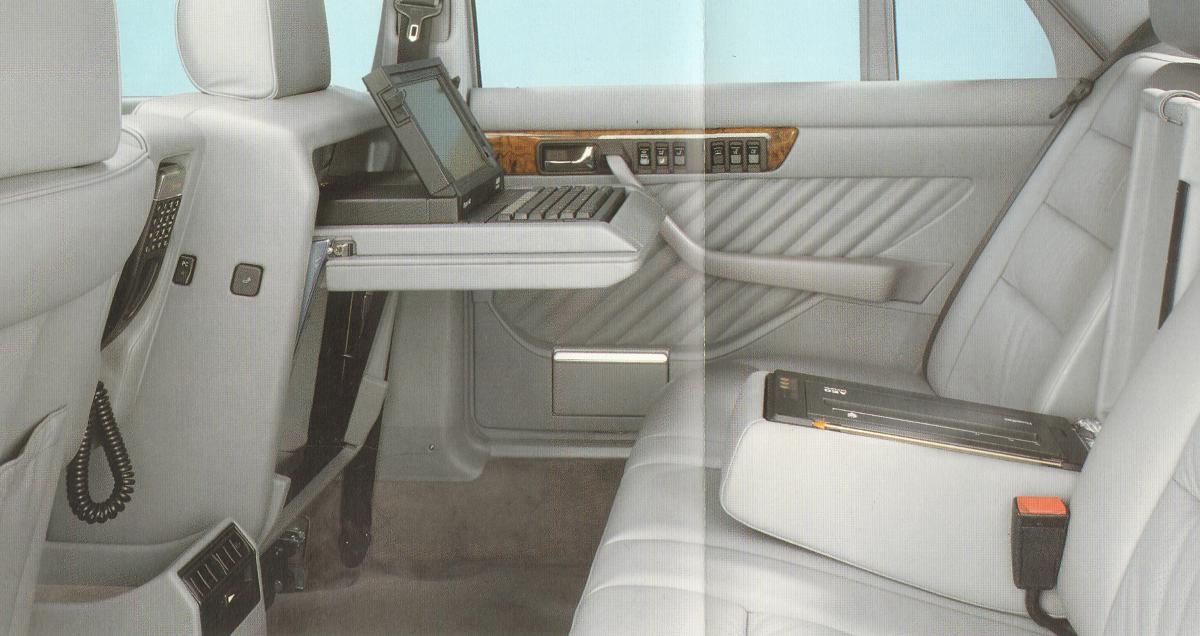
Mercedes-Benz was one of the first automakers to offer a remote fax option in 1990, but you needed to be able to afford an S-Class to get it. With that said, you got quite the setup if you invested in the Büro-Kommunikationssystem package. It worked via Germany’s C-Netz analog cellular system, and combined both a car phone and an AEG Roadfax fax machine. The phone was installed in the backrest of one of the front seats, while the fax sat in the fold-down armrest in the rear. The assumption was that if you were important enough to have a fax in the car, you were also important enough to have someone else driving for you. You also got an AEG Olyport 40/20 laptop integrated into the back of the front seats, and it could even print to the fax machine or send data via the C-Netz connection.
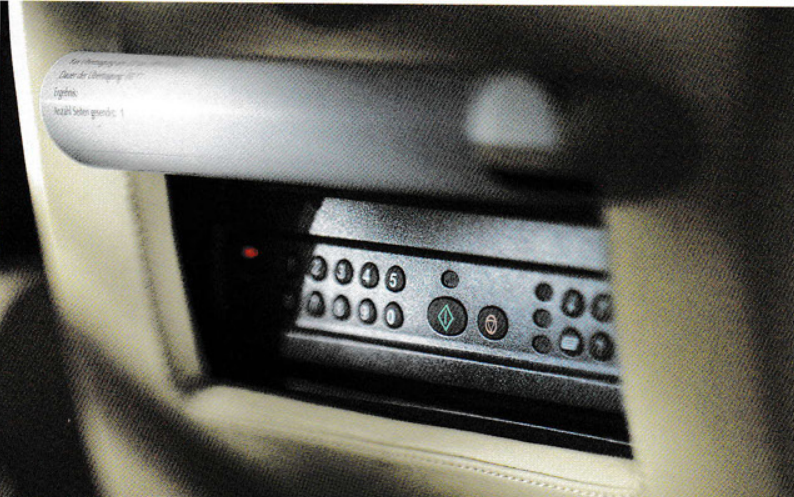
Not to be left out, BMW would also offer fax machines on certain premium 7 Series and L7 limousine models, though availability was very market-dependent. Some would stash a fax machine in the glove box, others would integrate it into the back rest of one of the front seats. Toyota was also keen to offer such facilities in its high-end models for the Japanese market. In the mid-90s, you could purchase a Toyota Celsior or Century with a fax machine secreted in the glove box. It even came with Toyota branding!
Ultimately, the in-car fax would be a relatively short-lived option in the luxury vehicle space, for several reasons. For one thing, it only became practical to offer an in-car fax in the mid-80s, when cellular networks started rolling out across major cities around the world.
By the mid-2000s, digital cell networks were taking over, and by the end of that decade, mobile internet access was trivial. It would thus become far more practical to use e-mail rather than a paper-based fax machine jammed into a car. Beyond the march of technology, the in-car fax was never going to be a particularly common selection on the options list. Only a handful of people ever really had a real need to fax documents on the go. Compared to the car phone, which was widely useful to almost anyone, it had a much smaller install base. Fax options were never widely taken up by the market, and had all but disappeared by 2010.
The Toyota Celsior offered a nice healthy-sized fax machine in the 1990s, but it did take up the entire glove box.
These days, you could easily recreate a car-based fax-type experience. All you’d need would be a small printer and scanner, ideally combined into a single device, and a single-board computer with a cellular data connection. This would allow you to send and receive paper documents to just about anyone with an Internet connection. However, we’ve never seen such a build in the wild, because the world simply doesn’t run on paper anymore. The in-car fax was thus a technological curio, destined only to survive for maybe a decade or so in which it had any real utility whatsoever. Such is life!








So once upon a time, big companies, accounting shops, law firms, etc. had FAX DEPARTMENTS.
Office space filled with thermal printing fax machines and dedicated employees whose only job was to keep the feeders (for scanning documents to be sent out) fed and cutting off the thermal paper as it reached “page size”.
Since this was one machine per phone line, and each page, even at lowest resolution usually took 15 to 30 seconds per page, if you needed to send out a 100 page document to 10 people (pretty common task), you had people making copies of the document, feeding them into 10 separate fax machines and watching for jams. “Junior” employees got to stay up until 4 a.m. “to make sure the fax got out.”
This was in the days when Fed-Ex had just really gotten started but “overnight” still wasn’t fast enough.
Often there was also a separate Duplicating Department also 24/7 devoted just to, say, gettting those 10 copies of that 100 page document printed for scanning.
And, of course, a totally separate Word Processing Department, also 24/7 because almost no one had a computer — maybe 4 secretaries (that’s what they were called back then) would share a Wang but they were rarely networked. So, you get a 100 page fax you needed to provide comments to. The scan was unbelievably poor and often skewed. There was no possibility of OCR scanning. You gave the 100 page scan to word processing to run into a document on your system and then marked it up by hand (e.g., with a pen) and then gave it back to word processing to revise.
Rinse. Repeat. Fax back out.
People who didn’t live through that era have no idea how massively more efficient modern office work is.
Still mostly drudgery and pointless, but at least once someone saves and hits send, they can go home or turn to something else without the need for 10+ additional man hours each time just to get it to the right people .
Don’t forget making a loop of black paper and sending an endless fax to your enemies.
Good fun!
50/50 on them being out of paper or out of toner the next day.
Unless they had a ‘fax department’.
Before regular fax machines there was the slow AF spinning paper, one line per spin, thingy.
Only law firms and the like could afford those.
The “spinning paper” type was also used by engineering firms to send and receive drawings.
And police departments to send documents with photos. You see them in old crime movies.
Press agencies used them too, such as Associated Press’s AP Wirephoto (trademark).
Regarding the endless black fax, me and a colleague were thinking decades ago about configuring a modem to send the necessary tones for that. It was still in dial-up era and modems were plenty.
What’s the technichal term for AF spinning paper? My search-fu only returns origami results for these terms.
AF = ‘as f!@%’
If I knew the correct term, I’d have used it.
‘Thingy’.
Perhaps ‘Telex’, from down thread.
“maybe 4 secretaries… would share a Wang”
The comments write themselves.
It should be noted that faxes are still considered legal documents where emails, even encrypted messages or attachments, are not. This means that contracts, medical orders, government notices etc, are still sent by fax.
Electronic documents signed using PKI are considered legal documents in many (if not all) EU countries.
Sorry, you beat me to the answer.
I’m not sure about courts in Germany, though.
To my knowledge, it has to be either a Telefax or a paper document (delivered via mail or in-person). No E-Mail for sure.
Germany is ass backwards in all things digital. You guys are so afraid of those (now 80-years old and slowly losing touch with reality) STASI agents that you refuse to use basic conveniences like credit/debit cards.
Wake up! The world has moved on and there’s more to life than your Amiga 500. We even have this thing called Internet now!
I can’t speak for everyone, but I think the 80s and 90s simply have a soft spot in our memory.
It was a time when things were looking prosperous, still.
To people of Japan, it must be similiar, I guess.
Also, our digital infrasture was initially meant to lead in a different direction, without internet in mind.
The communication networks were supposed to be switched, later packet based.
In the 70s, optical fibre connections had been planned but cable TV got all the money intended for that.
Then in the 80s, pilot projects with ISDN started in some cities.
ISDN wasn’t just a precursor to DSL, but a digital version of the POTS.
You could do direct connections to your partners, do Fax, video telephony and connect to BTX (aka Datex-J) or Datex-P.
You could call a BBS (aka mailbox) or another online service (AOL, CompuServe etc).
Connection was near instant, audio quality much better than VOIP!
But then, by mid-90s, the internet was here to stay, unfortunately.
ISDN was basically reduced to a cheap internet connection.
Then came DSL and started to replace ISDN on a large scale.
But many DSL router modems had kept the S0 port for ISDN telephones, fax devices and PBXes.
Distribution of fibre optical connection to the home was slowed down,
because Telekom/T-Online/DSL refused to make way for it (to exploit the old copper lines to the max).
So for a long time, cable internet was the fastest there was.
In retrospect, the technology of the 80s simply worked, at least.
A Fax gets a document from A to B, you can sign it with a pen (or rubber stamp), there’s no phishing or malware..
To the bureaucratic side of Germany (and Japan), the Telefax perhaps was the technological pinnacle. 🙂
About money.. Since the Corona pandamic, more card terminals have been installed.
Many shops now support paying via bank card (EC card or VPay).
Debit cards are still hit and miss, of course. Always have been questionable to us.
Real money, is physical money (“nur Bares ist Wahres”).
Cash provides a bit of anonymity, which is important for a healthy democracy.
Otherwise, people become transparent citizens, have to fear about what to buy and where.
Businesses should only get as little as information needed from their customers.
I’m sorry for the other EU nations who think otherwise and think they’re “modern” by doing everything entirely digital now, just because it’s in fashion right now.
That being said, I can’t speak for all my fellow citizens here, of course.
Some of us are mislead that an all-digital society is inevitable. ;)
Never! There’s no life without an Amiga or C64 (or Atari 800XL)! 😆
Also, long live the fax! Long live DOS! Long live the ’80s! 🩶
I think it’s because Germany is split up into states internally, and the banks in each state don’t co-operate very well, so card payment processing isn’t as smooth as it could be.
It shows up in business culture as well. If you buy something from Germany, they want to see the money in their bank account first before they’ll send you the item. Unfortunately for many companies, they want to see the item first before sending the money. It’s a whole song and dance to get anything done.
That’s not the case in the US. Email and electronic signatures, if combined, are more than adequate for binding legal documents of any sort other than those requiring notarization.
Depending on the seriousness of the document, even “Read Receipts” or TLS may be adequate.
For example, a legal requirement to provide written notice, even if mandated by regulation, can often be satisfied with email.
The level of bureaucracy might be different to, say, Germany, maybe.
I could imagine, opening a hot dog stand in Germany involves more paperwork, diligence and confidentality than an average US goverment project. 🥲
Have they opened an ‘America Theme Park’ where Germans might actually buy ‘hot dogs’?
America has plenty of paper being pushed.
I wouldn’t count on it universally being less.
For example:
If your house burnt down in Germany (leaving intact ‘crete shell), how long would it take to get permits to start rebuilding?
In the batshit crazy parts of the USA, there are multiple overlapping authorities.
Some of which are fully batshit (e.g. the Coastal Commission in CA).
Average time to get permits from them is…Applicant (very rich) gives up after 5 years.
The CA CC be the first against the wall ‘when the revolution comes’. (Joke feds)
Mountains of paper as effective ban is a universal method of government.
Strictly for a fire rebuild?? No way that long unless they are insanely swamped with all the rebuilds happening. But there’s always minimal review clauses for substantially the same house that burned to be put back up. Your rich friend probably wants to build some of those additions and other renovations now too. But still even for that 5 years seems exaggerated. Max I have seen was 1.5
Anything under CA CC is dead by design.
They richers give up after 5 years, buy elsewhere and sell to someone politically connected.
Who redevelops and kick’s up a nice % to the CA DNC.
What part of the world you’re talking about? Definitely not EU
Germany, maybe? It’s in the middle of Europe, last time checked.
If Fax is not an option and time is a critical factor,
we sometimes do travel by car and bring the paper documents with us. For signing an important contract, for example.
Because pidgeons only can carry so much, those poor things.
Germany is kind-of notorious for insisting on actual dead-tree paperwork, just like EFTPOS/PayWave tends to be the exception when paying at a cafe or restaurant and accepting only cash.
I think that’s true, but it also has some reasons.
Payment via card does cost the shop owner some money, so cash is preferred.
Cash also makes things more real to citizens.
You look into your purse and see how much money you have at hand,
how much you are allowed to spend.
On other hand, printed documents on paper can’t be hacked/deleted, either.
Considering the current dangers and the vincibility of the internet,
it’s a good thing that this country is so »backwards«.
Bad boys from the far can’t hack our arsenal of Leitz folders..
Also, we also have multi-function devices (phone/copier/fax/e-mail) and computer faxes now!
Not just classic thermal paper fax machines.
Modern fax software on a PC can do OCR and other nice things (color faxes!).
What the world needs is some additional encryption for existing fax machines, maybe.
So we can plug a little box between the fax machine and the telephone outlet.
That would be some real, practical progress, I think. E-Mail is for hippies! 😄☮️
People who’ve grown up with card payments comment that cash feels like funny money, because it doesn’t leave a trace in your account statement. It’s just there and gone, and you have no memory where it went.
@Dude That reminds me of something, for a long time into the present, some people lived totally without a bank account here in Germany.
They were basically free, no bank to depend on. No bank account force.
They got their money via crossed cheque that they could redeem at the post office counter instead.
Especially elderly people got their pension via mail as a crossed cheque.
It was a natural event to see them invading the post office (Deutsche Bundespost, later Postbank).
Federal institutions of all kinds also had to accept cash as another kind of payment by the citizens, it was demanded so by law.
So a bank account was no requirement to be able to live in Germany.
Today, the pressure is much higher, of course.
But in principle, citizens still have the right not to have a bank account and pay via cash or other means of paying.
I suppose you don’t need a bank account if you have no loans and no savings, basically living hand-to-mouth.
If people still kept significant amounts of cash on hand, the junkies would be breaking in to peoples homes constantly in search of it, whether you have it or not.
@Dude Hmm. We don’t really have that many people like that here.
At least usually not any among the German citizens, generally speaking.
They’re way too uptight for that! 😆
But I get your point. I guess.
There are some places in Germany, too were poverty and criminal activity is higher than normal.
Places like train stations in certain cities, or certain corners of Berlin, maybe.
Or districts close to refugee centers, abandoned places in the east..
But places like Berlin, Munich and Frankfurt are generally not exactly representative for Germany as a whole.
They are always bit at the extreme side of thungs, just like -um-, say, NYC, Texas or Washington? Or California etc?
Um, regarding the bills, rent, and so on…
The groups mentioned (elderly people, etc.) simply transferred cash at the post office counter
and deposited it into the recipient’s account.
Without needing to have their own bank account.
Some also had savings books at the bank, but no bank account.
With a little paper booklet where the bank recorded the deposited/withdrawn amounts using a dot-matrix printer or something similar.
Rent was also paid in cash to the landlord if he lived in the same building.
That was a different world, I guess. Very analog by comparison.
“You look into your purse and see how much money you have at hand,
how much you are allowed to spend.”
That is these days mostly a myth unless you have no bank account amd all your money is held as cash in your wallet. Easier to check your bank/credit card balance to see where you’re at.
If you’re incapable of keeping track of your spending as seemingly some people are then you can get a debit card account and only transfer in what you want to spend.
As Dude says, it’s very useful to have an electronic statement should you need to check back for an old purchase. In Europe at least a card statement is good as proof of purchase should you not have the receipt.
Int he Years Long Gone US Post Service (USPS – unrelated to UPS) used to offer such services, ie paying bills by cash deposited into bank accounts. As a matter of fact, it was so popular, banks were scared people (especially in rural US) would just stop using banks altogether, since they didn’t need them. Because back then it was easy to find open USPS office during the working hours (banks always closed at 3pm no matter what – especially rural places – this was before widespread ATMs), so working Sam only had USPS office to help with the bills, and USPS didn’t need a bank account.
It was even fancier than that – one could wire cash from USPS to USPS, and it was cheaper than Western Union (who mostly monopolized telegrams – a separate story of its own). There were talks about making USPS banks, ie, people opening accounts and using them, and I honestly don’t remember if average Sams did – quite likely, just I personally never found a need to do that.
I speculate that Travelers Checks were made available to Average Sam so that he’d stop going to USPS for things. I also speculate that the competition was fierce, and the direct result was that fees for using either one fell into nothing, thus, making it possible to do without mandatory banks accounts everywhere. Obviously, this was not favored by the for-profit banks (who were also quite constrained by the state-chartered and municipal banks who offered about the same banking services for less – and kept all the profits/proceeds mostly local).
Regardless, each such thing (transaction) was still very well regulated, since USPS is a federal entity, and, thus, was actually keeping up high accountability standards. It also kept proceeds local (to the US), so it was returning profits back to the economy, and not shipping them away to the far away investors’ pockets.
Things went south in the 1990s with the horrible mistake made with the “banks de-regulation”, essentially letting for-profit banks run free, and globally unaccountable. It remains to be seen whether this was a good thing, in some ways it probably was, but I didn’t notice anything changing – other than few behemoth banks suddenly becoming the sole monopoly in the US, which is always a bad thing.
The AEG Olyport 40/20 is clearly a rebadged GRiD 1500-series portable computer. Depending on model, these featured 80286/80386 processors with up to 8MB of RAM. Hard drives varied from 20MB to 120MB, depending on options. There was also an optional built-in modem available.
Given this was a high-end, expensive system with 12V car power available I’m surprised they didn’t spring for the much nicer (but power hungry) 640×400 plasma screen instead of the much poorer LCD…
I bet the LCD was reflective, so it was daylight readable, while the plasma wasn’t.
I was wondering the same thing. For 1990 the 1530 would have been a solid business machine.
I guess they assume that if you’re looking at faxes in the dark then you’ll turn on the overhead light, making a backlit or emissive display unnecessary.
Found some GRiD models here:
https://staff.salisbury.edu/~rafantini/grid_1550_and_1530.htm
The specs were good enough to run Windows 3.1 and the business software of the time.
Things like CompuServe WinCIM, Amaris BTX, MS Works, Excel,
some other telecommunications and fax software (WinFax etc).
Physical RAM should have been at least 4 MB, though, because Windows didn’t have a swap file in Standard-Mode (80286).
OS/2 and GeoWorks Ensemble were alternatives, too, probably.
By early 90s, the D-Netz became available, too. It used GSM/2G.
Celluar modems of the time could do 9600 Baud, I think.
The AEG Olyport 45 sports a red plasma display, maybe it was the deluxe version?
“a car phone was a great way to signal to the world that you were better than everybody else.”
Really ? Seems to be a bit of “projection” there. Only the real douchebags thought of them as
“status symbols”.
Many of us who had them back then were just working stiffs with bosses who felt they
would be useful to business at hand. New fangled technology, let’s try it out.
Yeah, I guess having a bag phone covered with white dust on a job site for a concrete pour automatically
made us superior to the common peasantry !
Or, having one in a medic rescue unit made us MICU medics superior to the proletariat.
Or, a tow operator wanting to dump their 800 mhz SMR radio, deciding to try out cell phones.
Only the insecure think of using objects to make up for their lack of character.
Only the insecure pass judgement on the rest of us.
The fax machine in the BMW L7 was a Swedish Possio PM80 Mobile Messenger. The legendary German fashion designer Karl Lagerfeld had one installed in his L7.
The PM80 had a National Semiconductor 486 CPU and the code was developed in Microsoft Visual C++.
Or that you couldn’t use a computer, fax, and drive at the same time, so the only logical place for the machine was with the passenger and not the driver.
So, could you play some network game 1 vs 1 using this system (computer plus fax)?
Who wins gets the closest to entry/boss spot parking for the week.
There was the joke about a sales dude (lets call him Michael), going to work and seeing his colleague John talking on the phone in the car (no mobiles those times) day after day, and it gets envious and, after getting the money, he installs a phone in the car and calls John: “Hi John, this is Michael, I got a phone in my car also!”, John replies: “Thats nice, can you please wait, I got a call on the other line”.
There is a scene in Hudson Hawk (1991), where the antagonist receives a fax in his limo, then shreds it. I always thought that was a spoof.
What do you know, it was a real thing !!!
Nothing about 4 secretaries sharing one wang?
If the boss has enough money, anything is possible
In the 70’s it was having a Telex machine at home. I knew one person whose parent had that, but I don’t know why. Likely finance.
Toyota weren’t above offering a fax machine in their lower end cars too. You could option one in to the Sera (you know, the car that was essentially a Starlet with the ‘gullwing’ (actually ‘dihedral’) doors that Maclaren bought one of and copied the geometry for their F1).
Admittedly it was a VERY rare option, but it was available.
The Sera was also the, if not one of the first cars to use projector headlights. Too bad they didn’t also offer it with a turbo engine like used in the Starlet GT, even if it did get the best version of the 5E engine (5E-FHE).
Some government agencies still use fax; our state DHS wanted taxes and would not accept emails, I had neither fax machine nor landline(if I could afford that stuff I wouldn’t be doing business with them, eh?) i finally did talk them into letting me foto the documents with my cell fone email it to them, since all government agencies do have email; I quit trying to make sense out government years ago, and now it’s even worse.
In NYC in the early 80s the parks department used to send parking permits by fax. That would have been handy,
Back in the mid 70s there were message servicees, great business that would not only answer your phone and take messages but would deliver messages to people who called like where the car was parked or that you were on your way to work if Work called or if you’re on your way to the beach if your girlfriend called. They would also send and receive faxes and telexs. If you wanted to get a meeting with somebody on the spur of the moment, you would call up the answering service and have them send a fax to whoever you were trying to meet apologizing for running late. There would be the department that received faxes, the secretary of whoever you were trying to visit and maybe be a receptionist all of whom figured that somebody had screwed up and just wanted to avoid being blamed. Not only would you get the meeting but you’d get lots and lots of apologies.
Of course, if you really wanted to get the attention of Somebody in an office on the 35th floor of a building in Midtown you’d send a Telex. Most people never got a Telex and had no idea what caused some machine in the basement to spit out a message to them, when you could just dictate it over the phone to somebody and pay $3.50 at the end of the month.
They need to set up a demonstration of receiving a Carfax report via the car’s fax.
Here’s the perfect song for this article, ‘Car Phone’ by Roger McGuinn (ex Byrds):
https://www.youtube.com/watch?v=wKYhUnky2IQ&list=RDwKYhUnky2IQ