

No matter the item on my list of childhood occupational dreams, one constant ran throughout: I saw myself using an old-fashioned punch clock with the longish time cards and everything. I now realize that I have some trouble with the daily transitions of life. In my childish wisdom, I somehow knew that doing this one thing would be enough to signify the beginning and end of work for the day, effectively putting me in the mood, and then pulling me back out of it.
But that day never came. Well, it sort of did this year. I realized a slightly newer dream of working at a thrift store, and they use something that I feel like I see everywhere now that I’ve left the place — a system called UKG that uses mag-stripe cards to handle punches. No it was not the same as a real punch clock, not that I have experience with a one. And now I just want to use one even more, to track my Hackaday work and other projects. At the moment, I’m torn between wanting to make one that uses mag-stripe cards or something, and just buying an old punch clock from eBay.
I keep calling it a ‘punch clock’, but it has a proper name, and that is the Bundy clock. I soon began to wonder how these things could both keep exact time mechanically, but also create a literal inked stamp of said time and date. I pictured a giant date stamper, not giant in all proportions, but generally larger than your average handheld one because of all the mechanisms that surely must be inside the Bundy clock. So, how do these things work? Let’s find out.
Bundy’s Wonder
Since the dawn of train transportation and the resulting surge of organized work during the industrial revolution, employers have had a need to track employees’ time. But it wasn’t until the late 1880s that timekeeping would become so automatic.
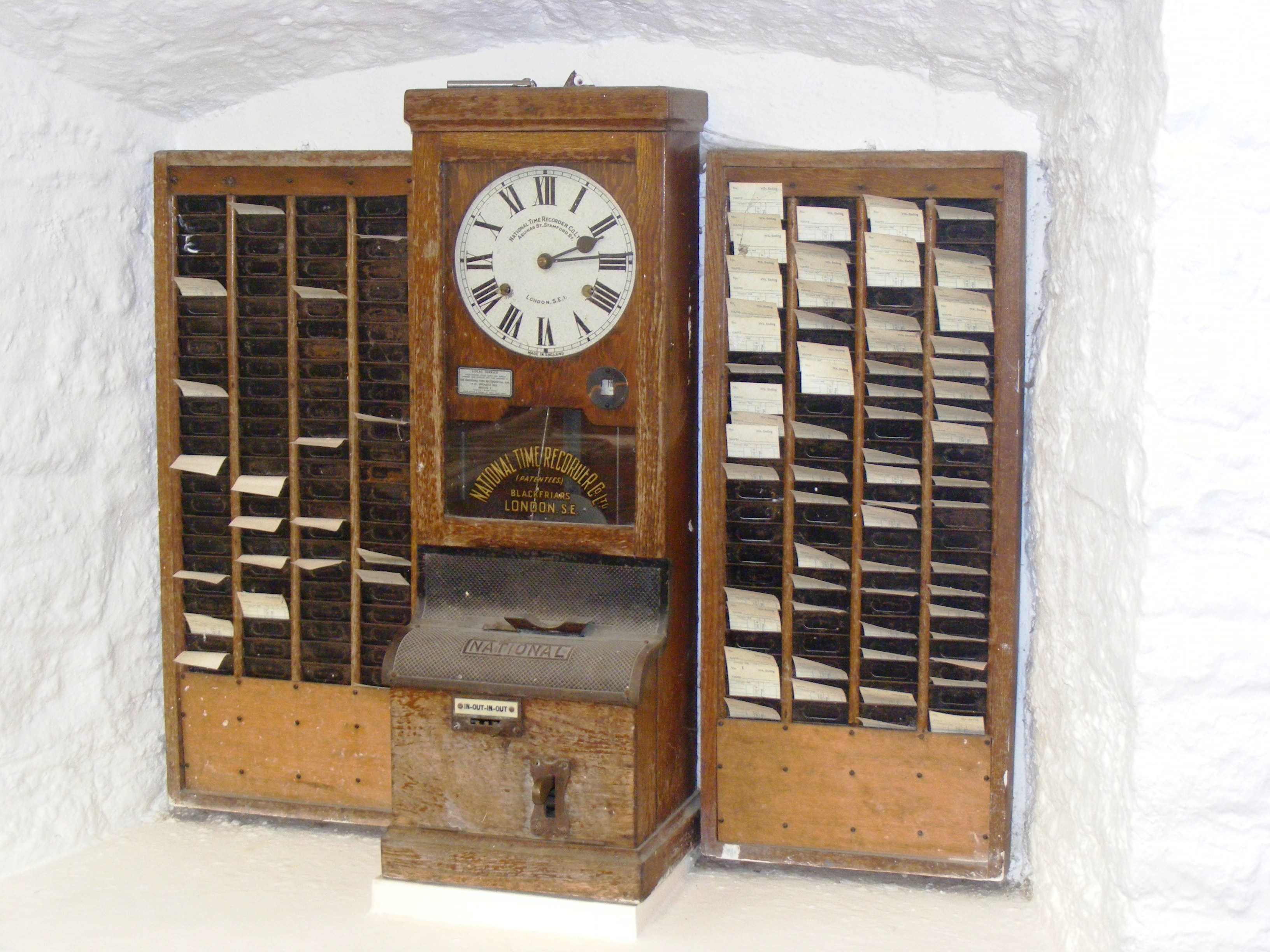
Willard Le Grand Bundy was a jeweler in Auburn, New York who invented a timekeeping clock in 1888. A few years later, Willard and his brother Harlow formed a company to mass-produce the clocks.
By the early 20th century, Bundy clocks were in use all over the world to monitor attendance. The Bundy Manufacturing Company grew and grew, and through a series of mergers, became part of what would become IBM. They sold the time-keeping business to Simplex in 1958.
Looking at Willard Le Grand Bundy’s original clock, which appears to be a few feet tall and demonstrates the inner workings quite beautifully through a series of glass panels, it’s no wonder that it is capable of time-stamping magic.
Part of that magic is evident in the video below. Workers file by the (more modern) time clock and operate as if on autopilot, grabbing their card from one set of pockets, inserting it willy-nilly into the machine, and then tucking it in safely on the other side until lunch. This is the part that fascinates me the most — the willy-nilly insertion part. How on Earth does the clock handle this? Let’s take a look.
Okay, first of all, you probably noticed that the video doesn’t mention Willard Le Grand Bundy at all, just some guy named Daniel M. Cooper. So what gives? Well, they both invented time-recording machines, and just a few years apart.
The main difference is that Bundy’s clock wasn’t designed around cards, but around keys. Employees carried around a metal key with a number stamped on it. When it was time clock in or out, they inserted the key, and the machine stamped the time and the key number on a paper roll. Cooper’s machine was designed around cards, which I’ll discuss next. Although the operation of Bundy’s machine fell out of fashion, the name had stuck, and Bundy clocks evolved slightly to use cards.
Plotting Time
You would maybe think of time cards as important to the scheme, but a bit of an afterthought compared with the clock itself. That’s not at all the case with Cooper’s “Bundy”. It was designed around the card, which is a fixed size and has rows and columns corresponding to days of the week, with room for four punches per day.
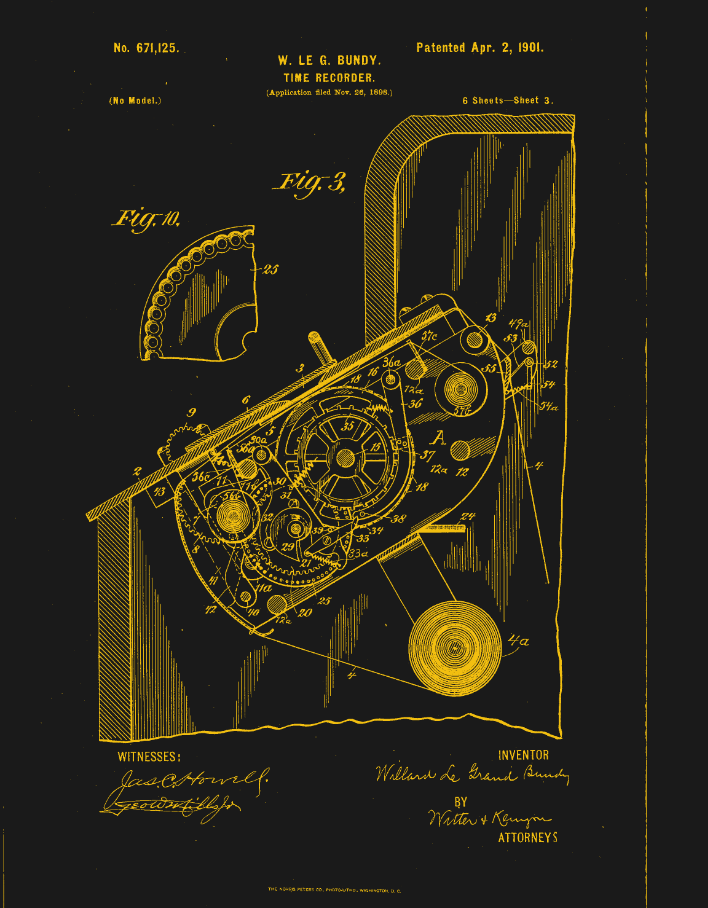
Essentially, the card is mechanically indexed inside the machine. When the card is inserted in the top slot, it gets pulled straight down by gravity, and goes until it hits a fixed metal stop that defines vertical zero. No matter how haphazardly you insert the card, the Bundy clock takes card of things. Inside the slot are narrow guides that align the card and eliminate drift. Now the card is essentially locked inside a coordinate system.
So, how does it find the correct row on the card? You might think that the card moves vertically, but it’s actually the punching mechanism itself that moves up and down on a rack-and-pinion system. This movement is driven by the timekeeping gears of the clock itself, which plot the times in the correct places as though the card were a piece of graph paper.
In essence, the time of day determined the punch location on the card, which wasn’t a punch in the hole punch sense, but a two-tone ink stamp from a type of bi-color ribbon you can still get online.
There’s a date wheel that selects the row for the given day, and a time cam to select the column. The early time clocks didn’t punch automatically — the worker had to pull a lever. When they did so, the mechanism would lock onto the current time, and the clock would fire a single punch at the card at the given coordinates.
Modern Time
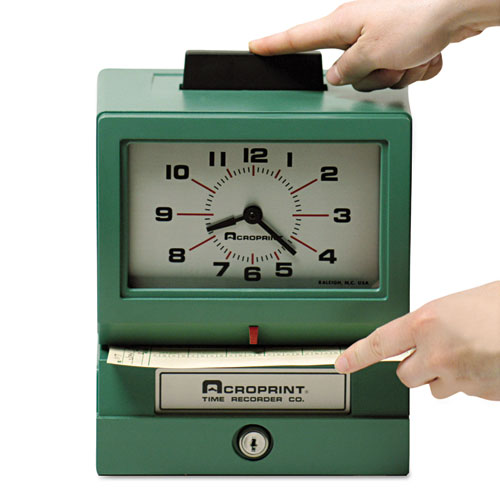
By the mid-century, time clocks had become somewhat simpler. No longer did the machine do the plotting for you. Now you put them in sideways, in the front, and use the indicator to get the punch in the right spot. It’s not hard to imagine why these gave way to more modern methods like fingerprint readers, or in my case, mag-stripe cards.
This is the type of time clock I intend to buy for myself, though I’m having trouble deciding between the manual model where you get to push a large button like this one, and the automatic version. I’d still like to build a time clock, too, for all the finesse and detail it could have by comparison. So honestly, I’ll probably end up doing both. Perhaps you’ll read about it on these pages one day.












The card could also be annotated which a key couldn’t. As for us it was a ID card around our neck that doubled as a indicator of when we checked in and out, and woe to anyone who forgot it.
Try dealing with old Detex clocks, which are common in the commercial security industry. Gotta “punch in” every few minutes.
Not the same ka-chunk satisfaction, but much more versatile and useful: android based ‘time recording’ app by DynamicG. (https://play.google.com/store/apps/details?id=com.dynamicg.timerecording)
We use photo badges containing contactless (RFID) smart cards. They also operate the doors, turnstiles, and some inventory management duties.
I thought there was a variant of the punch clock that indexed the next punch by nibbling along the long edge?
My small-town public library used those for checking out books. Still have one of the “due date” cards they’d put in the pouch in the back cover.
We use the mentioned UKG for time reporting at my current employer. Hourly people (you know, the ones who actually do the work) at our plant do clock in and out, but not with a mag-stripe on a card. They use their faces. (Salaried, I basically only use the web site and/or mobile app to request PTO.)
Historically, other biometric options have been employed such as the “hand punch” which compares your hand against a stored reference for said hand. Allegedly, it was based largely on finger lengths.
At other places I’ve worked, I saw the transition away from a mag stripe/card punch in authentication driven by people punching in themselves and friends whose cards they were carrying — said friends not being on the premises at said time of punch in.
The last (only) job where I physically punched a ka-chunky clock was at a fast food joint in the mid 1980’s. (I’m pretty sure that clock could be heard from the farthest reaches of the dining room.) At that time we used a manila card maybe 4″ wide by 8 or 9″ tall, inserted vertically. The time clock physically punched holes down the side of the card and stamped it with the current date and time. There was also fraudulent punch-in activity with these physical cards. Faces seem harder to fake.
I worked at a local sandwich joint from 2007-2010 where we used punch cards, these were about the same size but inserted horizontally, where the user would line up the correct box with an indicator above the slot and the time/date would be stamped automatically. There was certainly the possibility of chicanery, but it was a small outfit and least one of the two owner/operators was almost always on premises, so it would have been difficult to get away with any serious fraud.
I worked somewhere that used these clocks (paper cards, inked stamp) in the most ancient year of … 2016.
I used one in the 1990’s, clocked in workmates running late and they would clock me in if I was running late. Back in the day when no cameras were recording such devilment.
One thing I never had to do was clock in and clock out to mark time worked.
Today it is a security badge to get into/out of places … And that is a relatively ‘recent’ change. No security when I first started professional work back in the 80s I grumbled a bit when security became a ‘concern’ and you had to badge into the buildings… Now we even have a security fence around the current facility… So it goes.
Neat to see a little history of bygone years.
Mistype … we don’t have to badge out. Just badge in.
Car numberplate recognition, card pass and videophone on the gates, RFID on the doors, photo ID, thermal cameras, facial recognition in order to clock in and get paid, overtime is unpaid unless approved in advance. 24/7 working environment. 15-20 min breaks, all internet traffic and device locations are logged and actively monitored and almost every square inch is covered by CCTV. Pay slips and holiday requests are made with multifactor authentication, code, facial recognition and phone tracking. You’d think it was a military base, but no.
It truly is an Orwellian nightmare. I miss punch cards.
And every one of those features had to be justified and paid for, either because of some safety or security event or fraudulent activity.
Ouch. And I thought just a few security cameras, badges, and PIN was ‘overkill’. Oh and two factor to get on our laptops…. You have it much worst! Orwellian indeed.
As a utility keeping the lights on and the gas flowing, we are 24×7 also.
Try security at a bank data center. More than once, a newbie or person carrying something awkward had to be manually released from the man trap turnstile. Badge reader couldn’t be reached from inside to release yourself. This was pre-cellphone so you’d better hope the guard hadn’t taken a coffee break when you got stuck. The setup was quite effective at preventing “piggybacking”. Rumor had it that badges could be flagged to intentionally capture someone in that little round cage.
The vault was another story. I avoided going in there. You entered into a long-ish bare corridor at the opposite end of which sat a guard with a rifle and a gun port through bullet proof glass.
(that was supposed to be a reply to rclark above. It even showed as Reply to rclark while I was typing. This UI is…something.)
Apparently as a Canadian I’m not allowed to watch the video linked in the article. :/
My apologies! Here is an article with the transcription. https://www.cbsnews.com/news/almanac-workplace-time-clock/
The video is unavailable in Canada.
I’m sorry! Here is an article with the transcription. https://www.cbsnews.com/news/almanac-workplace-time-clock/
I’ve worked salaried my whole career (35-ish years), yet I’ve had to account for every single hour I’ve worked with various time sheets and computer systems.
At my last job (a consulting company), yes, I’ve had to fill out a weekly online time card so my work could be allocated (and billed) to the correct project. Access to the building ( and the labs) was by proximity card. But at previous jobs, no time card required. I did use one of those punch clocks at a summer factory job. It nibbled the card edge to set the next row to be stamped.
I’ve had 2 different versions of punch clock in my time in 80s and early 90s. One you had to manually align the card to the day of the week, and line up with clock in, meal out, meal in, and clock out. 15 minutes break weren’t clocked but still mandated. Empty spot on the day is usually employee’s day off or sick call.
At a different place, it was more automatic and the side of the card were notched when I used it so the date and time would always line up. That card didn’t use day of the week, it just stamped in the current date along with time.
I haven’t seen those since I think 1992 or 1993, all other places used electronic record, you just punched in your ID or used card.
My friend uses a punch card system in his factory here in Japan. As his IT guy, I use them when working for him (tax accounting reasons etc, even though I’m not ‘officially’ an employee) and I’ve fixed and maintained them too.
They are a box about the size of a toaster turned on its end, with a slot in top and a digital clock using a dot matrix display on front.
The cards are the usual manilla cardboard of the usual size and are indexed with a unique coarse barcode along one side (a failure point is the optical sensor to read the barcode getting dirty, easily fixed with a blast of strategically aimed canned air through the top slot).
Stick your card in, it is automatically pulled in and the barcode read as it enters, the machine compares to its internal memory, if it’s new, it prints the start time. If already in memory, it knows the last punch times and updates memory and punch card appropriately.
The time is stamped in the correct box with a dot-matrix printer that moves along the x-axis (a clever little rod with two helixes of opposing directions moulded into the plastic overmoulding, allowing the print head to run in one direction then come back without having to reverse the motor) while the paper moves up and down for the y-axis.
This plastic helix is the other main failure point, the plastic shrinks around the metal center rod over time (measured in a good number of years) and cracks, leading to the printer head jamming.
The clock can be synchronised via NTP if an Ethernet connection is present, via the time signal by radio, or just setting manually.
Also, all the time data can be transferred via the Ethernet to be logged into whatever accounting software is used, in addition to the physical cards acting as a hard copy for physical evidence.
Rumor has it, before watches became commodity, automatic time clocks were regularly abused by the management – they were running slightly earlier in the day, so the workers would clock in earlier, and the pace was slowed down a bit, so employees would be putting in extra time without being paid. Analog kinds were the easiest to trick into that, so the arrival of electronic kinds put an end to that (or so it goes – keep reading).
On a separate note, I have YET to encounter a time-clock-operated facility that did NOT have managers regularly adjusting hours clocked in/out after the fact, or even at the end of the week/month. While obvious hiccups happen (like it did not clock one OUT – or did not clock one IN), other occasions are less obvious and sure look like managers willy-nilly adding/subtracting others’ hours without consulting them first. I have little trust in such places, and I am also quite sure they regularly siphon hours off others – or add overtime hours to those who didn’t work overtime, etc . In short, adding electronic fully integrated kind didn’t prevent managers from tricking employees into working for free – it moved trickery into different domain that no longer can be controlled by the employees with watches.
As a side note, at some I worked for one of those places, and more than few times I was told “Sam, you forgot to clock in”, even though not only I did, I had distinctly and unmistakably heard the sound, and there were others clocking in at about the same time, who’s clocking in apparently worked no problem. Ah, I also recall that few times I was told that I am late for work (ahem, re-read the first paragraph – sometimes time clocks were made to run FASTER and start SOONER, thus making it look like you are late for work), so now my hours have to be adjusted, blah blah, you get the point.
My first job as an intern at a large bank, I had some secretarial tasks o days the real secretary was away. Our office was right above an employee entrance and the walk to the main entrance to get mail or guests was about 5mn shorter going via the outside than via the long inside corridors, but only after two months I realized the automatic pay system logged those as “undertime” to my boss. After I explained what happened I never got asked about any undertime again.
That’s very subtle way of doing that, and I suspect there are a lot of tricks regularly used.
My previous job had this eerily weird system of “floating week” where we’d work three days 12 hrs each, take a 4-day break, work 4 days of 12 hrs each, take a 3 day break. 3 x 12 = 36, and 4 X 12 = 48, and yes, 36 + 48 = 84, not 80, we were FORCED to put in extra 4 hours without being paid. Oh, they also had three separate time tracking systems, one – for us, real hours worked, another one – for our managers to report our wokr, third one – for the HR to issue checks. The third one always clocked 80 hours in two weeks, no matter when/how we clocked in/out. The name of the company is well-known, though it was gobbled up by one of the rivals and all of us were fired. I also remember people not really putting in too much work, watching soup operas, while lightly tapping on the keyboard and shaking mice at random, etc. It was exercise in patience/tedium (not security), and as a matter of fact I am glad it was during that mostly idle time (and partially unpaid) that I learned how to do real databasing.
Funny, I just found one I put in storage 25 years ago. I was thinking of putting it in the entry of my new home and left people time stamp little art postcards I’m giving away.
It was in my grandfathers milking barn, they used it to record when they milked each cow and how much milk she gave.
I cut my professional programming teeth (to help pay my way through uni back in the 90s) on digital time clock systems that tried to take the best of both worlds (mechanical stamp and digital register) and even now I still haven’t seen anything that really progressed the concept. A physical, portable record of entry/start and exit/finish tied to the individual and the digital collation of records from multiple time clocks on site (all over RS232…). I could make improvements to the coding and communication but the fundamental concept is sound. The beauty was it didn’t have to be hugely complex to work reliably. It doesn’t stop people cheating (clock a friend in because they’re running late) but the system isn’t trying to solve such things and adding layers of complexity to tackle cheats (on both sides) is more of a massive undertaking than anything else but can be dealt with in other ways
Modern entry/exit systems using rfid are great but throw more than a few practical benefits out with the bathwater…
I used to use one that printed date and time on the card, with the minutes closest to the edge. I figured out how to trigger it with the card not quite all the way in for those mornings when it would’ve been 8:01 otherwise.
Great article! As a long-time collector of industrial clocks, including time recording clocks, I thought I would make a couple of comments. The use of the term “Bundy clock” to refer to a time recording clock is most prevalent in Australia for some reason and in England to a lesser extent. It is not common in the USA to use this term – it is like referring to a tissue as a “Kleenex.”
The Cooper patent was far superior to the original Bundy patent for two main reasons: First, the employee could easily verify the time stamped on a time card while this verification was not possible on the Bundy key recorder. Second, in 1898, Bundy charged 50 cents for each new key while the cost of a new time card was almost nothing. So, if employees were added to the payroll it was much more expensive to use the Bundy clock. The Cooper patent was assigned to the Willard & Frick Manufacturing Co. of Rochester, NY which commercialized Cooper’s patent in the late 1890s. This clock was called the Rochester Time Recorder, and early and original examples are very rare today.
One correction: Employees who used the Bundy key recorder did not carry their keys around all day. On the left side of the Bundy clock there was a key rack marked “OUT,” and each numbered key had a specific hook upon which the key hung while the employee assigned to the key was not at work. On the right there was a similar rack marked “IN,” so each employee would take his or her key off the “OUT” rack when arriving for work, and then place the key in the corresponding spot on the “IN” rack after registering. The reverse occurred when the employee left for lunch or to go home for the day. These racks allowed management to quickly see who was and was not at work at any given time. Bundy keys are not easy to find these days, but the original racks are very rare.