
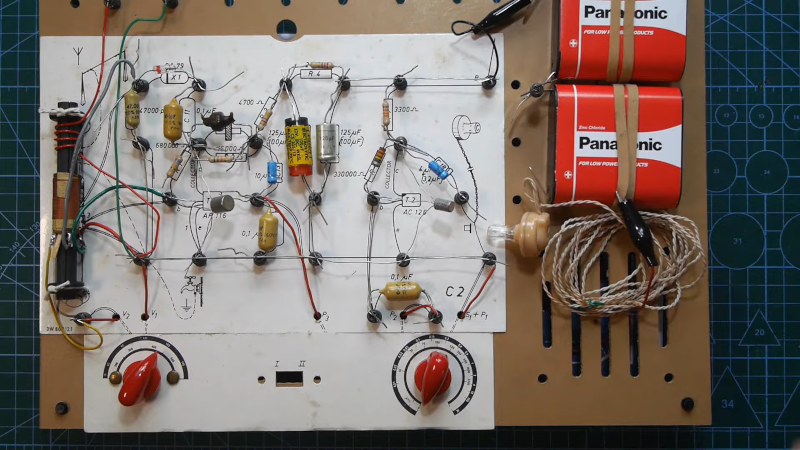
[Anthony Francis-Jones], like us, has a soft spot for the educational electronic kits from days gone by. In a recent video you can see below, he shows the insides of a Philips EE08 two-transistor radio kit. This is the same kit he built a few months ago (see the second video, below).
Electronics sure look different these days. No surface mount here or even printed circuit boards. The kit had paper cards to guide the construction since the kit could be made into different circuits.
The first few minutes of the video recap how AM modulation works. If you skip to about the ten-minute mark, you can see the classic instruction books for the EE08 and EE20 kits (download a copy in your favorite language), which were very educational.
There were several radios in the manual, but the one [Anthony] covers is the two-transistor version with a PNP transistor as a reflex receiver with a diode detector with a second transistor as an audio power amplifier.
We covered [Anthony’s] original build a few months ago, but we liked the deep dive into how it works. We miss kits like these. And P-Boxes, too.









Yep. Had one of those in the mid 60s.
The radio worked pretty well on long wave.
Had an EE20 in the mid 60s. Still have some of the components :) Bought a complete EE8, just for old time’s sake.
The manuals are extremely well thought out: half is the theory of how a circuit should work, half is the practical implementation and construction.
I wish all instructional material was as concise and good. There’s too much “talking head” stream of consciousness guff, complete with ums and ahs :(
This comment was sponsored by, um, Squarespace.
Never had the kit (as a kid in the 80ies), but got a photocopy of the manual and a breadboard with some components, self made jumper wires and learned electronics that way. Still know the colour codes of the resistors by heart :) It taught me how to read schematics and experiment with different values for resistors, capacitors and transistors. Simple but really fun!
As a kid in the 80s I had these:
https://en.wikipedia.org/wiki/Denshi_block
Awesome kit for teaching the basics whilst being robust enough to be kid-proof..
These kits were very easy to work with and needed minimum tools, and no soldering. The three transistor radio had an excellent tone probably because the solid breadboard held the speaker well with rubber grommet standoffs. Only problem was the 4.5 volt 3R12 rectangular batteries it was designed to work with were nowhere to be found in our part of Canada.
I have the ’90 interactive version, in italian his name is “Elettronica Divertente” (funny electronic), that consist in a cardboard box with various component with springs connected to the terminals and a cd-rom game that instruct how to create various circuit and the basic theory behind those.
I have to imagine the disk, I find very little about it.
When I was a kid, we had Heathkits and Radio Shack Project Kits (I think I had the 160 in One). Fun times.
Still got the book, and a few of the clips and springs that held the components together. Lost the cards etc several house moves ago 🙁 Learnt a lot though.
Wow, a real blast from the past! Had this in the 60s I must have been 9 or 10, and it got me started with electronics. I remember going on to use the components building projects from magazines like practical wireless . Those little springs went everywhere though.
All the kits I had used Fahnestock clips.
Looking at the Google-pricing for only the clips now, these would have exceeded the early-60’s price of the entire project kit.
http://www.google.com/search?q=fanstock+clips&oq=fanstock+clips
I got the EE20 for my birthday when I became 10 years old. They were expensive, but my dad worked for Philips and therefore got a discount. Build all circuits again and again, especially the 3 transistor Radio. Somewhere in my life I parted from the kit. At the age of 60 I found a complete kit and bought it. Everytime I look at it, I remember those days.
I had one in the 70s. There were so many things to build.
There was an intercom that I built. Used 2 speakers.
Connected between my house and the neighbors.
KOSMOS was a big publisher of these in germany. I believe I had one of theirs where I wound (the spools) of a motor myself but I can not find it online. Does anyone know a current one where you would have to make a motor?
Looking at the things KOSMOS now publishes, it all seems to be too “kiddy” for me and making the step from simplest electronics to microcontrollers, skipping things like transistors.
I have had a look at the “Lernpakete” from Franzis over the last few years and I feel more at home with them, though they are much smaller in scope:
https://www.franzis.de/bausaetze/elektronik-und-elektrotechnik/lernpaket-elektronik-bausatz
All in german though.
I had an EE1050 as a kid, and recently I rebought off ebay, plus 1051 and 1052.
Ironically I went for an interview at Philips Farnborough but they didn’t give me a job.