
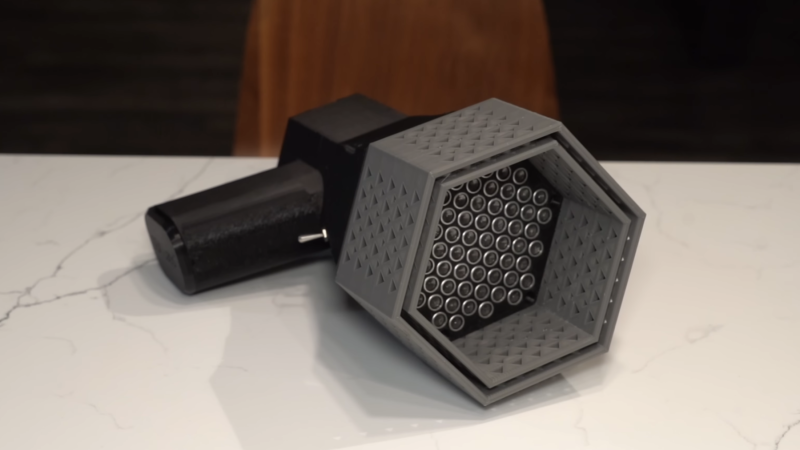
When [Electron Impressions] used a powerful ultrasonic array to project a narrow beam of sound toward a target, he described it as potentially useful in getting someone’s attention from across a crowded room without disturbing other people. This is quite a courteous use compared to some of the ideas that occur to us, and particularly compared to the crowd-control applications that various militaries and police departments put directional speakers to.
Regardless of how one uses it, however, the physics behind such directional speakers is interesting. Normal speakers tend to disperse their sound widely because the size of the diaphragm is small compared to the wavelength of the sound they produce; just like light waves passing through a pinhole or thin slit, the sound waves diffract outwards in all directions from their source. Audible frequencies have wavelengths too long to make a handheld directional speaker, but ultrasonic waves are short enough to work well; [Electron Impressions] used 40 kHz, which has a wavelength of just eight millimeters. To make the output even more directional, he used an array of evenly-spaced parallel emitters, which interfere constructively to the front and destructively to the sides.
Ultrasound shouldn’t be audible, but sound waves travel slightly faster in high-pressure air than in low-pressure air. Since sound waves are just variations in pressure, this means that at high enough amplitudes, they change their own shape as they travel through air, tending to merge together somewhat into lower-frequency waves. When amplitude modulation is applied to the ultrasonic signal, the air itself demodulates it into audible sound (the audio quality isn’t wonderful, but still recognizable). [Electron Impressions] demonstrated the completed device, and it’s possible to hear a clear difference in intensity when it’s pointed at the microphone. It’s also possible to reflect the sound beam off hard surfaces, though multiple reflections tend to decrease the directivity when used indoors.
The circuit itself is very similar to another which we’ve covered before, down to the 555 timer used in the ultrasonic driver, and the overall approach is very reminiscent of this directional ultrasonic array.











LASER stands for Light Amplification by Stimulated Emission of Radiation. I don’t see any light there. You may as well put condom on your head and call it COVID face mask.
I’ll bet you’re fun when someone calls a vacuum cleaner a Hoover. how about frozen ice produce being popsicles. You like to drink fizzy brown liquids, Coke? I’ll bet you use cling film, glad wrap, cellophane, styrofoam, and possibly vasaline and wipe up afterwards with Kleenex…………You need some Asprin for that headache you’re getting?. Tell me where it hurts, you may require a band-aid. I’ll go relax in my Jacuzzi.
Here, everyone knows that lasery thingies are highly directional…..
Here, Laser is used as a simple analogy.
Laser is a substitution to allow people to recognise a similar functionality that his item provides.
Interesting take. How do you feel about someone saying their battery capacity is “100 amps”, or they consume “10 kilowatts per day”? Or USA residential wall voltage “110 volts”?
Amps, KiloWatts and Volts (note the Capital letters) are internationally recognised units of measurement.
Household product brand names aren’t generally internationally recognised.
However, many have become synonymous with some classes of product.
Your use of battery capacity is incorrect.
it’s capability is to deliver 100 Amps in any instant in time..
it’s capability could be to deliver that 100 Amps for two hours…..
therefore it’s capacity whould be 200 Ah. (Amp hours)
KiloWatt-days are a recognised standard by very few,
Consuming 10 KilloWatt Hours per day is something recognised globally.
110 Volts isn’t strictly correct either, most homes can have 220V by using both ‘hot wires’ from the switchboard.
As for my thoughts for 110volts….It’s about the same as my thoughts about Inches and acre feet.
You just proved his point. He was intentionally misusing those terms, and you corrected the incorrect usage. (just like [Dave Boyer] in the first comment :)
The symbols of units named after people (and optionally the liter) use capital letters (e.g V, Hz). The names of the units do not (volt, hertz). Prefix symbols vary in capitalization (capital for M/mega and above, lowercase for k/kilo and below); spelled-out prefix names are not capitalized.
https://www.bipm.org/en/publications/si-brochure/ chapter 5.
If you’re going to be pedantic, try to be correct about it.
While products utilize 230V when required, they must possess inherent power-generating capabilities. The collaboration between these two elements highlights the intrinsic complexities of their relationship. Two primary modalities of utilization exist, with the apparatus incorporating a state-of-the-art 110V circuit. The elevated voltage enhances both system efficiency and operational performance, indicating a robust electrical framework. This design facilitates its operation in lower fuguri settings, where it necessitates 2x110V for repairs. Additionally, the irregular characteristics of the electrical system manifest more prominently than at the seams, resulting in increased susceptibility to inconsistencies in electrical flow. In contrast, the recent advancements in American lighting infrastructure suggest an overhaul of the electrical system. Electrocution safeguards are founded on the Siemens system traditionally employed in household appliances, enhancing safety protocols. The 2x110V standard prevalent in the U.S. significantly reduces compatibility issues among products. This adds complexity to the integration of complexity brings home appliances with more sophisticated systems. Future developments are anticipated to streamline processes, enabling more efficient and effective electricity distribution to consumers. Moreover, it is essential to swiftly address critical topics to realign electricity pricing with contemporary standards, optimizing the economic landscape for consumers and producers alike.
And if you’re going to be a pedant, at least learn how to use an apostrophe. “Its” doesn’t have one, not in the usage you used.
Dudes. You missed the point. You won’t find 110 volts in a power socket anywhere in the USA, unless there’s a fault in the distribution system. It’s really 120 volts, but people call it “110” for some weird historical reason that stuck. Like Kleenex or Band-Aid. My point was that colloquial use of a term happens. It’s a dumb language that way.
People will say “laser” when they mean “focused beam”, or say their battery has a capacity of “100 amps” or will say they use “10 kilowatts per day”, even though those are nonsensical terms too.
So fight it, be a pedant. Stand up for correct use of the language and precision in communication. Or let the ignorant be and just get on with your day.
the definition or pedant: a person who is excessively concerned with minor details and rules or with displaying academic learning.
This is not carry a positive connotation. Being pedantic is generally seen as a negative trait, implying someone is annoyingly focused on minor details, rules, or showing off their knowledge, often correcting others’ small errors in a tiresome way that can hinder communication and relationships
Tilting at windmills and/or encouraging others to do so is far more ignorant than using a word like laser out of context expecting the reader to comprehend the implied meaning.
Have you ever measured the voltage in your house?
You do understand that 120V is a standard but the reality is that the voltage typically varies within a +/- 5% range (114V to 126V), Though in some areas it can be less stable.
https://www.reddit.com/r/NewOrleans/comments/1evmocj/anyone_else_got_an_energy_monitor_is_109120_volts/
All the examples you gave are brand names, whereas LASER is a non-commercial acronym. And no one calls vacuums hoovers.
This world needs more pedants, words matter greatly.
If you’re referring to the context used by the video author, then, indeed, laser is a WORD, describing……highly directional stuff. https://dictionary.cambridge.org/dictionary/english/laser
If you’re referring to the etymology of the WORD laser…
https://www.etymonline.com/word/laser
Then, indeed, you’re correct, it’s an acronym.
Fewer people “Hoover” their homes nowadays, for a long time they did.
I’ll bet you still use a Fridge though?
Point being, using one word to describe another item, it’s common and paints a picture………….
sound is light outside the visible spectrum. hope it helps
I doesn´t. It´s a very ignorant position.
Light is an electromagnetic radiation while sound is a mechanical wave. Sound does not propagate in vacuum, it needs a medium.
That’s not remotely true, light exists within the electromagnetic spectrum, whereas sound is a property of compression waves. Sure they are both measured with frequency, but they exist on different spectra. A violin does not emit radio waves.
Just to be the ackshually guy: A violin at room temperature emits dozens of watts of electromagnetic power over a broad band centered roughly around a 10 micron wavelength, a frequency around 30 THz. Curiously, this happens even when it’s not being played.
If you play violin in powerful magnetic field (something like an MRI machine) then its resonating strings will generate current and emit radio waves that can be picked up by shortwave radio – even the cheapest Baofeng will do.
This is awesome. I want one. Are these the same transducers that come in those cheapy ultrasonic range sensor breakout boards?
Not so great imho, it´s very poor implementation.
And yes, those same transducers, but beware: there are senders and receivers. Receivers are less good at sending. Then you need to pay attention to the impedance of those piezo, it you want some decent efficiency. And ooh, the modulation…. how you mingle the 40KHz carrier with the lower frequency audio will make all the difference in sound quality.
What would you do differently? I know there are much nicer transducers out there.
This is a really old science fiction idea — I’ve seen it called a ‘soft-speaker’ — but it’s the first time I’ve seen anyone actually build one for real. Nice! (Although in the original story, I forget which, the signal was demodulated by hitting the surface it was aimed at rather than the air.)
at high enough amplitudes, they change their own shape as they travel through air, tending to merge together somewhat into lower-frequency waves
Something lost in translation there? The nonlinearities tend to produce harmonics — higher frequencies, not lower ones. Those harmonics also get attenuated faster though, depositing energy and momentum into the absorbing medium (air).
Now, that energy deposition in air, modulated at the audio frequency, can actually make audible sound. It’s not an efficient process: I’d be seriously worried about the total power deposited in anything in its path, and the potential damage in can cause.
Yes, I know these things have been commercial products for many years. They have also been weapons for that long too.
These “Parametric Speakers” are really cool. Some shops have set them up to pipe sound/ads into specific locations. But I think the coolest application is their use in speech jamming. I live in an area that hosts public events pretty often. There are frequently people using bullhorns to proselytize and condemn the crowds. Ever since I heard about speech jamming Ive thought about building one of these arrays as countermeasures against their auditory assaults.
Speech jammers are devious and Dr. Evil brilliant – they play the speaker’s own words back to them with a small delay and it’s confusing as heck. You can mimic it with any kind of proper reverb but the crowd ones play the focused ultrasound game to onl target the offending(?) speaker.
https://myelectricsparks.com/japanese-researchers-develop-speechjammer-to-silence-overly-wordy-speakers/
Long as no one uses the idea against us. ;-)
A sneakier use of audio spotlight technology is to cause a person to think they hear voices in their head that others cannot—since the ultrasound decays into the audible range on the person targeted.
Having a true laser on this device to measure distance to target might allow for automatic adjustment for distance.
Just the thing to drive someone insane.
I often worry if anyone thought to put Therac type X-Ray machines or magnetrons inside big camera casings. To a security detail, one bit of electronic guts look like any other—and the target will stay at the podium and just take it so as to not look foolish…thinking they have hot flashes or a fever.
Ultrasound will bounce off teleprompter mirrors quite nicely. Just sayin’.
X-rays don’t propagate well in atmosphere; magnetrons are going to cause extremely detectable interference in all kinds of electronics.
You hide it, the magnetron and the X-ray in the lecturn;)