
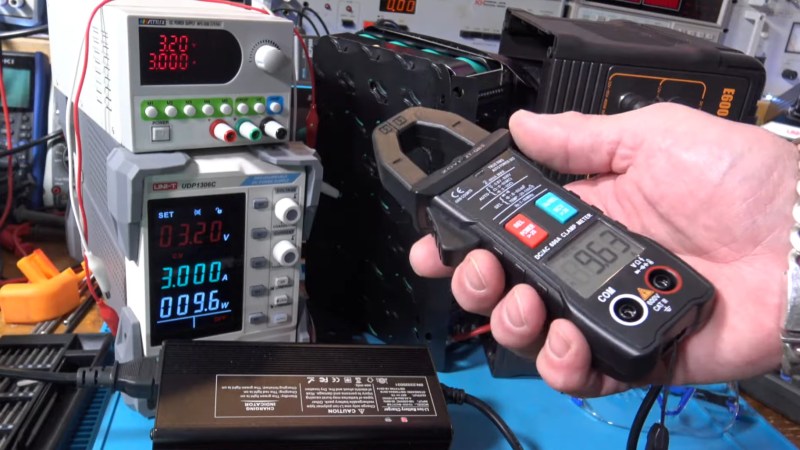
Over on YouTube [Kiss Analog] reviews the New Zoyi ZT-QB9 Smart Clamp meter.
If you’re putting together an electronics lab from scratch you absolutely must get a multimeter to start. A typical multimeter will be able to do current measurements but it will require you to break the circuit you’re measuring and interface it to your meter using its mechanical probes.
A good choice for your second, or third, multimeter is a clamp-based one. Many of the clamp meters have the clamp probe available for current measurements while still allowing you to use the standard 4mm banana jack probes for other measurements, particularly voltage and resistance.
If you’re curious to know more about how clamp meters work the answer is that they rely on some physics called the Hall Effect, as explained by the good people at Fluke.
In the video the following clamp meters are seen: Zoyi ZT-QB9, PROVA 11, and Hioki CM4375. If you’re in the market for a clamp meter you might also like to consider the EEVblog BM036 or a clamp meter from Fluke.
We have of course posted about clamp meters before. Check out Frnisi DMC-100: A Clamp Meter Worth Cracking Open or ESP32 Powers DIY Smart Energy Meter if you’d like to know more. Have your own trusty clamp meter? Don’t need no stinkin’ clamp meter? Let us know in the comments!












The “EEVBlog BM036” link appears to also link to Fluke.com
nice catch. fixed now. thanks!
Does the Eevblog meter come with Daves annoying voiceover?
Yes, the continuity test beeper plays a pre-recorded Dave’s high-pitched “eeeh” of disapproval.
“A good choice for your second, or third, multimeter is a clamp-based one. Many of the clamp meters have the clamp probe available for current measurements while still allowing you to use the standard 4mm banana jack probes for other measurements, particularly voltage and resistance.”
Lower limit I believe.
And the review is only a year old.
Like everything published here !
The Zoyi link also goes to the fluke site…
sigh. also fixed. thank you.
TLDR: he found an apparent 10% measurement discrepancy, but barely characterized it. The cheapo clamp meter may or may not be any good. Despite having a bunch of equipment that he might use as a reference to find out the actual current flow, he just compared it to a handful of other clamp meters that i frankly wasn’t convinced he actually knew how to use.
It’s a cheap meter, buy it and make your own video if you think you can do it better. If not, shut up and don’t blame others for your own failings.
A review exists to inform others.
If the review is flawed in methodology or conclusion, at best it has no value, at worst it is damaging.
You act as if OP is entitled by pointing out a perceived flaw, yet your argument falls flat because you choose to ignore the entire premise for the original thing existing.
Good job.
If I need accurate, lab type measurement, I reach for one of my Flukes, otherwise pretty much any meter will do. I am old enough to have used meters with dials that were horribly innaccurate, but they did the job.
I could find no declaration of conformity, so am not certain that the ‘CE’ mark has any meaning.